 Ati daayinoo kami? Qormaata
 Lola daayinoo
 Dorgommii daayinoo
 Taphoota daayinoo xixiqqoo
 Albamii istiikarii
 Tarreewwan TOP daayinoo
 Na dinqisiisi!
Yoom jiraate?

Hammam guddaa ture?
Hammam dheeraa ture?
Hammam ol-dheeraa ture?
Hammam ulfaataa ture?
 akka saree 4 funyaan hanga eegeetti dheeraa🍌akka muuzii 25 walitti hiriiran dheeraa🍉akka habxuu 120 ulfaata🧸akka ijoollee KG 31 ulfaata🎒akka ijoollee mana barumsaa 18 ulfaata🏃meetira 100 sekondii 9.2 keessatti fiiguu danda'a (namni hunda caalaa saffisaan 9.6 barbaada)
SI wajjin yoo wal bira qabamu, Tethyshadros hammam guddaa ture?
Herrega qofa barbaadduu kee keessatti. Wanti tokkollee hin olkaa'amu, eessayyuu hin ergamu.
Hammam saffisaa ture?


Odeeffannoowwan bashannansiisoo
Tethyshadros lived on a large island in the ancient Tethys Ocean, which is why it was named after that sea.1
The first skeleton, nicknamed Antonio, was found in a vertical rockface and took years to dig out.1
Tethyshadros had a mix of old-fashioned features, like a short neck and a skull like Iguanodon, and advanced features, like teeth arranged in batteries like true hadrosaurs.1
Scientists once thought Tethyshadros was a dwarf dinosaur, but later bone studies showed the main skeleton was from a teenager, not a full-grown adult.1
A second skeleton, nicknamed Bruno, is bigger and more complete, with a full skull and many bones.1
Tethyshadros is one of the latest surviving non-hadrosaurid hadrosauromorphs, meaning it lived just before true hadrosaurs became common.1
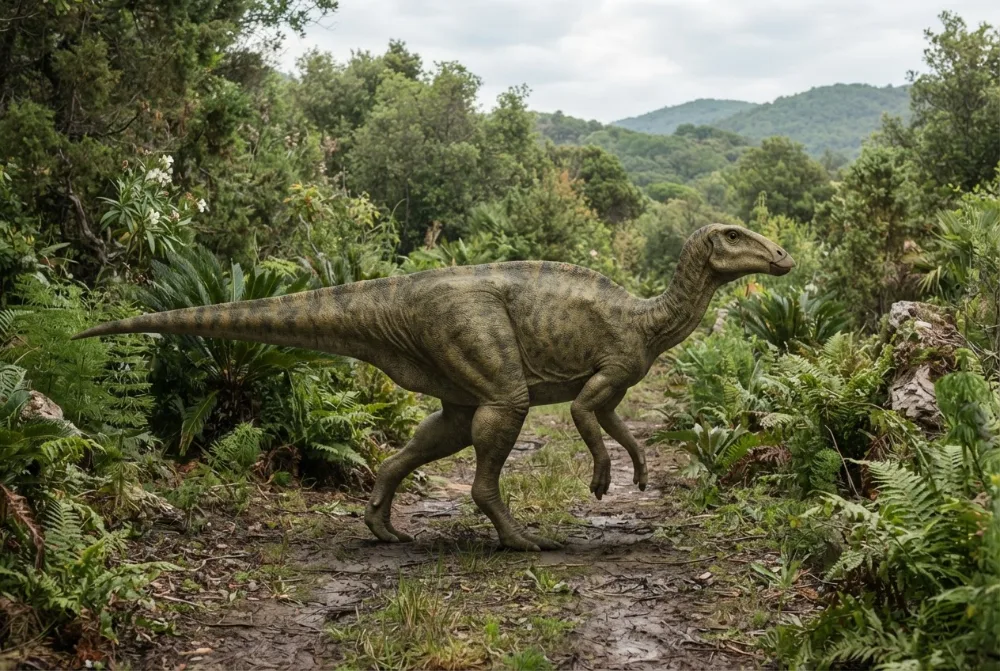
Gaaffiiwwan waa'ee Tethyshadros baay'ee gaafataman
?How big was Tethyshadros?
About 4.5 metres (15 feet) long, though some scientists think that estimate might be too high. The adult skeleton Bruno was 15 to 20% larger than the subadult Antonio.1
?What did Tethyshadros eat?
It was a plant-eater. Its beak and teeth were adapted for eating plants, and it may have used its strange serrated beak to bite specific food items.13
?Why did Tethyshadros have a strange beak?
Nobody knows for sure. It might have helped it bite certain plants, or been used for grooming or display.3
?Was Tethyshadros a dwarf dinosaur?
It was originally thought to be a dwarf, but later bone studies showed the main skeleton (Antonio) was a teenager, not a full-grown adult. The adult Bruno was larger.1
?When did Tethyshadros live?
It lived during the Late Cretaceous, about 81.5 to 80.5 million years ago.1
?Where was Tethyshadros found?
In an abandoned quarry at Villaggio del Pescatore, near Trieste, Italy. It lived on a large island in the ancient Tethys Ocean.1
Seenaa sobaa diigaa
Seenaa sobaa: Tethyshadros was a dwarf dinosaur.
Dhugaa: The first skeleton was a subadult, not a full-grown adult, so it was not a dwarf species.1
Ogeeyyii daayinootiif
- Maqaa saayinsii
- Tethyshadros
- Kan maqaa baase
- Dalla Vecchia 20094
- Garee
- Biqiltuu-nyaattota afaan simbirroo qaban
- Maatii / kilaadii
- Telmatosauridae4
- Ramaddii
- Ornithischia > Ornithopoda > Iguanodontia4
- Umurii dhagaawwanii
- waggaa miliyoona 84 hanga 72 (Campanian)4
- Caasaawwan dhagaa
- Aurisina4
- Biyyoota
- Xaaliyaanii4
- Galmee fosilii
- 1 The Paleobiology Database keessa4
- Argannoo
- Fossil fragments were found in the 1980s by Alceo Tarlao and Giorgio Rimoli. A nearly complete skeleton was discovered in 1994 and excavated by 1999. The dinosaur was named Tethyshadros insularis by Fabio Dalla Vecchia in 2009.1
- Ammallee falmisiisaa
- Scientists still debate the exact total length of Tethyshadros, because the tail of the first skeleton was missing and its length had to be estimated.1
Odeeffannoon eessaa dhufa
- Tethyshadros (en.wikipedia.org)
- Friuli-Venezia Giulia - Fossili Regionali (fossiliregionali.it)
- The “Duck-billed” Dinosaur That Wasn’t (smithsonianmag.com)
- Tethyshadros in The Paleobiology Database (CC BY 4.0): umurii, bakkeewwan, caasaawwan dhagaa, ramaddii.
Odeeffannoon fuula kana irra jiru hundi lakkoofsa madda isaa agarsiisu qaba. Yoo waa dogoggorre, dhiifama, nuti jaallattoota daayinoo malee joornaalii saayinsii miti. [email protected] irratti nutti himi, nus ni sirreessina.
 Rex beela'eera! Dino Wiki pirojektii abbaa tokkoo kan ilma isaa daayinoo jaallatuuf hojjetame, bilisa, beeksisa malee fi hordoftuu malee. Ga'eessonni akka inni interneetii irra turuuf Rexiif nyaata xiqqoo kennuu danda'u.Rex soori
Garee sana irraa kan biroo: Biqiltuu-nyaattota afaan simbirroo qaban
 IguanodonBiqiltuu-nyaattota afaan simbirroo qaban
 TenontosaurusBiqiltuu-nyaattota afaan simbirroo qaban
 ThescelosaurusBiqiltuu-nyaattota afaan simbirroo qaban
 ZalmoxesBiqiltuu-nyaattota afaan simbirroo qaban
 CamptosaurusBiqiltuu-nyaattota afaan simbirroo qaban
 RhabdodonBiqiltuu-nyaattota afaan simbirroo qaban
 Tyrannosaurus
 Triceratops
 Velociraptor
 Spinosaurus
 Ankylosaurus
 Parasaurolophus