 Quiz: Tge dino es ti?
 Cumbat da dinos
 Cursa da dinos
 Mini-gieus da dinos
 Album d'adesivs
 TOP-glistas da dinos
 Ma surprenda!
Cura viveva el?

Quant grond era el?
Quant lung era el?
Quant aut era el?
stima
Quant grev era el?

 uschè lung sco 5 chauns dal nas a la cua🍌uschè lung sco 28 bananas ina suenter l'autrauschè grev sco 100 chauns🍉uschè grev sco 400 melunas🎒uschè grev sco 2,5 classas da scola entiras🐻❄️uschè grev sco 4 urs polars🏃pudess currer 100 meters en 18 secundas (il pli spert uman dovra 9,6)
Quant grond era Polacanthus cumpareglià cun TAI?
Mo matematica en tes navigatur. Nagut na vegn arcunà u tramess.
Quant spert era el?


Fatgs divertents
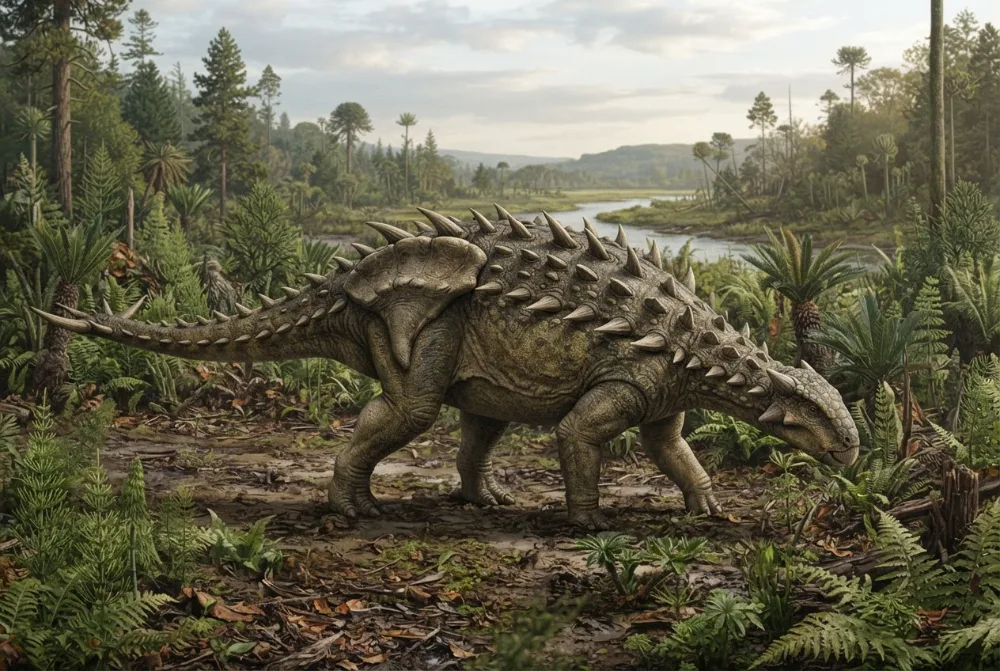
Polacanthus had a large fused plate of bone over its hips called a 'pelvic shield', which was about 108 centimetres wide and 90 centimetres long.1
Its body was covered with many spikes and small bony studs called ossicles.1
The first fossil of Polacanthus was discovered by the Reverend William Fox on the Isle of Wight in 1865.1
Polacanthus lived about 130 to 125 million years ago during the Early Cretaceous.1
Scientists are not sure if Polacanthus belongs to the Nodosauridae family or its own family, the Polacanthidae.1
A second species, Polacanthus rudgwickensis, was named in 1996 but later moved to its own genus Horshamosaurus in 2015.1
Las dumondas las pli frequentas davart Polacanthus
?How big was Polacanthus?
Polacanthus grew to about 4 to 5 metres (13 to 16 feet) long. Estimates of its weight vary significantly, with some scientists suggesting it weighed around 2 tonnes (4,400 pounds), while others estimate it was much lighter.1
?What did Polacanthus eat?
Polacanthus was a herbivore, meaning it ate plants. Its teeth and body were built for eating vegetation.1
?Did Polacanthus have a tail club?
No, Polacanthus did not have a tail club like Ankylosaurus. Instead, its tail had spikes and bony plates for protection.1
?Where was Polacanthus found?
Polacanthus fossils have been found in England, especially on the Isle of Wight. The first fossil was discovered there in 1865 by the Reverend William Fox.13
?When did Polacanthus live?
Polacanthus lived during the Early Cretaceous Period, about 130 to 125 million years ago.1
?How fast could Polacanthus run?
Nobody knows for sure how fast Polacanthus could run, but it walked on all fours and had relatively long hindlimbs for an ankylosaur, which might have allowed it to move fairly quickly.1
Chatschader da mitus
Mitus: Polacanthus could swing its tail like a club.
Vardad: Polacanthus did not have a tail club; its tail was covered in spikes but lacked the heavy bony club seen in some other ankylosaurs.1
Per experts da dinos
- Num scientific
- Polacanthus
- Numnà da
- Fox 18664
- Gruppa
- Dinos cun armadura
- Famiglia / clada
- Nodosauridae4
- Classificaziun
- Ornithischia > Ankylosauria > Nodosauridae > Thyreophora4
- Vegliadetgna da la crappa
- 139 fin 100 milliuns onns (Berriasian / Albian)4
- Formaziuns da crap
- Wessex, Vectis, Pinilla de los Moros4
- Pajais
- Reginavel Unì, Spagna4
- Chats da fossils
- 16 en The Paleobiology Database4
- Era enconuschent sco
- Euacanthus, Vectensia (nums pli vegls che valan ussa sco il medem animal)4
- Scuverta
- Polacanthus was discovered by Reverend William Fox on the Isle of Wight in 1865. The name was first used by Richard Owen in a lecture later that year, and the full description was published by Fox in 1866.1
- Anc discutà
- Scientists still debate whether Polacanthus was a nodosaurid or belonged to a separate family called Polacanthidae.1
Danunder che vegnan ils fatgs
- Polacanthus (en.wikipedia.org)
- Polacanthus | Natural History Museum (nhm.ac.uk)
- Spotlight on Polacanthus - Horniman Museum and Gardens (horniman.ac.uk)
- Polacanthus in The Paleobiology Database (CC BY 4.0): vegliadetgna, lieus, formaziuns da crap, classificaziun.
Mintga fatg sin questa pagina ha in numer che maina tar sia funtauna. Sche nus avain fatg in sbagl, perstgisa, nus essan fans da dinos, betg ina revista scientifica. Scriva a nus sin [email protected] e nus il curregin.
 Rex ha fom! Dino Wiki è in project d'in bab per ses figl che ama ils dinos, gratuit, senza reclama e senza trackers. Ils creschids pon dar ina marenda a Rex per gidar a tegnair la pagina online.Pavlar Rex
 Ankylosaurus
 Sauropelta
 Pinacosaurus
 Scutellosaurus
 Struthiosaurus
 Euoplocephalus
 Stegosaurus
 Iguanodon
 Archaeopteryx
 Giganotosaurus
 Microraptor
 Deinonychus