 Uri dinozore iyihe? Umukino w'ibibazo
 Intambara ya dinozore
 Isiganwa rya dinozore
 Imikino mito ya dinozore
 Alubumu ya sitikeri
 Intonde za TOP za dinozore
 Ntungura!
Yabayeho ryari?

Yanganaga ite?
Yari ndende ite?
Ubutumburuke bwayo bwanganaga iki?
Yari iremereye ite?
 ndende nk'imbwa 8 zikurikiranye🍌ndende nk'imineke 44 ikurikiranye🍉iremereye nk'imbuto 200 za watermelon🧸iremereye nk'abana 53 bo mu ishuri ry'incuke🎒iremereye nk'abanyeshuri 31🐻❄️iremereye nk'idubu 2 zo mu rubura🏃yashoboraga kwiruka metero 100 mu masegonda 9 (umuntu wihuta kurusha abandi akenera 9,6)
Afrovenator yanganaga ite ugereranyije NAWE?
Ni imibare gusa ibarirwa muri mushakisha yawe. Nta kintu kibikwa cyangwa cyoherezwa ahandi.
Yihutaga ite?


Utuntu dushimishije
Afrovenator is the most complete predatory dinosaur from the Cretaceous period ever found in Africa.2
Afrovenator had a flexible, S-shaped neck and strong neck muscles, which helped it move its head side to side and up and down while hunting.1
Its lower leg bones were long compared to its thigh bone, meaning it was probably a fast runner.1
The name Afrovenator comes from Latin words meaning 'African hunter'.1
Afrovenator lived during the Middle to Late Jurassic Period, about 167 to 157 million years ago.1
Ibibazo bibazwa cyane kuri Afrovenator
?How big was Afrovenator?
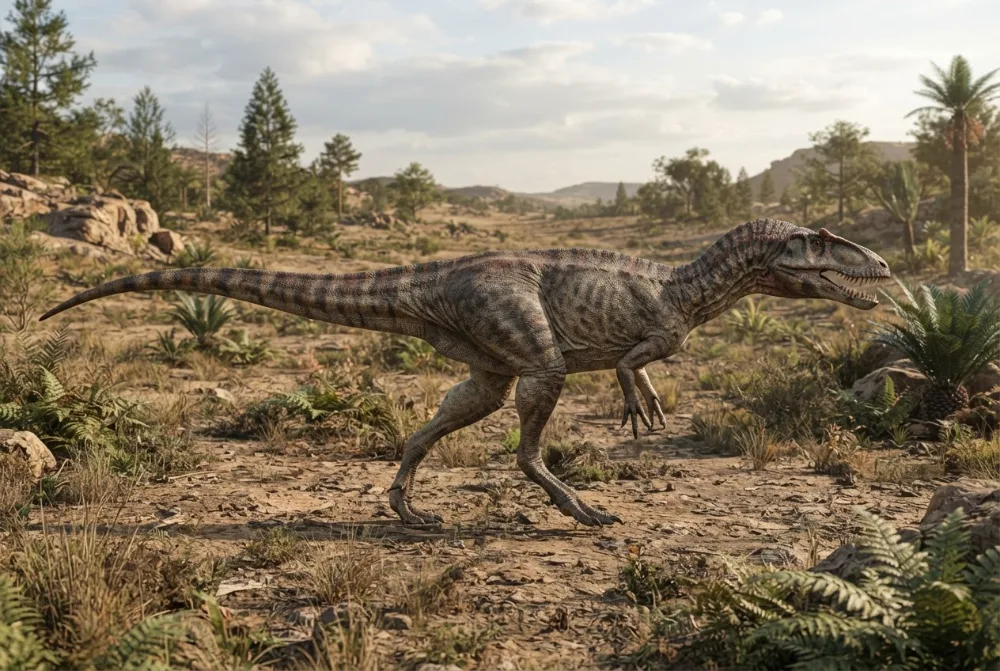
Afrovenator was about 8 metres (26 feet) long from snout to tail tip, stood about 1.9 metres (6.2 feet) tall at the hips, and weighed around 790 kg (1,740 lb). Different scientists give slightly different estimates, but it was a medium-sized, slender predator.1
?What did Afrovenator eat?
Afrovenator was a meat-eater. It had long, blade-shaped teeth for slicing into prey, and it probably hunted other dinosaurs and animals in what is now the Sahara Desert.12
?When did Afrovenator live?
Afrovenator lived during the Middle to Late Jurassic Period, about 167 to 157 million years ago. Some older sources said it lived in the Early Cretaceous, but scientists now think it is Jurassic in age.1
?Where was Afrovenator found?
Afrovenator was discovered in 1993 in the Tiourarén Formation of Niger, in West Africa. Its skeleton is the most complete predatory dinosaur from the Jurassic period ever found in Africa.12
Ku bazobereye muri dinozore
- Izina rya siyansi
- Afrovenator
- Yiswe na
- Sereno et al. 19944
- Itsinda
- Dinozore zirya inyama
- Umuryango / ishami
- Megalosauridae4
- Ishyirwa mu byiciro
- Theropoda4
- Imyaka y'amabuye
- imyaka miliyoni 171 kugeza 143 (Bajocian / Tithonian)4
- Inzego z'amabuye
- Tiourarén, Irhazer II4
- Ibihugu
- Nijeri4
- Ibisigazwa byanditswe
- 3 muri The Paleobiology Database4
- Ivumburwa
- Afrovenator was named in 1994 by Paul Sereno and his team, based on a nearly complete skeleton found in Niger, West Africa. The species name, abakensis, comes from the Tuareg name for the region where it was found.1
- Biracyagibwaho impaka
- Scientists are not sure exactly how big Afrovenator was, because different estimates give different lengths and weights.1
Aho amakuru yakuwe
- Afrovenator (en.wikipedia.org)
- Discoveries | Paul Sereno - Paleontologist | The University of Chicago (paulsereno.uchicago.edu)
- PBDB Taxon (paleobiodb.org)
- Afrovenator in The Paleobiology Database (CC BY 4.0): imyaka, ahantu, inzego z'amabuye, ishyirwa mu byiciro.
Buri kintu kiri kuri uru rupapuro gifite nimero yerekana aho cyakuwe. Niba hari icyo twibeshye, tubabarire, turi abakunzi ba dinozore, ntituri ikinyamakuru cya siyansi. Tubwire kuri [email protected] tuzagikosora.
 Rex arashonje! Dino Wiki ni umushinga wa papa umwe yakoreye umuhungu we ukunda dinozore, ni ubuntu, nta matangazo kandi nta bigukurikirana. Abantu bakuru bashobora guha Rex akantu ko kurya kugira ngo Dino Wiki ikomeze kuboneka kuri interineti.Gaburira Rex
 Allosaurus
 Carnotaurus
 Dilophosaurus
 Giganotosaurus
 Compsognathus
 Paronychodon
 Brachiosaurus
 Diplodocus
 Brontosaurus
 Camarasaurus
 Morosaurus
 Apatosaurus