 Uri dinozore iyihe? Umukino w'ibibazo
 Intambara ya dinozore
 Isiganwa rya dinozore
 Imikino mito ya dinozore
 Alubumu ya sitikeri
 Intonde za TOP za dinozore
 Ntungura!
Borealopelta
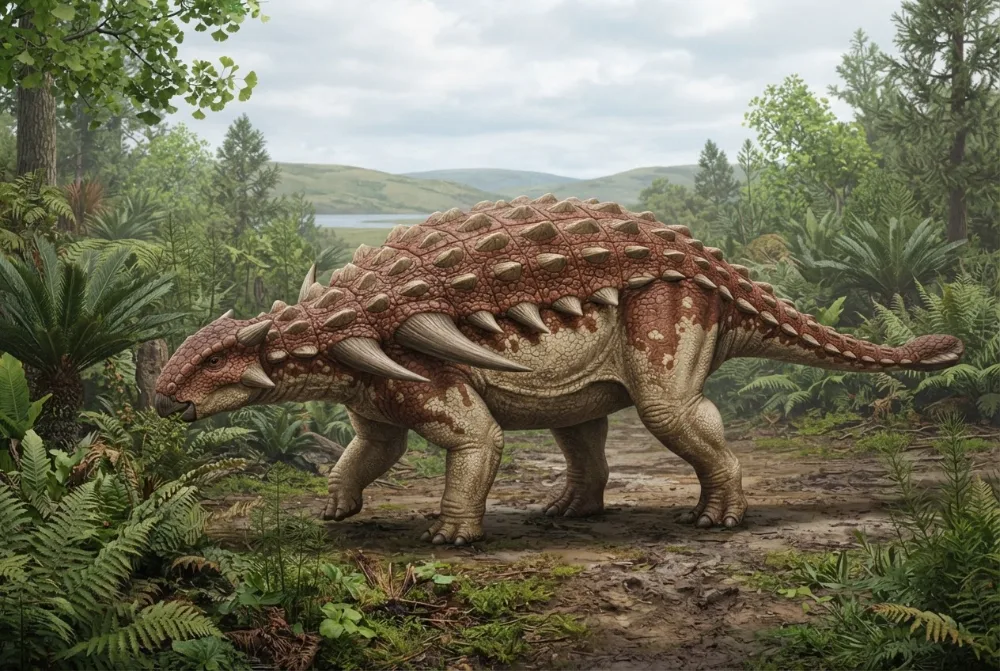
Borealopelta was a heavily armoured dinosaur that looked like a living tank. It had huge spikes on its shoulders and a body covered in bony plates and scales. Scientists even know what colour it was: reddish-brown on top and lighter underneath, like a deer today.1
Yabayeho ryari?
Yanganaga ite?
Yari ndende ite?
Ubutumburuke bwayo bwanganaga iki?
Yari iremereye ite?
 ndende nk'imbwa 6 zikurikiranye🍌ndende nk'imineke 31 ikurikiranye🍉iremereye nk'imbuto 260 za watermelon🧸iremereye nk'abana 68 bo mu ishuri ry'incuke🎒iremereye nk'abanyeshuri 41🐻❄️iremereye nk'idubu 3 zo mu rubura🏃yashoboraga kwiruka metero 100 mu masegonda 21 (umuntu wihuta kurusha abandi akenera 9,6)
Borealopelta yanganaga ite ugereranyije NAWE?
Ni imibare gusa ibarirwa muri mushakisha yawe. Nta kintu kibikwa cyangwa cyoherezwa ahandi.
Yihutaga ite?


Utuntu dushimishije
Borealopelta is one of the best-preserved armoured dinosaurs ever found. Its fossil includes skin, scales, and even the horn sheaths on its spikes.1
This dinosaur had countershading: its back was reddish-brown and its belly was lighter. This helped it hide from predators.1
The largest spikes on its shoulders were probably used for display, not just defence. They were lighter in colour and covered in a thick horn sheath.1
Borealopelta weighed over 1,300 kilograms, as much as a small rhinoceros. Despite its size and armour, it still needed camouflage from big meat-eating dinosaurs.2
It lived about 121 to 113 million years ago during the Early Cretaceous period, in what is now Alberta, Canada.5
The fossil was found in an oil sands mine. It was so well preserved that scientists could study the melanin in its skin to figure out its colour.1
Borealopelta had more than 20 small bony plates on its snout and a large hexagonal plate on its forehead.1
Ibibazo bibazwa cyane kuri Borealopelta
?How big was Borealopelta?
About 5.5 metres long and weighed 1.3 metric tons.4
?What did Borealopelta eat?
It ate plants, especially ferns. Its last meal was mostly ferns, and it also swallowed a little bit of charcoal from a wildfire.4
?Did Borealopelta have a tail club?
No, it had a straight tail without a club, unlike some other armoured dinosaurs.4
?Why did Borealopelta have spikes?
The big shoulder spikes were probably used for display to attract mates or scare rivals, but they could also help defend against predators.41
?Was Borealopelta camouflaged?
Yes, it had countershading: a reddish-brown back and a lighter belly, which helped it hide from predators.41
?When did Borealopelta live?
It lived about 110 to 112 million years ago during the Early Cretaceous period.4
?Where was Borealopelta found?
It was discovered in an oil sands mine near Fort McMurray, Alberta, Canada.4
?How well preserved is Borealopelta?
It is one of the best-preserved armoured dinosaurs ever found, with skin, scales, horn sheaths, and even stomach contents still intact.41
?Could Borealopelta swim?
It probably could not swim well. Its body was found in ancient sea sediments, so it likely drowned and sank after being washed out to sea.4
Gusenya ibinyoma
Ibivugwa: Many people think all armoured dinosaurs were slow and clumsy.
Ukuri: Borealopelta was heavily armoured but its legs were built for walking and it could probably move quickly when needed. Its camouflage shows it was an active prey animal.1
Ku bazobereye muri dinozore
- Izina rya siyansi
- Borealopelta
- Yiswe na
- Brown et al. 20175
- Itsinda
- Dinozore zifite igikingira
- Umuryango / ishami
- Nodosauridae5
- Ishyirwa mu byiciro
- Ornithischia > Ankylosauria > Nodosauridae > Thyreophora5
- Imyaka y'amabuye
- imyaka miliyoni 121 kugeza 113 (Aptian)5
- Inzego z'amabuye
- Clearwater5
- Ibihugu
- Kanada5
- Ibisigazwa byanditswe
- 1 muri The Paleobiology Database5
- Ivumburwa
- Borealopelta was discovered in 2011 at the Suncor Millennium Mine in Alberta, Canada, by miners removing overburden. It was named by Caleb Brown and colleagues in 2017.15
- Biracyagibwaho impaka
- Scientists are not sure exactly how many different kinds of nodosaurids existed, and whether Borealopelta's shoulder spikes were mainly for fighting rivals or scaring predators.1
Aho amakuru yakuwe
- An Exceptionally Preserved Three-Dimensional Armored Dinosaur Reveals Insights into Coloration and Cretaceous Predator-Prey Dynamics: Current Biology (cell.com)
- An Exceptionally Preserved Three-Dimensional Armored Dinosaur Reveals Insights into Coloration and Cretaceous Predator-Prey Dynamics (pubmed.ncbi.nlm.nih.gov)
- BOREALOPELTA - DinoChecker dinosaur archive (dinochecker.com)
- Borealopelta (en.wikipedia.org)
- Borealopelta in The Paleobiology Database (CC BY 4.0): imyaka, ahantu, inzego z'amabuye, ishyirwa mu byiciro.
Buri kintu kiri kuri uru rupapuro gifite nimero yerekana aho cyakuwe. Niba hari icyo twibeshye, tubabarire, turi abakunzi ba dinozore, ntituri ikinyamakuru cya siyansi. Tubwire kuri [email protected] tuzagikosora.
 Rex arashonje! Dino Wiki ni umushinga wa papa umwe yakoreye umuhungu we ukunda dinozore, ni ubuntu, nta matangazo kandi nta bigukurikirana. Abantu bakuru bashobora guha Rex akantu ko kurya kugira ngo Dino Wiki ikomeze kuboneka kuri interineti.Gaburira Rex
 Ankylosaurus
 Sauropelta
 Pinacosaurus
 Scutellosaurus
 Struthiosaurus
 Euoplocephalus
 Stegosaurus
 Iguanodon
 Archaeopteryx
 Giganotosaurus
 Microraptor
 Deinonychus