 Uri dinozore iyihe? Umukino w'ibibazo
 Intambara ya dinozore
 Isiganwa rya dinozore
 Imikino mito ya dinozore
 Alubumu ya sitikeri
 Intonde za TOP za dinozore
 Ntungura!
Yabayeho ryari?

Yanganaga ite?
Yari ndende ite?
Ubutumburuke bwayo bwanganaga iki?
igereranya
Yari iremereye ite?
 ndende nk'injangwe 2 zo mu rugo zikurikiranye🍌ndende nk'imineke 6 ikurikiranyeiremereye nk'injangwe yo mu rugo🍌iremereye nk'imineke 42🪑nto ku buryo yanyura munsi y'intebe🏃yashoboraga kwiruka metero 100 mu masegonda 14 (umuntu wihuta kurusha abandi akenera 9,6)
Caudipteryx yanganaga ite ugereranyije NAWE?
Ni imibare gusa ibarirwa muri mushakisha yawe. Nta kintu kibikwa cyangwa cyoherezwa ahandi.
Yihutaga ite?


Utuntu dushimishije
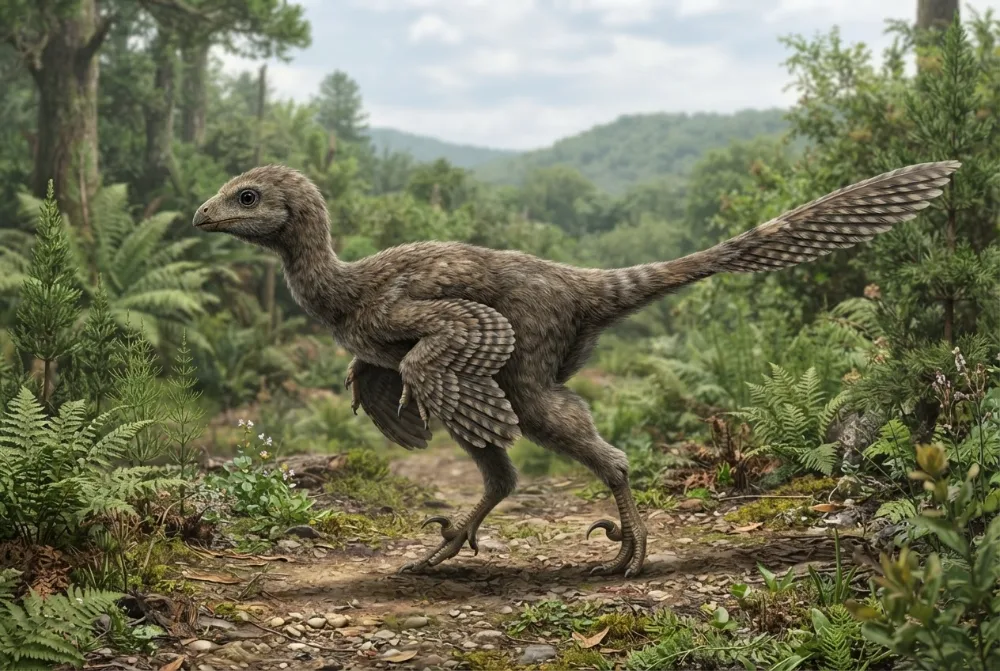
Caudipteryx had long, symmetrical feathers on its hands and tail, measuring 15 to 20 centimetres (5.9 to 7.9 inches) long. These feathers were black with a banded pattern on the tail.1
Its discovery in 1998 helped prove that birds evolved from dinosaurs, because it had clear feathers but was not a bird.1
Caudipteryx had a short, boxy skull with a beak-like snout and only a few teeth in the front of its upper jaw.1
Scientists think Caudipteryx was secondarily flightless, meaning its ancestors could fly but it lost that ability.1
Fossils of Caudipteryx have been found with gizzard stones in the place where its stomach would have been, just like in some plant-eating dinosaurs and modern birds.1
Ibibazo bibazwa cyane kuri Caudipteryx
?How big was Caudipteryx?
About 72.5 to 89 centimetres (2 feet 4.5 inches to 2 feet 11 inches) long and weighed around 5 kilograms (11 pounds). It was about the size of a peacock.14
?What did Caudipteryx eat?
It was an omnivore. It probably ate insects and maybe plants, and it swallowed small stones called gastroliths to help digest its food.12
?Could Caudipteryx fly?
No, it could not fly. Its arms were too short to work as wings, and scientists think it was secondarily flightless, meaning its ancestors could fly but it lost that ability.14
?When did Caudipteryx live?
It lived during the Early Cretaceous period, about 124 to 122 million years ago.12
?Where was Caudipteryx found?
All Caudipteryx fossils have been found in the Yixian Formation in Liaoning, China.14
?Is Caudipteryx a bird?
Most scientists say it is a non-avian dinosaur, but a few think it might be a flightless bird. The debate helped prove that birds evolved from dinosaurs.1
Gusenya ibinyoma
Ibivugwa: Caudipteryx was a bird because it had feathers.
Ukuri: Caudipteryx was a non-avian dinosaur, not a bird. It belongs to a group called oviraptorosaurs, which are dinosaurs closely related to birds.1
Ku bazobereye muri dinozore
- Izina rya siyansi
- Caudipteryx
- Yiswe na
- Ji et al. 19985
- Itsinda
- Dinozore zidasanzwe zifite ibyoya
- Umuryango / ishami
- Oviraptorosauria5
- Ishyirwa mu byiciro
- Theropoda > Oviraptorosauria5
- Imyaka y'amabuye
- imyaka miliyoni 126 kugeza 120 (Barremian / Aptian)5
- Inzego z'amabuye
- Yixian5
- Ibihugu
- Ubushinwa5
- Ibisigazwa byanditswe
- 2 muri The Paleobiology Database5
- Ivumburwa
- Caudipteryx was named in 1998 by Ji and colleagues based on two nearly complete skeletons found in Liaoning, China. The name honors Zou Jiahua, a Chinese vice premier.1
- Biracyagibwaho impaka
- Scientists still debate whether Caudipteryx was a bird or a non-avian dinosaur, though most now agree it is a non-avian oviraptorosaur.1
Aho amakuru yakuwe
- Caudipteryx (en.wikipedia.org)
- Caudipteryx | Natural History Museum (nhm.ac.uk)
- PBDB Taxon (paleobiodb.org)
- Caudipteryx | Size, Habitat, & Facts | Britannica (britannica.com)
- Caudipteryx in The Paleobiology Database (CC BY 4.0): imyaka, ahantu, inzego z'amabuye, ishyirwa mu byiciro.
Buri kintu kiri kuri uru rupapuro gifite nimero yerekana aho cyakuwe. Niba hari icyo twibeshye, tubabarire, turi abakunzi ba dinozore, ntituri ikinyamakuru cya siyansi. Tubwire kuri [email protected] tuzagikosora.
 Rex arashonje! Dino Wiki ni umushinga wa papa umwe yakoreye umuhungu we ukunda dinozore, ni ubuntu, nta matangazo kandi nta bigukurikirana. Abantu bakuru bashobora guha Rex akantu ko kurya kugira ngo Dino Wiki ikomeze kuboneka kuri interineti.Gaburira Rex
 Therizinosaurus
 Oviraptor
 Chirostenotes
 Citipes
 Leptorhynchos
 Avimimus
 Stegosaurus
 Iguanodon
 Archaeopteryx
 Giganotosaurus
 Microraptor
 Deinonychus