 Uri dinozore iyihe? Umukino w'ibibazo
 Intambara ya dinozore
 Isiganwa rya dinozore
 Imikino mito ya dinozore
 Alubumu ya sitikeri
 Intonde za TOP za dinozore
 Ntungura!
Cryptoclidus
Cryptoclidus was a medium-sized plesiosaur that swam in warm seas during the Middle and Late Jurassic. It had a small head, a long neck, and four flippers. It probably ate soft animals like squid and small fish.1
Yabayeho ryari?
Yanganaga ite?
Yari ndende ite?
Yari iremereye ite?
 ndende nk'imbwa 4 zikurikiranye🍌ndende nk'imineke 22 ikurikiranye🍉iremereye nk'imbuto 150 za watermelon🧸iremereye nk'abana 40 bo mu ishuri ry'incuke🎒iremereye nk'abanyeshuri 24🏊yashoboraga koga uburebure bwa pisine nini (50 m) mu masegonda 6,4
Cryptoclidus yanganaga ite ugereranyije NAWE?
Ni imibare gusa ibarirwa muri mushakisha yawe. Nta kintu kibikwa cyangwa cyoherezwa ahandi.
Yihutaga ite?


Utuntu dushimishije
The name Cryptoclidus means 'hidden collarbone' because its collarbones are tiny and hidden in the shoulder area.1
Fossils of Cryptoclidus have been found in the Oxford Clay of Cambridgeshire, England, and in the Kimmeridge Clay of France.1
The type species was first called Plesiosaurus eurymerus, which means 'wide thigh bone', because scientists mistook a front flipper bone for a back leg bone.1
Cryptoclidus had a small, fragile skull and teeth that could not handle tough prey, so it ate only soft animals.1
Scientists think Cryptoclidus used its long, intermeshing teeth to strain small animals from the water or sift through mud.1
The size and shape of its nostrils suggest Cryptoclidus could smell chemicals in seawater, helping it find food.1
Complete skeletons of Cryptoclidus have been found, including some that are nearly entirely preserved, showing both adults and juveniles.1
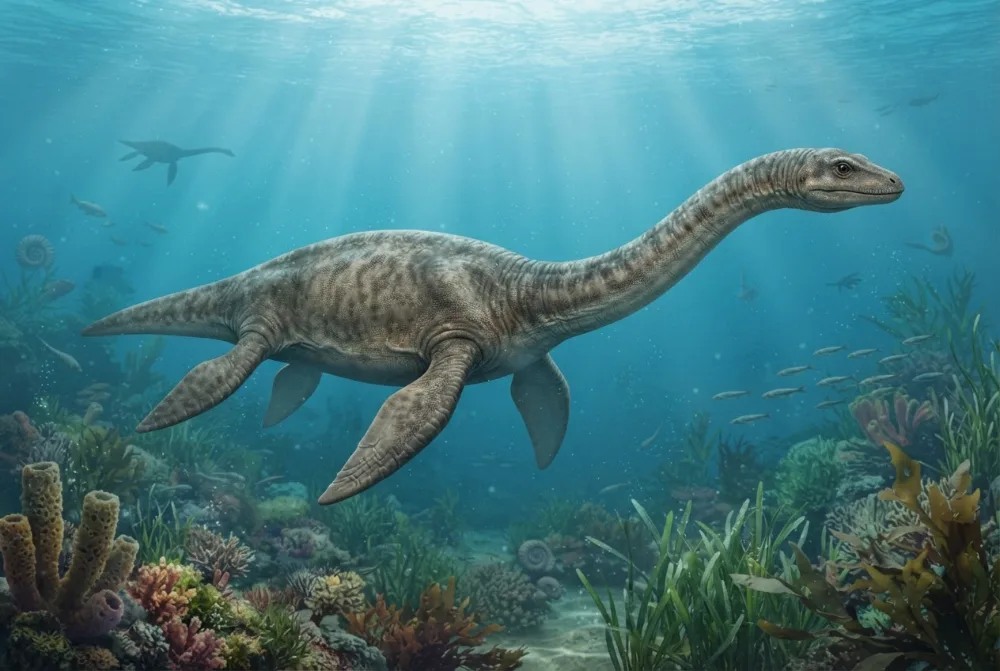
Ibibazo bibazwa cyane kuri Cryptoclidus
?How big was Cryptoclidus?
About 4 metres long and weighed around 737 to 756 kilograms. That is about as long as a small car.1
?What did Cryptoclidus eat?
It ate small, soft animals like squid and small fish. Its fragile teeth could not handle tough prey.1
?Was Cryptoclidus a dinosaur?
No, it was a plesiosaur, which is a marine reptile that lived in the sea. It is not a dinosaur.1
?When did Cryptoclidus live?
It lived during the Middle and Late Jurassic Period, about 166 to 160 million years ago.1
?Where were Cryptoclidus fossils found?
Fossils have been found in England, France, Cuba, and Russia. Many come from the Oxford Clay in Cambridgeshire, England.12
?Could Cryptoclidus swim?
Yes, it was a good swimmer. It used its four flippers to move through warm Jurassic seas.1
Gusenya ibinyoma
Ibivugwa: Some people think Cryptoclidus was a dinosaur.
Ukuri: Cryptoclidus was a plesiosaur, a marine reptile that lived in the sea, not a dinosaur.1
Ku bazobereye muri dinozore
- Izina rya siyansi
- Cryptoclidus
- Yiswe na
- (Seeley 1892)2
- Itsinda
- Plesiyozore
- Umuryango / ishami
- Cryptoclididae2
- Ishyirwa mu byiciro
- Plesiosauria > Sauropterygia2
- Imyaka y'amabuye
- imyaka miliyoni 165 kugeza 143 (Callovian / Tithonian)2
- Inzego z'amabuye
- Oxford Clay, Jagua, Kimmeridge Clay2
- Ibihugu
- Ubwongereza, Kuba, Arijantine, Ubufaransa2
- Ibisigazwa byanditswe
- 17 muri The Paleobiology Database2
- Izwi kandi ku izina rya
- Apractocleidus (amazina ya kera ubu abarwa nk'inyamaswa imwe)2
- Ivumburwa
- The first fossils were described in 1871 by John Phillips as Plesiosaurus eurymerus. Harry Govier Seeley renamed it Cryptoclidus in 1892.12
- Biracyagibwaho impaka
- Scientists are not sure whether Cryptoclidus caught prey by swimming fast or by ambushing it, because its skeleton was not built for speed.1
Aho amakuru yakuwe
- Cryptoclidus (en.wikipedia.org)
- Cryptoclidus in The Paleobiology Database (CC BY 4.0): imyaka, ahantu, inzego z'amabuye, ishyirwa mu byiciro.
Buri kintu kiri kuri uru rupapuro gifite nimero yerekana aho cyakuwe. Niba hari icyo twibeshye, tubabarire, turi abakunzi ba dinozore, ntituri ikinyamakuru cya siyansi. Tubwire kuri [email protected] tuzagikosora.
 Rex arashonje! Dino Wiki ni umushinga wa papa umwe yakoreye umuhungu we ukunda dinozore, ni ubuntu, nta matangazo kandi nta bigukurikirana. Abantu bakuru bashobora guha Rex akantu ko kurya kugira ngo Dino Wiki ikomeze kuboneka kuri interineti.Gaburira Rex
 Elasmosaurus
 Pliosaurus
 Plesiosaurus
 Cimoliasaurus
 Colymbosaurus
 Trinacromerum
 Brachiosaurus
 Diplodocus
 Allosaurus
 Brontosaurus
 Compsognathus
 Camarasaurus