 Uri dinozore iyihe? Umukino w'ibibazo
 Intambara ya dinozore
 Isiganwa rya dinozore
 Imikino mito ya dinozore
 Alubumu ya sitikeri
 Intonde za TOP za dinozore
 Ntungura!
Eolambia
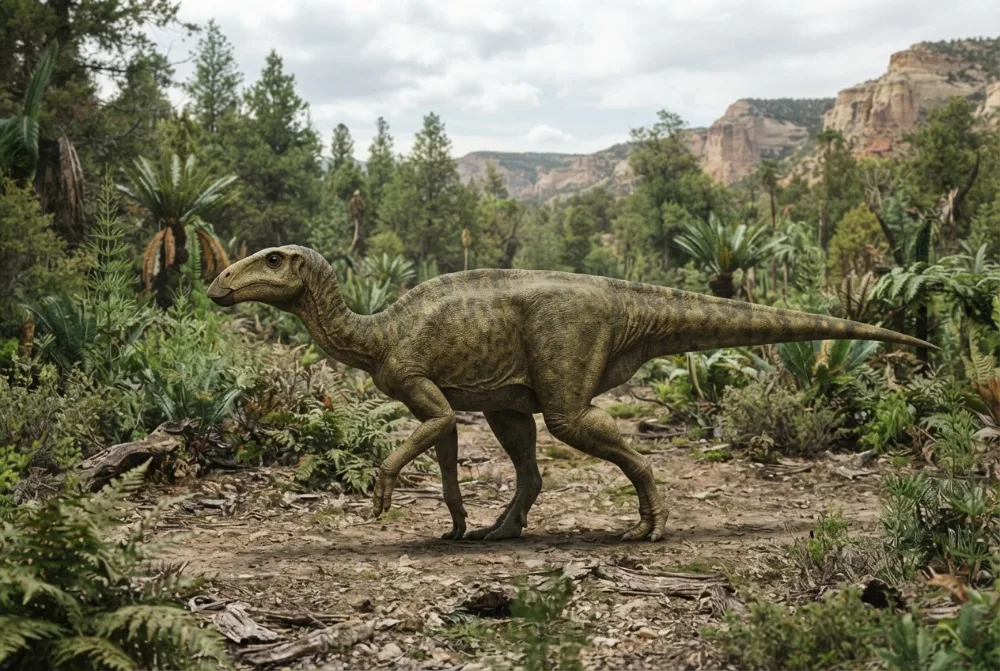
Eolambia was a plant-eating dinosaur that lived in what is now Utah, USA, about 96 million years ago. It had a beak and lots of teeth for chewing tough plants. It was an early cousin of the duck-billed dinosaurs.15
Yabayeho ryari?
Yanganaga ite?
Yari ndende ite?
Ubutumburuke bwayo bwanganaga iki?
Yari iremereye ite?
 ndende nk'imbwa 7 zikurikiranye🍌ndende nk'imineke 37 ikurikiranye🍉iremereye nk'imbuto 260 za watermelon🧸iremereye nk'abana 68 bo mu ishuri ry'incuke🎒iremereye nk'abanyeshuri 41🐻❄️iremereye nk'idubu 3 zo mu rubura🏃yashoboraga kwiruka metero 100 mu masegonda 11 (umuntu wihuta kurusha abandi akenera 9,6)
Eolambia yanganaga ite ugereranyije NAWE?
Ni imibare gusa ibarirwa muri mushakisha yawe. Nta kintu kibikwa cyangwa cyoherezwa ahandi.
Yihutaga ite?


Utuntu dushimishije
Eolambia is known from hundreds of bones, including both adults and babies, so scientists have a good picture of its skeleton.1
The first Eolambia fossil was found by Carole and Ramal Jones in 1993, and the species name honors Carole.1
Young Eolambia were hunted by big crocodile-like reptiles that lived in the lakes, but adults were too big for them.1
Grown-up Eolambia, at least eight or nine years old, were hunted by large meat-eating dinosaurs like Siats.1
Eolambia lived in a floodplain with lakes that changed water levels over about 21,000-year cycles.1
The name Eolambia was suggested by paleoartist Michael Skrepnick, replacing an earlier informal name.1
Ibibazo bibazwa cyane kuri Eolambia
?How big was Eolambia?
About 6 metres (20 feet) long. That is about as long as a large van.1
?What does the name Eolambia mean?
It means 'dawn lambeosaurine', because scientists first thought it was an early member of the lambeosaurine group.1
?Was Eolambia a hadrosaur?
No, it is a hadrosauroid, an early cousin of the true duck-billed dinosaurs (hadrosaurs).1
?How old could Eolambia get?
Scientists estimate it lived at least 8 to 9 years, based on a subadult specimen.4
Gusenya ibinyoma
Ibivugwa: Eolambia was a duck-billed dinosaur like later hadrosaurs.
Ukuri: Eolambia was an early relative of hadrosaurs, but it was not a true hadrosaurid. Scientists place it outside the hadrosaurid family.2
Ku bazobereye muri dinozore
- Izina rya siyansi
- Eolambia
- Yiswe na
- Kirkland 19985
- Itsinda
- Izirya ibimera zifite umunwa w'inyoni
- Umuryango / ishami
- Hadrosauroidea5
- Ishyirwa mu byiciro
- Ornithischia > Ornithopoda > Iguanodontia5
- Imyaka y'amabuye
- imyaka miliyoni 121 kugeza 94 (Aptian / Cenomanian)5
- Inzego z'amabuye
- Cedar Mountain5
- Ibihugu
- Amerika5
- Ibisigazwa byanditswe
- 12 muri The Paleobiology Database5
- Ivumburwa
- The first Eolambia fossils were found in 1993 by Carole and Ramal Jones in Utah. Paleontologist James Kirkland named it Eolambia caroljonesa in 1998.1
- Biracyagibwaho impaka
- Scientists debate exactly where Eolambia sits on the family tree, with some originally thinking it was a lambeosaurine hadrosaurid, but later studies place it as a more basal hadrosauroid.2
Aho amakuru yakuwe
- Eolambia (en.wikipedia.org)
- Osteology of the Basal Hadrosauroid Eolambia caroljonesa (Dinosauria: Ornithopoda) from the Cedar Mountain Formation of Utah | PLOS One (journals.plos.org)
- Eolambia caroljonesa | Dinosaur Database by DinoAnimals.com (dinoanimals.com)
- Anatomy, taphonomy, and phylogenetic implications of a new specimen of Eolambia caroljonesa (Dinosauria: Ornithopoda) from the Cedar Mountain Formation, Utah, USA (pmc.ncbi.nlm.nih.gov)
- Eolambia in The Paleobiology Database (CC BY 4.0): imyaka, ahantu, inzego z'amabuye, ishyirwa mu byiciro.
Buri kintu kiri kuri uru rupapuro gifite nimero yerekana aho cyakuwe. Niba hari icyo twibeshye, tubabarire, turi abakunzi ba dinozore, ntituri ikinyamakuru cya siyansi. Tubwire kuri [email protected] tuzagikosora.
 Rex arashonje! Dino Wiki ni umushinga wa papa umwe yakoreye umuhungu we ukunda dinozore, ni ubuntu, nta matangazo kandi nta bigukurikirana. Abantu bakuru bashobora guha Rex akantu ko kurya kugira ngo Dino Wiki ikomeze kuboneka kuri interineti.Gaburira Rex
 Iguanodon
 Tenontosaurus
 Thescelosaurus
 Zalmoxes
 Camptosaurus
 Rhabdodon
 Stegosaurus
 Archaeopteryx
 Giganotosaurus
 Microraptor
 Deinonychus
 Baryonyx