 Uri dinozore iyihe? Umukino w'ibibazo
 Intambara ya dinozore
 Isiganwa rya dinozore
 Imikino mito ya dinozore
 Alubumu ya sitikeri
 Intonde za TOP za dinozore
 Ntungura!
Gobihadros
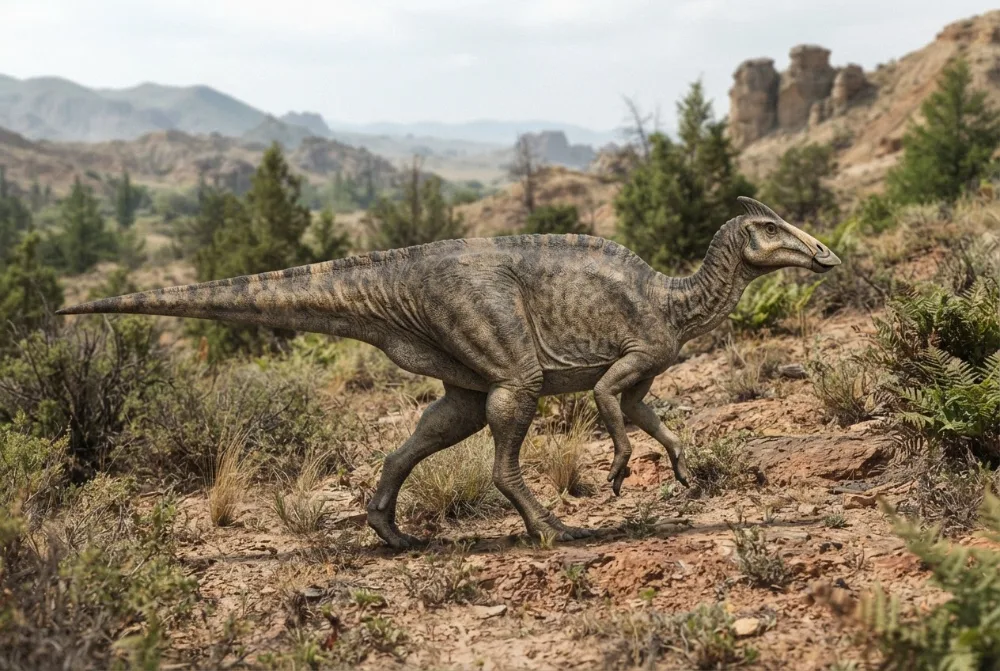
Gobihadros was a small, plant-eating dinosaur that lived in what is now Mongolia. It had a beak like a duck and could walk on two legs or all fours. Scientists found a nearly complete skeleton, so we know a lot about its body.1
Yabayeho ryari?
Yanganaga ite?
Yari ndende ite?
Ubutumburuke bwayo bwanganaga iki?
igereranya
 ndende nk'imbwa 8 zikurikiranye🍌ndende nk'imineke 42 ikurikiranye🏃yashoboraga kwiruka metero 100 mu masegonda 12 (umuntu wihuta kurusha abandi akenera 9,6)
Gobihadros yanganaga ite ugereranyije NAWE?
Ni imibare gusa ibarirwa muri mushakisha yawe. Nta kintu kibikwa cyangwa cyoherezwa ahandi.
Yihutaga ite?


Utuntu dushimishije
Gobihadros is the first non-hadrosaurid hadrosauroid from the Late Cretaceous of central Asia known from a complete, articulated skull and skeleton.1
It had up to three functional teeth in each tooth position in its lower jaw, which is unusual for a hadrosauroid.1
The upper jaw of Gobihadros had a 'double-layer' oral margin, a feature also seen in later hadrosaurids.1
Its ilium (hip bone) had a sigmoidal (S-shaped) upper outline and a fan-shaped rear process, which helped scientists identify it as a new species.1
Gobihadros had a spike-like thumb claw on its hand, which it may have used for defense or digging.1
The fossils were collected by a joint Mongolian-Japanese expedition between 1993 and 2004.1
Ibibazo bibazwa cyane kuri Gobihadros
?How big was Gobihadros?
About 7.5 metres (25 feet) long for the largest fully grown individuals, though some specimens were smaller, like 3 metres (9.8 feet) for an immature one.3
?What did Gobihadros eat?
It was a plant-eater. It had a beak like a duck and up to three functional teeth in each spot in its lower jaw to chew plants.3
?Did Gobihadros have a thumb spike?
Yes, it had a conical, spike-like claw on its first finger, which it may have used for defense or digging.3
?When did Gobihadros live?
It lived during the Late Cretaceous period, about 100 to 84 million years ago (Cenomanian to Santonian stages).3
Ku bazobereye muri dinozore
- Izina rya siyansi
- Gobihadros
- Yiswe na
- Tsogtbaatar et al. 20194
- Itsinda
- Izirya ibimera zifite umunwa w'inyoni
- Umuryango / ishami
- Hadrosauroidea4
- Ishyirwa mu byiciro
- Ornithischia > Ornithopoda > Iguanodontia4
- Imyaka y'amabuye
- imyaka miliyoni 100 kugeza 84 (Cenomanian / Santonian)4
- Inzego z'amabuye
- Baynshire4
- Ibihugu
- Mongoliya4
- Ibisigazwa byanditswe
- 6 muri The Paleobiology Database4
- Ivumburwa
- Gobihadros was named in 2019 by Khishigjav Tsogtbaatar, David B. Weishampel, David C. Evans, and Mahito Watabe. The type specimen, a nearly complete skeleton, was found at Bayshin Tsav in the Gobi Desert, Mongolia.41
- Biracyagibwaho impaka
- Scientists are not sure whether Gobihadros was a direct ancestor of later hadrosaurids or just a close cousin.1
Aho amakuru yakuwe
- journals.plos.org (journals.plos.org)
- PBDB Taxon (paleobiodb.org)
- Gobihadros (en.wikipedia.org)
- Gobihadros in The Paleobiology Database (CC BY 4.0): imyaka, ahantu, inzego z'amabuye, ishyirwa mu byiciro.
Buri kintu kiri kuri uru rupapuro gifite nimero yerekana aho cyakuwe. Niba hari icyo twibeshye, tubabarire, turi abakunzi ba dinozore, ntituri ikinyamakuru cya siyansi. Tubwire kuri [email protected] tuzagikosora.
 Rex arashonje! Dino Wiki ni umushinga wa papa umwe yakoreye umuhungu we ukunda dinozore, ni ubuntu, nta matangazo kandi nta bigukurikirana. Abantu bakuru bashobora guha Rex akantu ko kurya kugira ngo Dino Wiki ikomeze kuboneka kuri interineti.Gaburira Rex
 Iguanodon
 Tenontosaurus
 Thescelosaurus
 Zalmoxes
 Camptosaurus
 Rhabdodon
 Tyrannosaurus
 Triceratops
 Velociraptor
 Spinosaurus
 Ankylosaurus
 Parasaurolophus