 Uri dinozore iyihe? Umukino w'ibibazo
 Intambara ya dinozore
 Isiganwa rya dinozore
 Imikino mito ya dinozore
 Alubumu ya sitikeri
 Intonde za TOP za dinozore
 Ntungura!
Houornis
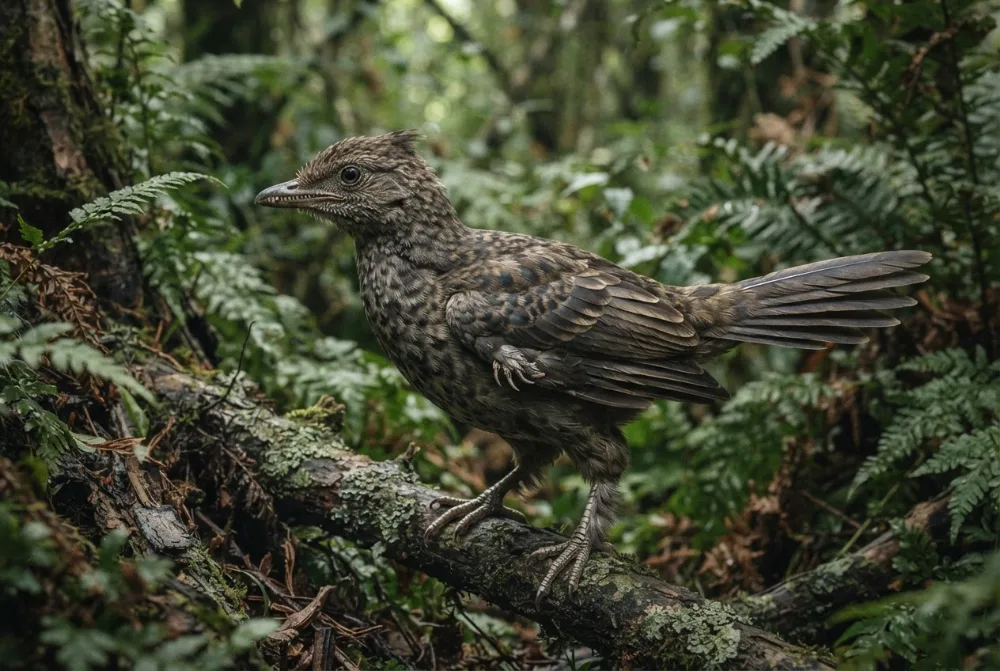
Houornis was a tiny, toothy bird that lived in China about 120 million years ago. It had perching feet and a surprisingly long tail made of fused bones. This little bird was an enantiornithean, a group of early birds that went extinct with the dinosaurs.1
Yabayeho ryari?
Yihutaga ite?


Utuntu dushimishije
Houornis is known from only one main fossil, which is not preserved as bones but as impressions left in the rock.1
Its tail was originally thought to be long and bony like Archaeopteryx, but scientists later realized it had a long pygostyle, a fused tail bone.1
The upper arm bone of Houornis is less than 30 millimeters (1.2 inches) long, making it a very small bird.1
Houornis was once classified as a species of Cathayornis, but in 2015 it was given its own genus because of unique features like its large pygostyle.1
Some scientists have considered Houornis a doubtful species because the fossil is poorly preserved, but a 2015 study found it was distinct enough to keep.1
Gusenya ibinyoma
Ibivugwa: Houornis had a long, bony tail like a dinosaur.
Ukuri: Houornis actually had a short tail with a long pygostyle (fused tail vertebrae), not a long bony tail. The original mistake came from misidentifying hip bones as tail vertebrae.1
Ku bazobereye muri dinozore
- Izina rya siyansi
- Houornis
- Yiswe na
- Wang and Liu 20152
- Itsinda
- Inyoni za mbere
- Umuryango / ishami
- Enantiornithes2
- Ishyirwa mu byiciro
- Theropoda > Avialae2
- Imyaka y'amabuye
- imyaka miliyoni 121 kugeza 113 (Aptian)2
- Inzego z'amabuye
- Jiufotang2
- Ibihugu
- Ubushinwa2
- Ibisigazwa byanditswe
- 1 muri The Paleobiology Database2
- Ivumburwa
- The only known fossil of Houornis was found in 1993 by Zhou Zhonghe near Boluochi, China. It was first named Cathayornis caudatus by Hou Lianhu in 1997, and then renamed Houornis by Wang and Liu in 2015.1
- Biracyagibwaho impaka
- Scientists are not sure exactly how Houornis is related to other enantiornithean birds, because its fossil is too incomplete for a detailed family tree analysis.1
Aho amakuru yakuwe
- Houornis (en.wikipedia.org)
- Houornis in The Paleobiology Database (CC BY 4.0): imyaka, ahantu, inzego z'amabuye, ishyirwa mu byiciro.
Buri kintu kiri kuri uru rupapuro gifite nimero yerekana aho cyakuwe. Niba hari icyo twibeshye, tubabarire, turi abakunzi ba dinozore, ntituri ikinyamakuru cya siyansi. Tubwire kuri [email protected] tuzagikosora.
 Rex arashonje! Dino Wiki ni umushinga wa papa umwe yakoreye umuhungu we ukunda dinozore, ni ubuntu, nta matangazo kandi nta bigukurikirana. Abantu bakuru bashobora guha Rex akantu ko kurya kugira ngo Dino Wiki ikomeze kuboneka kuri interineti.Gaburira Rex
 Archaeopteryx
 Hesperornis
 Ichthyornis
 Baptornis
 Jurapteryx
 Gobipteryx
 Stegosaurus
 Iguanodon
 Giganotosaurus
 Microraptor
 Deinonychus
 Baryonyx