 Uri dinozore iyihe? Umukino w'ibibazo
 Intambara ya dinozore
 Isiganwa rya dinozore
 Imikino mito ya dinozore
 Alubumu ya sitikeri
 Intonde za TOP za dinozore
 Ntungura!
Hypsilophodon
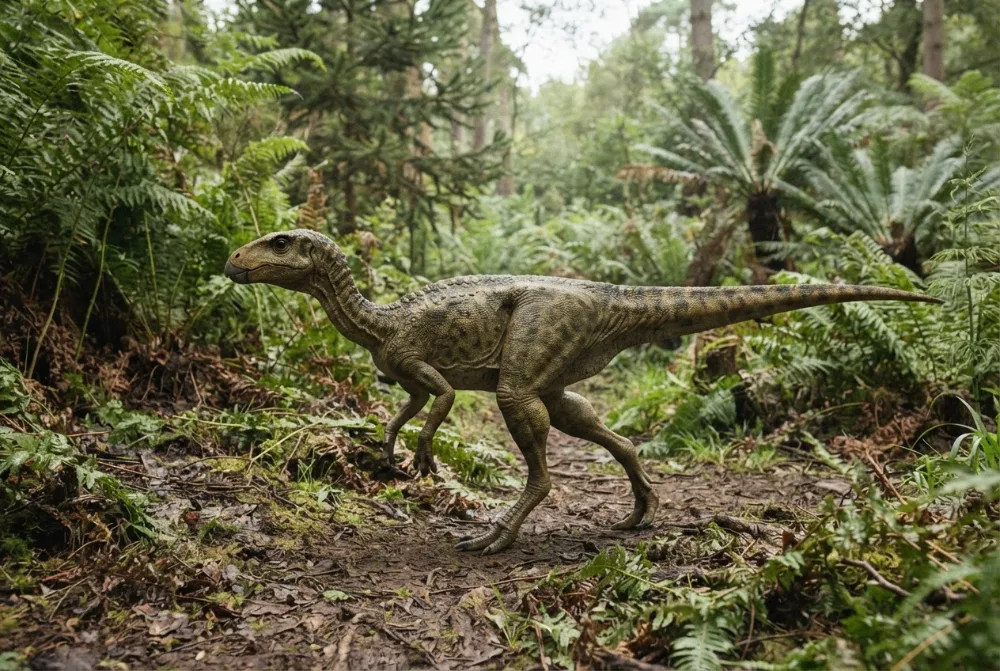
Hypsilophodon was a tiny, speedy plant-eater that sprinted through the forests of Early Cretaceous England. It had a sharp beak like a parrot and a long stiff tail to help it balance while running.12
Yabayeho ryari?
Yanganaga ite?
Yari ndende ite?
Ubutumburuke bwayo bwanganaga iki?
Yari iremereye ite?
 ndende nk'injangwe 4 zo mu rugo zikurikiranye🍌ndende nk'imineke 11 ikurikiranye🍉iremereye nk'imbuto 4 za watermelon🏃yashoboraga kwiruka metero 100 mu masegonda 9,2 (umuntu wihuta kurusha abandi akenera 9,6)
Hypsilophodon yanganaga ite ugereranyije NAWE?
Ni imibare gusa ibarirwa muri mushakisha yawe. Nta kintu kibikwa cyangwa cyoherezwa ahandi.
Yihutaga ite?


Utuntu dushimishije
Hypsilophodon had five fingers on each hand, and one of them was opposable, like a thumb, so it could grasp branches and food.1
Its tail was stiffened by bony tendons, which helped it keep balance while running fast on two legs.1
Its teeth were self-sharpening: the upper and lower teeth rubbed together as it chewed, keeping them sharp.1
Hypsilophodon probably had cheeks, which helped it hold and chew food, just like modern plant-eaters.12
All the true Hypsilophodon fossils come from a single layer of rock called the Hypsilophodon Bed, on the Isle of Wight.1
Ibibazo bibazwa cyane kuri Hypsilophodon
?How big was Hypsilophodon?
It was about 1.5 to 2 metres (5 to 6.5 feet) long and weighed around 20 kilograms (44 pounds).12
?What did Hypsilophodon eat?
It was a herbivore, eating low-growing plants like young shoots and roots. It used its sharp beak to clip vegetation and probably had cheeks to help chew.21
?Could Hypsilophodon climb trees?
No, scientists used to think it climbed trees, but we now know it lived on the ground and was a fast runner.21
?How fast could Hypsilophodon run?
It was built for running with long legs, a stiff tail for balance, and a light body, but no exact speed is known.21
?Did Hypsilophodon have feathers?
No, there is no evidence that Hypsilophodon had feathers. It was a small ornithischian dinosaur with scaly skin.1
?Where did Hypsilophodon live?
It lived in what is now England, specifically on the Isle of Wight, during the Early Cretaceous period about 126 million years ago.21
?Was Hypsilophodon bigger than a chicken?
Yes, it was about the size of a large turkey or a small deer, much bigger than a chicken.2
?Did Hypsilophodon live in groups?
Yes, several fossils were found together, so some experts think it lived in groups, like deer.2
Gusenya ibinyoma
Ibivugwa: Some people thought Hypsilophodon lived in trees, like a climbing dinosaur.
Ukuri: Scientists now know it lived on the ground and was built for running, not climbing.2
Ku bazobereye muri dinozore
- Izina rya siyansi
- Hypsilophodon
- Yiswe na
- Huxley 18704
- Itsinda
- Izirya ibimera zifite umunwa w'inyoni
- Umuryango / ishami
- Hypsilophodontidae4
- Ishyirwa mu byiciro
- Ornithischia > Ornithopoda4
- Imyaka y'amabuye
- imyaka miliyoni 155 kugeza 120 (Kimmeridgian / Aptian)4
- Inzego z'amabuye
- Wessex, Vectis, Artoles4
- Ibihugu
- Ubwongereza, Esipanye, Rumaniya, Ubuyapani, Porutugali4
- Ibisigazwa byanditswe
- 10 muri The Paleobiology Database4
- Ivumburwa
- The first fossils were found in 1849 on the Isle of Wight, but they were thought to be from a young Iguanodon. In 1869, Thomas Henry Huxley realized it was a new dinosaur and named it Hypsilophodon foxii.1
- Biracyagibwaho impaka
- Scientists are not sure exactly how Hypsilophodon is related to other plant-eating dinosaurs. Some think it belongs in Ornithopoda, but recent studies question that.1
Aho amakuru yakuwe
- Hypsilophodon (en.wikipedia.org)
- Hypsilophodon | Natural History Museum (nhm.ac.uk)
- enchantedlearning.com (enchantedlearning.com)
- Hypsilophodon in The Paleobiology Database (CC BY 4.0): imyaka, ahantu, inzego z'amabuye, ishyirwa mu byiciro.
Buri kintu kiri kuri uru rupapuro gifite nimero yerekana aho cyakuwe. Niba hari icyo twibeshye, tubabarire, turi abakunzi ba dinozore, ntituri ikinyamakuru cya siyansi. Tubwire kuri [email protected] tuzagikosora.
 Rex arashonje! Dino Wiki ni umushinga wa papa umwe yakoreye umuhungu we ukunda dinozore, ni ubuntu, nta matangazo kandi nta bigukurikirana. Abantu bakuru bashobora guha Rex akantu ko kurya kugira ngo Dino Wiki ikomeze kuboneka kuri interineti.Gaburira Rex
 Iguanodon
 Tenontosaurus
 Thescelosaurus
 Zalmoxes
 Camptosaurus
 Rhabdodon
 Stegosaurus
 Archaeopteryx
 Giganotosaurus
 Microraptor
 Deinonychus
 Baryonyx