 Uri dinozore iyihe? Umukino w'ibibazo
 Intambara ya dinozore
 Isiganwa rya dinozore
 Imikino mito ya dinozore
 Alubumu ya sitikeri
 Intonde za TOP za dinozore
 Ntungura!
Yabayeho ryari?

Yanganaga ite?
Yari ndende ite?
Juravenator yanganaga ite ugereranyije NAWE?
Ni imibare gusa ibarirwa muri mushakisha yawe. Nta kintu kibikwa cyangwa cyoherezwa ahandi.
Yihutaga ite?


Utuntu dushimishije
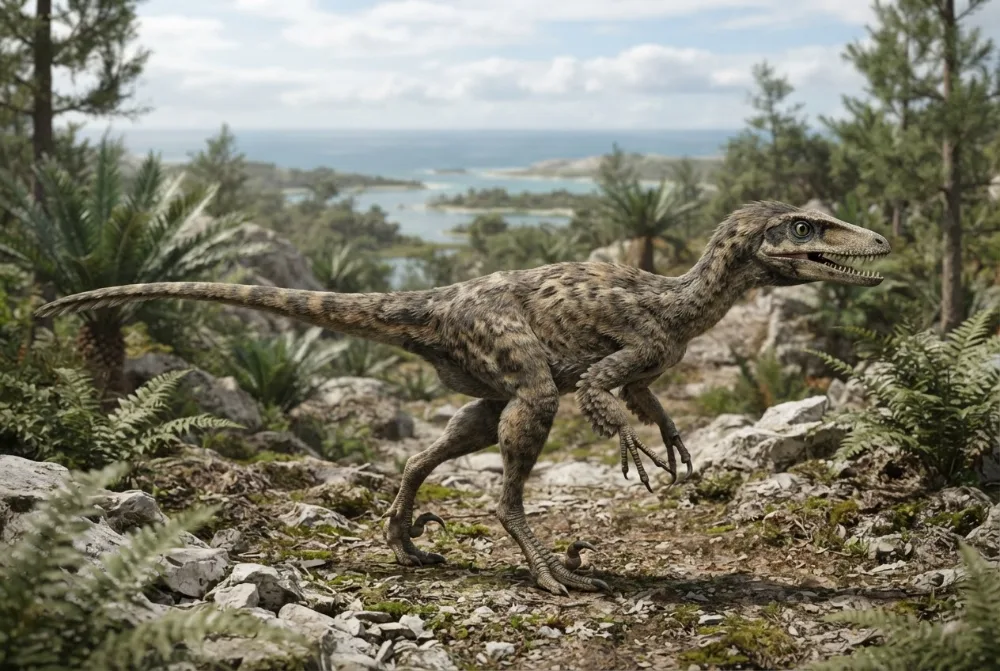
Juravenator is known from a single, nearly complete skeleton of a juvenile, making it one of the best-preserved predatory dinosaurs from Europe.21
Unlike many other small theropods from the same time, Juravenator did not have feathers or feather-like structures on its tail.21
Scientists think Juravenator may have been nocturnal, based on the shape of its eye bones.1
In 2020, researchers found tiny round structures on the sides of Juravenator's tail that might have been sensory organs, like those on crocodile scales.1
The only known Juravenator fossil was found in a lagoon deposit, suggesting it may have drowned after being washed into the water.1
Ibibazo bibazwa cyane kuri Juravenator
?How big was Juravenator?
About 75 centimetres (2.46 feet) long, which is roughly the size of a small dog.1
?Did Juravenator have feathers?
It had mostly scales on its tail and legs, but some faint impressions of possible simple feathers have been found on the top of the tail and hips.1
?What did Juravenator eat?
It was a small meat-eater that may have hunted fish and other small prey in shallow water.4
?Could Juravenator swim?
It may have waded in water to hunt, but it probably did not swim well. The only known fossil was found in a lagoon, possibly after drowning.1
?Was Juravenator nocturnal?
Yes, scientists think it may have been nocturnal based on the shape of its eye bones.1
?Where was Juravenator found?
In Germany, in the Franconian Jura region, from rocks that are about 151 to 152 million years old.1
Ku bazobereye muri dinozore
- Izina rya siyansi
- Juravenator
- Yiswe na
- Göhlich and Chiappe 20065
- Itsinda
- Dinozore zirya inyama
- Umuryango / ishami
- Coelurosauria5
- Ishyirwa mu byiciro
- Theropoda5
- Imyaka y'amabuye
- imyaka miliyoni 152 kugeza 149 (Kimmeridgian)5
- Inzego z'amabuye
- Painten5
- Ibihugu
- Ubudage5
- Ibisigazwa byanditswe
- 1 muri The Paleobiology Database5
- Ivumburwa
- Juravenator was discovered in 1998 by volunteers Klaus-Dieter Weiß and Hans-Joachim Weiß in a quarry near Schamhaupten, Germany. It was named and described by Ursula Göhlich and Luis Chiappe in 2006.12
- Biracyagibwaho impaka
- Scientists are not sure if Juravenator was fully grown when it died, because the only known skeleton is from a juvenile.1
Aho amakuru yakuwe
- Juravenator (en.wikipedia.org)
- A new carnivorous dinosaur from the Late Jurassic Solnhofen archipelago | Nature (nature.com)
- PBDB Taxon (paleobiodb.org)
- This small dinosaur had a marvelous sense of touch, detailed fossils reveal | National Geographic (nationalgeographic.com)
- Juravenator in The Paleobiology Database (CC BY 4.0): imyaka, ahantu, inzego z'amabuye, ishyirwa mu byiciro.
Buri kintu kiri kuri uru rupapuro gifite nimero yerekana aho cyakuwe. Niba hari icyo twibeshye, tubabarire, turi abakunzi ba dinozore, ntituri ikinyamakuru cya siyansi. Tubwire kuri [email protected] tuzagikosora.
 Rex arashonje! Dino Wiki ni umushinga wa papa umwe yakoreye umuhungu we ukunda dinozore, ni ubuntu, nta matangazo kandi nta bigukurikirana. Abantu bakuru bashobora guha Rex akantu ko kurya kugira ngo Dino Wiki ikomeze kuboneka kuri interineti.Gaburira Rex
 Allosaurus
 Carnotaurus
 Dilophosaurus
 Giganotosaurus
 Compsognathus
 Paronychodon
 Brachiosaurus
 Diplodocus
 Brontosaurus
 Camarasaurus
 Morosaurus
 Apatosaurus