 Uri dinozore iyihe? Umukino w'ibibazo
 Intambara ya dinozore
 Isiganwa rya dinozore
 Imikino mito ya dinozore
 Alubumu ya sitikeri
 Intonde za TOP za dinozore
 Ntungura!
Mikadocephalus
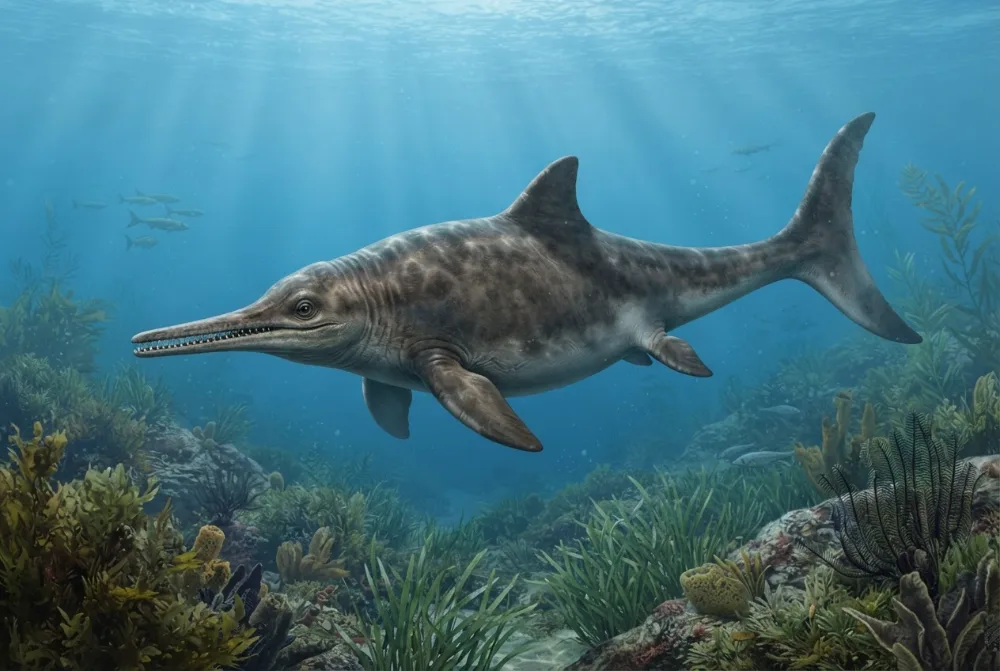
Mikadocephalus was a big, fish-shaped marine reptile that swam in warm seas during the Triassic Period. It was not a dinosaur, but a kind of ichthyosaur, with a long snout full of teeth for catching fish and squid.14
Yabayeho ryari?
Yanganaga ite?
Yari ndende ite?
 ndende nk'imbwa 8 zikurikiranye🍌ndende nk'imineke 44 ikurikiranye🏊yashoboraga koga uburebure bwa pisine nini (50 m) mu masegonda 4,6
Mikadocephalus yanganaga ite ugereranyije NAWE?
Ni imibare gusa ibarirwa muri mushakisha yawe. Nta kintu kibikwa cyangwa cyoherezwa ahandi.
Yihutaga ite?


Utuntu dushimishije
Mikadocephalus is known from a skull that was so crushed and jumbled that it looked like a game of pick-up sticks, which is how it got its name.1
It lived about 247 to 237 million years ago, during the Middle Triassic, making it one of the earliest big ichthyosaurs.4
Its fossils were found in the Besano Formation, which was once a warm, shallow lagoon with poor oxygen at the bottom.1
Scientists think Mikadocephalus might actually be the same animal as another ichthyosaur called Besanosaurus, because they look very similar.1
The species name gracilirostris means 'slender snout', because its jaws were long and thin.1
Ibibazo bibazwa cyane kuri Mikadocephalus
?How big was Mikadocephalus?
About 8 metres (26 feet) long, based on the largest known specimen of Besanosaurus, which scientists think is the same animal.2
?What did Mikadocephalus eat?
It ate small fish and squid, catching them with its long, slender snout and tiny pointed teeth.2
?Is Mikadocephalus a dinosaur?
No, it is not a dinosaur. It is a kind of ichthyosaur, a fish-shaped marine reptile that lived in the sea.1
?Why is it called Mikadocephalus?
Its name means 'Mikado head,' because its skull was so crushed and jumbled that it looked like a game of pick-up sticks.1
Gusenya ibinyoma
Ibivugwa: Some people think Mikadocephalus was a dinosaur because it lived long ago and had a long snout.
Ukuri: Mikadocephalus was an ichthyosaur, a marine reptile that lived in the sea. Ichthyosaurs are not dinosaurs.1
Ku bazobereye muri dinozore
- Izina rya siyansi
- Mikadocephalus
- Yiswe na
- Maisch and Matzke 19974
- Itsinda
- Iktiyozore
- Umuryango / ishami
- Guanlingsauridae4
- Ishyirwa mu byiciro
- Ichthyosauria > Ichthyosauromorpha4
- Imyaka y'amabuye
- imyaka miliyoni 247 kugeza 237 ()4
- Inzego z'amabuye
- Monte San Giorgio bituminous shales, Tschermakfjellet4
- Ibihugu
- Ubusuwisi, Svalbard4
- Ibisigazwa byanditswe
- 2 muri The Paleobiology Database4
- Ivumburwa
- The skull was found in Switzerland, in the Besano Formation, and was named by Michael Maisch and Andreas Matzke in 1997.1
- Biracyagibwaho impaka
- Scientists still debate whether Mikadocephalus is its own species or the same as Besanosaurus, since the skull is so crushed.1
Aho amakuru yakuwe
- Besanosaurus (en.wikipedia.org)
- Besanosaurus (Wikipedia) (Wikipedia)
- Cranial anatomy of Besanosaurus leptorhynchus Dal Sasso & Pinna, 1996 (Reptilia: Ichthyosauria) from the Middle Triassic Besano Formation of Monte San Giorgio, Italy/Switzerland: taxonomic and palaeobiological implications [PeerJ] (peerj.com)
- Mikadocephalus in The Paleobiology Database (CC BY 4.0): imyaka, ahantu, inzego z'amabuye, ishyirwa mu byiciro.
Buri kintu kiri kuri uru rupapuro gifite nimero yerekana aho cyakuwe. Niba hari icyo twibeshye, tubabarire, turi abakunzi ba dinozore, ntituri ikinyamakuru cya siyansi. Tubwire kuri [email protected] tuzagikosora.
 Rex arashonje! Dino Wiki ni umushinga wa papa umwe yakoreye umuhungu we ukunda dinozore, ni ubuntu, nta matangazo kandi nta bigukurikirana. Abantu bakuru bashobora guha Rex akantu ko kurya kugira ngo Dino Wiki ikomeze kuboneka kuri interineti.Gaburira Rex
 Ichthyosaurus
 Platypterygius
 Stenopterygius
 Khudiakovia
 Ophthalmosaurus
 Chonespondylus
 Placodus
 Lariosaurus
 Cyamodus
 Cymatosaurus
 Proneusticosaurus
 Neusticosaurus