 Uri dinozore iyihe? Umukino w'ibibazo
 Intambara ya dinozore
 Isiganwa rya dinozore
 Imikino mito ya dinozore
 Alubumu ya sitikeri
 Intonde za TOP za dinozore
 Ntungura!
Stenopterygius
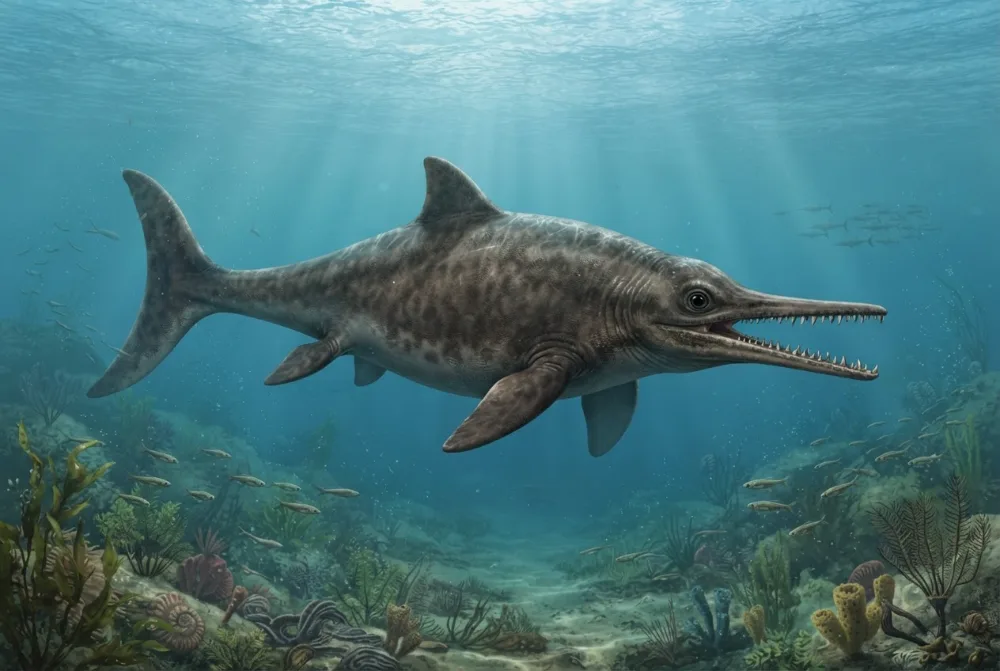
Stenopterygius was a fast-swimming marine reptile that lived in the Jurassic seas. It looked a bit like a dolphin but was actually an ichthyosaur, not a dinosaur. It had a long beak full of teeth and chased after fish and squid.1
Yabayeho ryari?
Yanganaga ite?
Yari ndende ite?
 ndende nk'imbwa 4 zikurikiranye🍌ndende nk'imineke 22 ikurikiranye🏊yashoboraga koga uburebure bwa pisine nini (50 m) mu masegonda 3,8
Stenopterygius yanganaga ite ugereranyije NAWE?
Ni imibare gusa ibarirwa muri mushakisha yawe. Nta kintu kibikwa cyangwa cyoherezwa ahandi.
Yihutaga ite?


Utuntu dushimishije
Stenopterygius had a small skull and narrow flippers compared to its relative Ichthyosaurus.1
One well-preserved fossil shows traces of skin, revealing that Stenopterygius was countershaded: darker on the back and lighter on the belly.1
Fossils of Stenopterygius often contain the remains of its last meal in the stomach area.1
The tail ended in a large, semicircular, leathery vertical fin, and it also had a triangular dorsal fin on its back.1
Stenopterygius lived during the Early and Middle Jurassic, about 183 to 173 million years ago.1
The type specimen of Stenopterygius quadriscissus is a complete skeleton that even preserved a very large embryo inside.1
Ibibazo bibazwa cyane kuri Stenopterygius
?How big was Stenopterygius?
Stenopterygius was a medium sized ichthyosaur, with most species reaching about 3.5 metres long, while the largest, S. uniter, could exceed 4 metres.1
?What did Stenopterygius eat?
Stenopterygius hunted fish, cephalopods, and other animals in the open sea. Fossils often contain the remains of its last meal in the stomach area.1
?Was Stenopterygius a dinosaur?
No, Stenopterygius was an ichthyosaur, a marine reptile, not a dinosaur. It looked a bit like a dolphin but was actually a different group of reptiles.1
?Did Stenopterygius give birth to live young?
Yes, Stenopterygius gave birth to live young, and one famous fossil shows a mother that died in childbirth. It preferred tail-first births, like modern dolphins and whales.1
Ku bazobereye muri dinozore
- Izina rya siyansi
- Stenopterygius
- Yiswe na
- Jaekel 19043
- Itsinda
- Iktiyozore
- Umuryango / ishami
- Thunnosauria3
- Ishyirwa mu byiciro
- Ichthyosauria > Ichthyosauromorpha3
- Imyaka y'amabuye
- imyaka miliyoni 184 kugeza 171 (Toarcian / Aalenian)3
- Inzego z'amabuye
- Posidonia Shale, Opalinuston, Beacon Limstone3
- Ibihugu
- Ubudage, Ubwongereza, Lugizamburu, Ubufaransa3
- Ibisigazwa byanditswe
- 47 muri The Paleobiology Database3
- Ivumburwa
- The species was first named as Ichthyosaurus quadriscissus by Quenstedt in 1856. Otto Jaekel gave it its own genus, Stenopterygius, in 1904.1
- Biracyagibwaho impaka
- Scientists are still debating exactly how many species of Stenopterygius existed, because the fossils are often incomplete.2
Aho amakuru yakuwe
- Stenopterygius (en.wikipedia.org)
- First Diagnostic Marine Reptile Remains from the Aalenian (Middle Jurassic): A New Ichthyosaur from Southwestern Germany | PLOS One (journals.plos.org)
- Stenopterygius in The Paleobiology Database (CC BY 4.0): imyaka, ahantu, inzego z'amabuye, ishyirwa mu byiciro.
Buri kintu kiri kuri uru rupapuro gifite nimero yerekana aho cyakuwe. Niba hari icyo twibeshye, tubabarire, turi abakunzi ba dinozore, ntituri ikinyamakuru cya siyansi. Tubwire kuri [email protected] tuzagikosora.
 Rex arashonje! Dino Wiki ni umushinga wa papa umwe yakoreye umuhungu we ukunda dinozore, ni ubuntu, nta matangazo kandi nta bigukurikirana. Abantu bakuru bashobora guha Rex akantu ko kurya kugira ngo Dino Wiki ikomeze kuboneka kuri interineti.Gaburira Rex
 Ichthyosaurus
 Platypterygius
 Khudiakovia
 Ophthalmosaurus
 Chonespondylus
 Cymbospondylus
 Dilophosaurus
 Dorygnathus
 Lufengosaurus
 Scutellosaurus
 Yunnanosaurus
 Sinosaurus