 Uri dinozore iyihe? Umukino w'ibibazo
 Intambara ya dinozore
 Isiganwa rya dinozore
 Imikino mito ya dinozore
 Alubumu ya sitikeri
 Intonde za TOP za dinozore
 Ntungura!
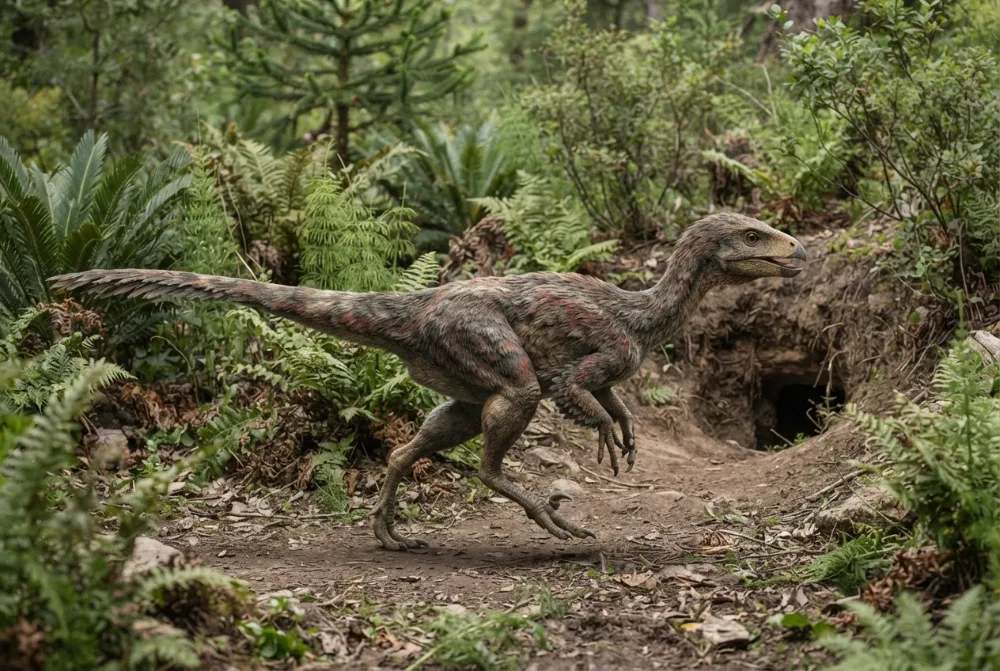
Oryctodromeus
Oryctodromeus was a small, fast dinosaur that dug burrows to live in. It is the first non-bird dinosaur ever found with proof that it lived underground. An adult, two babies, and their burrow were all fossilized together.1
Yabayeho ryari?
Yanganaga ite?
Yari ndende ite?
Ubutumburuke bwayo bwanganaga iki?
igereranya
Yari iremereye ite?
 ndende nk'injangwe 4 zo mu rugo zikurikiranye🍌ndende nk'imineke 12 ikurikiranye🍉iremereye nk'imbuto 6 za watermelon🏃yashoboraga kwiruka metero 100 mu masegonda 8,8 (umuntu wihuta kurusha abandi akenera 9,6)
Oryctodromeus yanganaga ite ugereranyije NAWE?
Ni imibare gusa ibarirwa muri mushakisha yawe. Nta kintu kibikwa cyangwa cyoherezwa ahandi.
Yihutaga ite?


Utuntu dushimishije
Oryctodromeus means 'digging runner' because it could both dig burrows and run fast on two legs.1
Its burrow was about 2 meters (6.6 feet) long and 70 centimeters (2.3 feet) wide, with two turns.1
The adult Oryctodromeus was about 2.1 meters (6.9 feet) long and weighed between 22 and 32 kilograms (50 to 70 pounds).1
Two baby Oryctodromeus were found with the adult, showing that parents cared for their young in the burrow.1
Its strong shoulders and arms helped it dig, but it was not as specialized for digging as a mole or wombat.1
Oryctodromeus was named the state dinosaur of Idaho in 2023.1
The burrow was filled with sand and turned into sandstone, which preserved the bones inside.1
Ibibazo bibazwa cyane kuri Oryctodromeus
?How did Oryctodromeus dig?
It used its strong shoulders, arms, and broad snout to scratch and move soil. It was not as specialized for digging as a mole or wombat, but more like a rabbit or hyena.13
?What did Oryctodromeus eat?
It was a plant-eater, or herbivore.2
?When did Oryctodromeus live?
It lived during the mid-Cretaceous Period, about 105 to 96 million years ago.1
Ku bazobereye muri dinozore
- Izina rya siyansi
- Oryctodromeus
- Yiswe na
- Varricchio et al. 20074
- Itsinda
- Izirya ibimera zifite umunwa w'inyoni
- Umuryango / ishami
- Thescelosauridae4
- Ishyirwa mu byiciro
- Ornithischia4
- Imyaka y'amabuye
- imyaka miliyoni 106 kugeza 94 (Albian / Cenomanian)4
- Inzego z'amabuye
- Wayan, Blackleaf4
- Ibihugu
- Amerika4
- Ibisigazwa byanditswe
- 9 muri The Paleobiology Database4
- Ivumburwa
- Oryctodromeus was named in 2007 by David Varricchio, Anthony Martin, and Yoshihiro Katsura. They found an adult and two juveniles inside a fossilized burrow in Montana.14
- Biracyagibwaho impaka
- Scientists are not sure if its close relatives Orodromeus and Zephyrosaurus also dug burrows, though they have similar features.1
Aho amakuru yakuwe
- Oryctodromeus (en.wikipedia.org)
- Oryctodromeus | Natural History Museum (nhm.ac.uk)
- First trace and body fossil evidence of a burrowing, denning dinosaur (pmc.ncbi.nlm.nih.gov)
- Oryctodromeus in The Paleobiology Database (CC BY 4.0): imyaka, ahantu, inzego z'amabuye, ishyirwa mu byiciro.
Buri kintu kiri kuri uru rupapuro gifite nimero yerekana aho cyakuwe. Niba hari icyo twibeshye, tubabarire, turi abakunzi ba dinozore, ntituri ikinyamakuru cya siyansi. Tubwire kuri [email protected] tuzagikosora.
 Rex arashonje! Dino Wiki ni umushinga wa papa umwe yakoreye umuhungu we ukunda dinozore, ni ubuntu, nta matangazo kandi nta bigukurikirana. Abantu bakuru bashobora guha Rex akantu ko kurya kugira ngo Dino Wiki ikomeze kuboneka kuri interineti.Gaburira Rex
 Iguanodon
 Tenontosaurus
 Thescelosaurus
 Zalmoxes
 Camptosaurus
 Rhabdodon
 Tyrannosaurus
 Triceratops
 Velociraptor
 Spinosaurus
 Ankylosaurus
 Parasaurolophus