 Uri dinozore iyihe? Umukino w'ibibazo
 Intambara ya dinozore
 Isiganwa rya dinozore
 Imikino mito ya dinozore
 Alubumu ya sitikeri
 Intonde za TOP za dinozore
 Ntungura!
Ouranosaurus
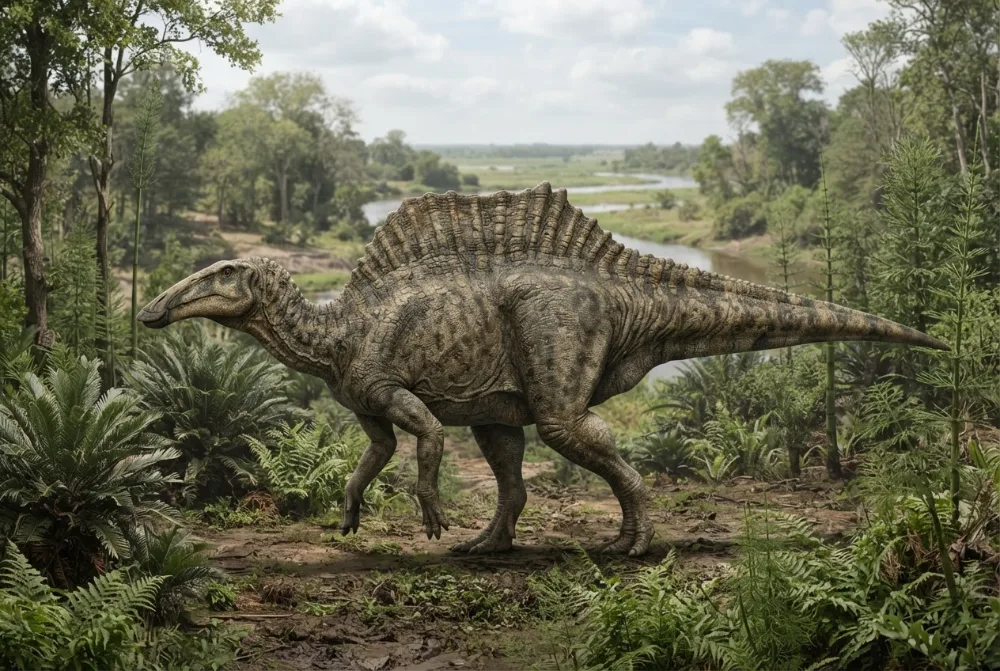
Ouranosaurus was a plant-eating dinosaur that lived in Africa during the Early Cretaceous. It had a long, duck-like beak and a strange hump or sail on its back. This dinosaur was about as long as a school bus and weighed as much as a small car.1
Yabayeho ryari?
Yanganaga ite?
Yari ndende ite?
Ubutumburuke bwayo bwanganaga iki?
igereranya
Yari iremereye ite?

 ndende nk'imbwa 8 zikurikiranye🍌ndende nk'imineke 46 ikurikiranyeiremereye nk'imbwa 110🍉iremereye nk'imbuto 440 za watermelon🎒iremereye nk'ibyumba 3 by'amashuri byuzuye abana🐻❄️iremereye nk'idubu 5 zo mu rubura🏃yashoboraga kwiruka metero 100 mu masegonda 13 (umuntu wihuta kurusha abandi akenera 9,6)
Ouranosaurus yanganaga ite ugereranyije NAWE?
Ni imibare gusa ibarirwa muri mushakisha yawe. Nta kintu kibikwa cyangwa cyoherezwa ahandi.
Yihutaga ite?


Utuntu dushimishije
Ouranosaurus is the only known horned ornithopod dinosaur, with small rounded horns in front of its eyes.1
Its snout was toothless and covered by a horny beak, like a duck's bill.1
Two nearly complete skeletons were found in Niger in 1965 and 1970, and a third partial specimen came from Cameroon.12
Ouranosaurus lived in a river delta alongside other dinosaurs like the huge crocodile Sarcosuchus and the meat-eater Suchomimus.1
It had 22 tooth positions in each jaw, for a total of 88 cheek teeth that formed a continuous grinding surface.1
The name Ouranosaurus means 'brave lizard' in Greek, and the species name nigeriensis refers to the country of Niger.1
Ibibazo bibazwa cyane kuri Ouranosaurus
?How big was Ouranosaurus?
About 7 to 8.3 metres long and weighed around 2.2 metric tons. That is roughly the length of a school bus and the weight of a small car.13
?Did Ouranosaurus have a sail on its back?
Yes, it had a large sail on its back made of long, wide neural spines. This sail spanned its back.1
?What did Ouranosaurus eat?
It was a plant-eater that used its cheek teeth to chew tough plants like leaves, fruit, and seeds. Its wide beak also suggests it could eat large amounts of low-quality food.1
?Where did Ouranosaurus live?
It lived in what is now Niger and Cameroon in Africa during the Early Cretaceous. It lived in a river delta environment alongside other dinosaurs.1
?When did Ouranosaurus go extinct?
It lived during the Aptian stage of the Early Cretaceous, about 125 to 113 million years ago. It died out long before the end of the dinosaurs.1
?Was Ouranosaurus a dinosaur?
Yes, it was a herbivorous basal hadrosauriform dinosaur. It is not a pterosaur or marine reptile.1
?Did Ouranosaurus have horns?
Yes, it had small rounded horns in front of its eyes, making it the only known horned ornithopod dinosaur.1
?How fast could Ouranosaurus run?
Scientists do not know its exact speed. It was a large, plant-eating dinosaur with a stiff back, so it was probably not very fast.1
Ku bazobereye muri dinozore
- Izina rya siyansi
- Ouranosaurus
- Yiswe na
- Taquet 19724
- Itsinda
- Izirya ibimera zifite umunwa w'inyoni
- Umuryango / ishami
- Neoiguanodontia4
- Ishyirwa mu byiciro
- Ornithischia > Ornithopoda > Iguanodontia4
- Imyaka y'amabuye
- imyaka miliyoni 121 kugeza 66 (Aptian / Maastrichtian)4
- Inzego z'amabuye
- Elrhaz, Koum, Aïn el Guettar4
- Ibihugu
- Nijeri, Kameruni, Tuniziya, Sudani4
- Ibisigazwa byanditswe
- 8 muri The Paleobiology Database4
- Ivumburwa
- Ouranosaurus was named by French paleontologist Philippe Taquet in 1976. The first skeleton was found in 1965 during a French expedition to the Gadoufaoua region of Niger.12
- Biracyagibwaho impaka
- Scientists still debate whether the tall spines on Ouranosaurus's back supported a hump or a sail.1
Aho amakuru yakuwe
- Ouranosaurus (en.wikipedia.org)
- Philippe TAQUET 1976 Cahiers de Paléontologie, CNRS, Paris (naturalhistory.si.edu)
- Ouranosaurus- Enchanted Learning Software (enchantedlearning.com)
- Ouranosaurus in The Paleobiology Database (CC BY 4.0): imyaka, ahantu, inzego z'amabuye, ishyirwa mu byiciro.
Buri kintu kiri kuri uru rupapuro gifite nimero yerekana aho cyakuwe. Niba hari icyo twibeshye, tubabarire, turi abakunzi ba dinozore, ntituri ikinyamakuru cya siyansi. Tubwire kuri [email protected] tuzagikosora.
 Rex arashonje! Dino Wiki ni umushinga wa papa umwe yakoreye umuhungu we ukunda dinozore, ni ubuntu, nta matangazo kandi nta bigukurikirana. Abantu bakuru bashobora guha Rex akantu ko kurya kugira ngo Dino Wiki ikomeze kuboneka kuri interineti.Gaburira Rex
 Iguanodon
 Tenontosaurus
 Thescelosaurus
 Zalmoxes
 Camptosaurus
 Rhabdodon
 Tyrannosaurus
 Triceratops
 Velociraptor
 Spinosaurus
 Ankylosaurus
 Parasaurolophus