 Uri dinozore iyihe? Umukino w'ibibazo
 Intambara ya dinozore
 Isiganwa rya dinozore
 Imikino mito ya dinozore
 Alubumu ya sitikeri
 Intonde za TOP za dinozore
 Ntungura!
Sclerocormus
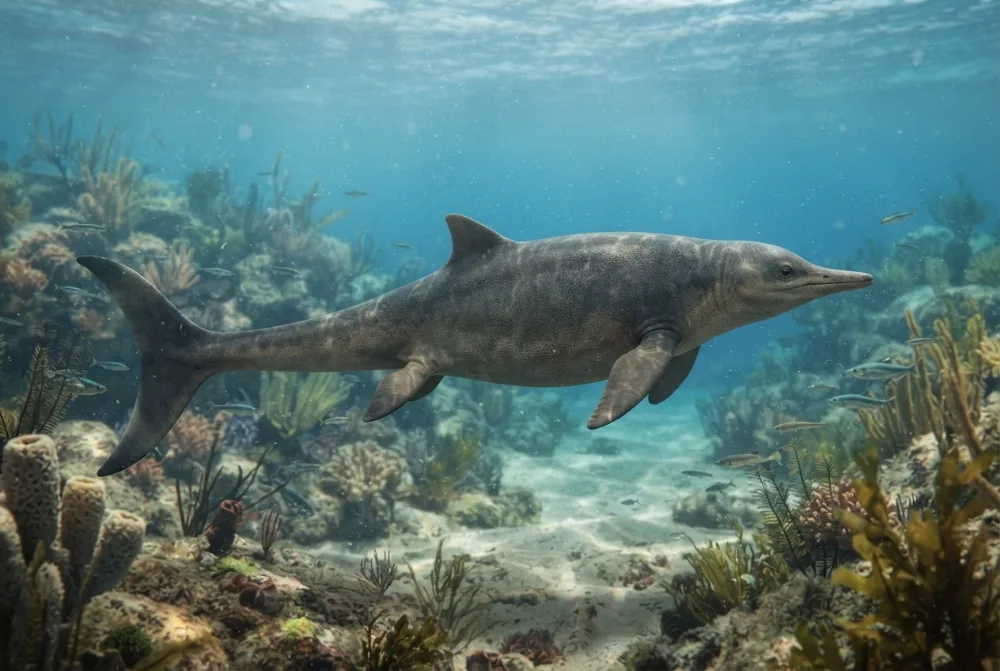
Sclerocormus was an early marine reptile that lived in the sea, not a dinosaur. It had a very tiny head and a long tail without a fluke, making it look different from later ichthyosaurs.1
Yabayeho ryari?
Yanganaga ite?
Yari ndende ite?
Yari iremereye ite?
 ndende nk'injangwe 3 zo mu rugo zikurikiranye🍌ndende nk'imineke 9 ikurikiranye🍌iremereye nk'imineke 120🏊yashoboraga koga uburebure bwa pisine nini (50 m) mu masegonda 6,2
Sclerocormus yanganaga ite ugereranyije NAWE?
Ni imibare gusa ibarirwa muri mushakisha yawe. Nta kintu kibikwa cyangwa cyoherezwa ahandi.
Yihutaga ite?


Utuntu dushimishije
Sclerocormus had an extremely small head that was only about 6.25% of its total body length, much smaller than other early marine reptiles like Chaohusaurus.1
Its tail was very long, making up about 58% of its total length, and it did not have a fluke like later ichthyosaurs.1
Sclerocormus had a heavily built body with flattened, overlapping belly ribs that formed a tight basket, similar to hupehsuchians.1
It lived during the Early Triassic period, about 248 to 247 million years ago, soon after the end-Permian mass extinction.41
Sclerocormus is one of the earliest known ichthyosauriforms, and its discovery shows that these marine reptiles evolved quickly within the first million years of their history.1
This reptile had large eyes with scleral plates, which are bony rings that help support the eye, like in many ichthyosaurs.1
Ibibazo bibazwa cyane kuri Sclerocormus
?How big was Sclerocormus?
Sclerocormus was about 1.6 metres (5.2 feet) long and weighed more than 15 kilograms (33 pounds).2
?What did Sclerocormus eat?
Sclerocormus was a suction feeder that used its narrow, toothless snout to suck in soft-bodied prey. Because its head and jaws were so small, it could only eat prey much smaller than itself.2
?Could Sclerocormus swim fast?
No, Sclerocormus was probably a slow swimmer. Its heavy build and body shape suggest it lived in shallow waters.2
?Is Sclerocormus a dinosaur?
No, Sclerocormus is not a dinosaur. It is an ichthyosauriform, a type of marine reptile that lived in the sea.2
Ku bazobereye muri dinozore
- Izina rya siyansi
- Sclerocormus
- Yiswe na
- Jiang et al. 20164
- Itsinda
- Iktiyozore
- Umuryango / ishami
- Omphalosauridae4
- Ishyirwa mu byiciro
- Ichthyosauromorpha4
- Imyaka y'amabuye
- imyaka miliyoni 249 kugeza 247 ()4
- Inzego z'amabuye
- Nanlinghu4
- Ibihugu
- Ubushinwa4
- Ibisigazwa byanditswe
- 1 muri The Paleobiology Database4
- Ivumburwa
- Sclerocormus was named by Jiang and colleagues in 2016 based on a single fossil skeleton found in the Nanlinghu Formation in Anhui, China.41
- Biracyagibwaho impaka
- Scientists are not sure exactly what Sclerocormus ate, because it had no teeth, but they think it may have been a suction feeder.1
Aho amakuru yakuwe
- A large aberrant stem ichthyosauriform indicating early rise and demise of ichthyosauromorphs in the wake of the end-Permian extinction | Scientific Reports (nature.com)
- Sclerocormus (en.wikipedia.org)
- A large aberrant stem ichthyosauriform indicating early rise and demise of ichthyosauromorphs in the wake of the end-Permian extinction | Scientific Reports (preview-www.nature.com)
- Sclerocormus in The Paleobiology Database (CC BY 4.0): imyaka, ahantu, inzego z'amabuye, ishyirwa mu byiciro.
Buri kintu kiri kuri uru rupapuro gifite nimero yerekana aho cyakuwe. Niba hari icyo twibeshye, tubabarire, turi abakunzi ba dinozore, ntituri ikinyamakuru cya siyansi. Tubwire kuri [email protected] tuzagikosora.
 Rex arashonje! Dino Wiki ni umushinga wa papa umwe yakoreye umuhungu we ukunda dinozore, ni ubuntu, nta matangazo kandi nta bigukurikirana. Abantu bakuru bashobora guha Rex akantu ko kurya kugira ngo Dino Wiki ikomeze kuboneka kuri interineti.Gaburira Rex
 Ichthyosaurus
 Platypterygius
 Stenopterygius
 Khudiakovia
 Ophthalmosaurus
 Chonespondylus
 Corosaurus