 Uri dinozore iyihe? Umukino w'ibibazo
 Intambara ya dinozore
 Isiganwa rya dinozore
 Imikino mito ya dinozore
 Alubumu ya sitikeri
 Intonde za TOP za dinozore
 Ntungura!
Yabayeho ryari?

Yanganaga ite?
Yari ndende ite?
Ubutumburuke bwayo bwanganaga iki?
Yari iremereye ite?
 ndende nk'imbwa 4 zikurikiranye🍌ndende nk'imineke 25 ikurikiranye🍉iremereye nk'imbuto 120 za watermelon🧸iremereye nk'abana 31 bo mu ishuri ry'incuke🎒iremereye nk'abanyeshuri 18🏃yashoboraga kwiruka metero 100 mu masegonda 9,2 (umuntu wihuta kurusha abandi akenera 9,6)
Tethyshadros yanganaga ite ugereranyije NAWE?
Ni imibare gusa ibarirwa muri mushakisha yawe. Nta kintu kibikwa cyangwa cyoherezwa ahandi.
Yihutaga ite?


Utuntu dushimishije
Tethyshadros lived on a large island in the ancient Tethys Ocean, which is why it was named after that sea.1
The first skeleton, nicknamed Antonio, was found in a vertical rockface and took years to dig out.1
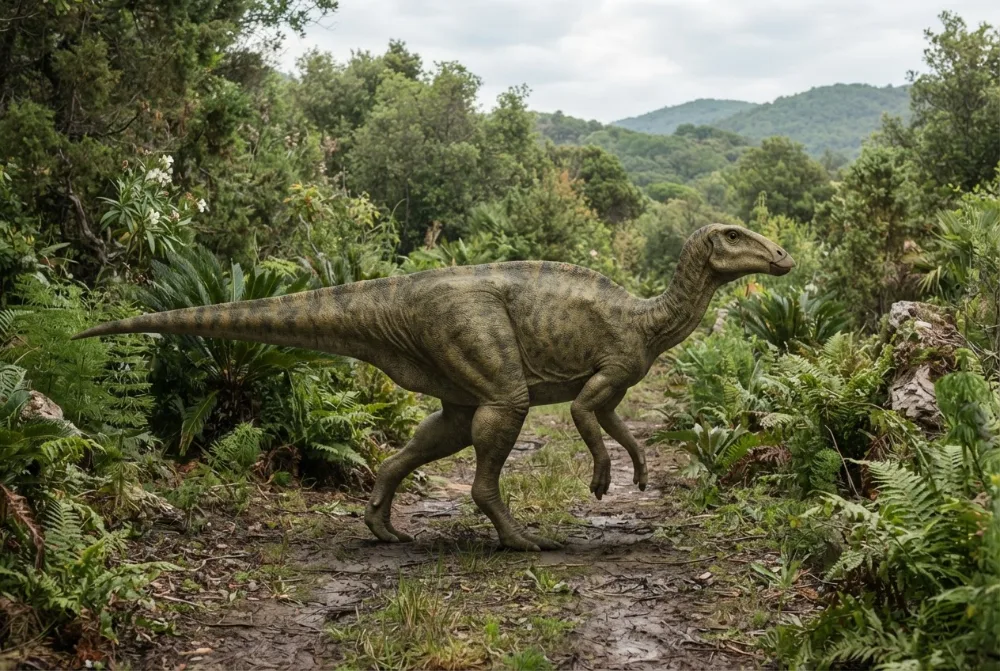
Tethyshadros had a mix of old-fashioned features, like a short neck and a skull like Iguanodon, and advanced features, like teeth arranged in batteries like true hadrosaurs.1
Scientists once thought Tethyshadros was a dwarf dinosaur, but later bone studies showed the main skeleton was from a teenager, not a full-grown adult.1
A second skeleton, nicknamed Bruno, is bigger and more complete, with a full skull and many bones.1
Tethyshadros is one of the latest surviving non-hadrosaurid hadrosauromorphs, meaning it lived just before true hadrosaurs became common.1
Ibibazo bibazwa cyane kuri Tethyshadros
?How big was Tethyshadros?
About 4.5 metres (15 feet) long, though some scientists think that estimate might be too high. The adult skeleton Bruno was 15 to 20% larger than the subadult Antonio.1
?What did Tethyshadros eat?
It was a plant-eater. Its beak and teeth were adapted for eating plants, and it may have used its strange serrated beak to bite specific food items.13
?Why did Tethyshadros have a strange beak?
Nobody knows for sure. It might have helped it bite certain plants, or been used for grooming or display.3
?Was Tethyshadros a dwarf dinosaur?
It was originally thought to be a dwarf, but later bone studies showed the main skeleton (Antonio) was a teenager, not a full-grown adult. The adult Bruno was larger.1
?When did Tethyshadros live?
It lived during the Late Cretaceous, about 81.5 to 80.5 million years ago.1
?Where was Tethyshadros found?
In an abandoned quarry at Villaggio del Pescatore, near Trieste, Italy. It lived on a large island in the ancient Tethys Ocean.1
Gusenya ibinyoma
Ibivugwa: Tethyshadros was a dwarf dinosaur.
Ukuri: The first skeleton was a subadult, not a full-grown adult, so it was not a dwarf species.1
Ku bazobereye muri dinozore
- Izina rya siyansi
- Tethyshadros
- Yiswe na
- Dalla Vecchia 20094
- Itsinda
- Izirya ibimera zifite umunwa w'inyoni
- Umuryango / ishami
- Telmatosauridae4
- Ishyirwa mu byiciro
- Ornithischia > Ornithopoda > Iguanodontia4
- Imyaka y'amabuye
- imyaka miliyoni 84 kugeza 72 (Campanian)4
- Inzego z'amabuye
- Aurisina4
- Ibihugu
- Ubutaliyani4
- Ibisigazwa byanditswe
- 1 muri The Paleobiology Database4
- Ivumburwa
- Fossil fragments were found in the 1980s by Alceo Tarlao and Giorgio Rimoli. A nearly complete skeleton was discovered in 1994 and excavated by 1999. The dinosaur was named Tethyshadros insularis by Fabio Dalla Vecchia in 2009.1
- Biracyagibwaho impaka
- Scientists still debate the exact total length of Tethyshadros, because the tail of the first skeleton was missing and its length had to be estimated.1
Aho amakuru yakuwe
- Tethyshadros (en.wikipedia.org)
- Friuli-Venezia Giulia - Fossili Regionali (fossiliregionali.it)
- The “Duck-billed” Dinosaur That Wasn’t (smithsonianmag.com)
- Tethyshadros in The Paleobiology Database (CC BY 4.0): imyaka, ahantu, inzego z'amabuye, ishyirwa mu byiciro.
Buri kintu kiri kuri uru rupapuro gifite nimero yerekana aho cyakuwe. Niba hari icyo twibeshye, tubabarire, turi abakunzi ba dinozore, ntituri ikinyamakuru cya siyansi. Tubwire kuri [email protected] tuzagikosora.
 Rex arashonje! Dino Wiki ni umushinga wa papa umwe yakoreye umuhungu we ukunda dinozore, ni ubuntu, nta matangazo kandi nta bigukurikirana. Abantu bakuru bashobora guha Rex akantu ko kurya kugira ngo Dino Wiki ikomeze kuboneka kuri interineti.Gaburira Rex
 Iguanodon
 Tenontosaurus
 Thescelosaurus
 Zalmoxes
 Camptosaurus
 Rhabdodon
 Tyrannosaurus
 Triceratops
 Velociraptor
 Spinosaurus
 Ankylosaurus
 Parasaurolophus