 Uri dinozore iyihe? Umukino w'ibibazo
 Intambara ya dinozore
 Isiganwa rya dinozore
 Imikino mito ya dinozore
 Alubumu ya sitikeri
 Intonde za TOP za dinozore
 Ntungura!
Yabayeho ryari?

Yanganaga ite?
Yari ndende ite?
Ubutumburuke bwayo bwanganaga iki?
igereranya
Yari iremereye ite?
 ndende nk'imbwa 4 zikurikiranye🍌ndende nk'imineke 19 ikurikiranye🍉iremereye nk'imbuto 30 za watermelon🧸iremereye nk'abana 8 bo mu ishuri ry'incuke🎒iremereye nk'abanyeshuri 5🏃yashoboraga kwiruka metero 100 mu masegonda 8 (umuntu wihuta kurusha abandi akenera 9,6)
Tietasaura yanganaga ite ugereranyije NAWE?
Ni imibare gusa ibarirwa muri mushakisha yawe. Nta kintu kibikwa cyangwa cyoherezwa ahandi.
Yihutaga ite?


Utuntu dushimishije
Tietasaura is known from just one fossil: the lower end of a left thigh bone (femur).1
The fossil was discovered in 1906 during expeditions by London's Natural History Museum to South America.1
For many years, scientists thought the bone belonged to a crocodile-like reptile called Hyposaurus or Sarcosuchus.1
Tietasaura lived between about 137 and 126 million years ago, during the Valanginian to Hauterivian ages of the Early Cretaceous.4
It was named in 2024, making it a very recently discovered dinosaur.1
The name Tietasaura comes from 'Tieta', the main character of a Brazilian novel, and 'saura', meaning lizard.1
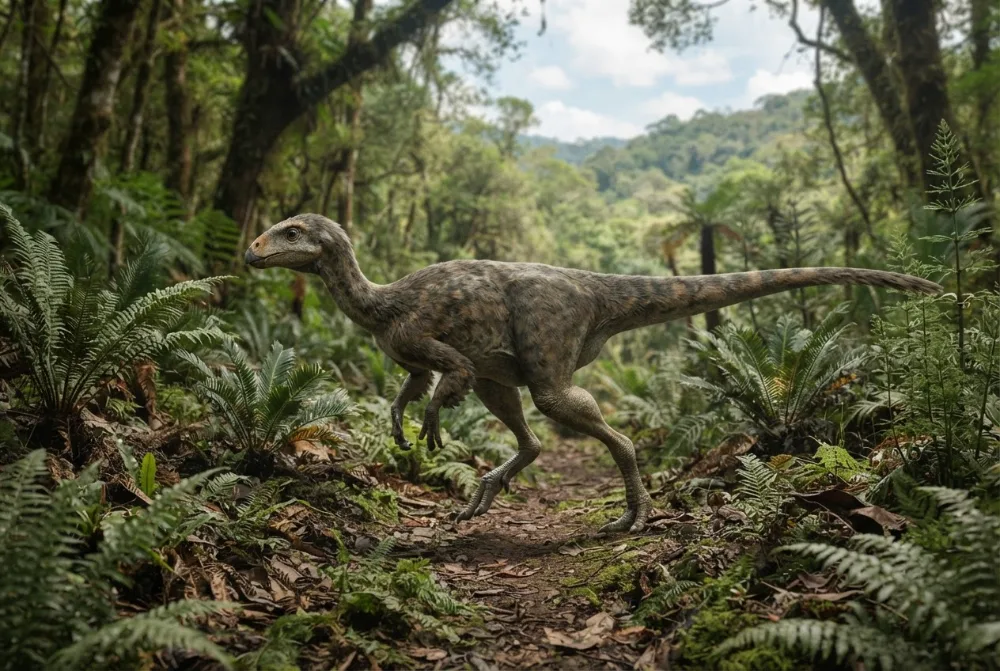
Ibibazo bibazwa cyane kuri Tietasaura
?How big was Tietasaura?
About 2 metres (6.6 feet) long. It was a small dinosaur, about the size of a bicycle.2
?What did Tietasaura eat?
Plants. It was an herbivore, meaning it ate leaves and other vegetation.4
?When was Tietasaura discovered?
The fossil was found in 2019, but it was not named as a new dinosaur until 2024.1
Ku bazobereye muri dinozore
- Izina rya siyansi
- Tietasaura
- Yiswe na
- Bandeira et al. 20244
- Itsinda
- Izirya ibimera zifite umunwa w'inyoni
- Umuryango / ishami
- Elasmaria4
- Ishyirwa mu byiciro
- Ornithischia > Ornithopoda > Iguanodontia4
- Imyaka y'amabuye
- imyaka miliyoni 137 kugeza 126 (Valanginian / Hauterivian)4
- Inzego z'amabuye
- Marfim4
- Ibihugu
- Burezili4
- Ibisigazwa byanditswe
- 1 muri The Paleobiology Database4
- Ivumburwa
- The only known fossil of Tietasaura was found in 1906 near Salvador, Bahia, Brazil, but it was misidentified as a crocodile for over a century. It was finally named and described as a new dinosaur by Bandeira and colleagues in 2024.1
- Biracyagibwaho impaka
- Scientists are not sure exactly how big Tietasaura was, because only a piece of its thigh bone has been found.1
Aho amakuru yakuwe
- Tietasaura (en.wikipedia.org)
- ‘Tietasaura’: pesquisadoras da Uerj identificam nova espécie de dinossauro encontrada no Recôncavo Baiano - UERJ - Universidade do Estado do Rio de Janeiro (uerj.br)
- Tietasaura derbyiana | Dinosaur Database by DinoAnimals.com (dinoanimals.com)
- Tietasaura in The Paleobiology Database (CC BY 4.0): imyaka, ahantu, inzego z'amabuye, ishyirwa mu byiciro.
Buri kintu kiri kuri uru rupapuro gifite nimero yerekana aho cyakuwe. Niba hari icyo twibeshye, tubabarire, turi abakunzi ba dinozore, ntituri ikinyamakuru cya siyansi. Tubwire kuri [email protected] tuzagikosora.
 Rex arashonje! Dino Wiki ni umushinga wa papa umwe yakoreye umuhungu we ukunda dinozore, ni ubuntu, nta matangazo kandi nta bigukurikirana. Abantu bakuru bashobora guha Rex akantu ko kurya kugira ngo Dino Wiki ikomeze kuboneka kuri interineti.Gaburira Rex
 Iguanodon
 Tenontosaurus
 Thescelosaurus
 Zalmoxes
 Camptosaurus
 Rhabdodon
 Stegosaurus
 Archaeopteryx
 Giganotosaurus
 Microraptor
 Deinonychus
 Baryonyx