 Uri dinozore iyihe? Umukino w'ibibazo
 Intambara ya dinozore
 Isiganwa rya dinozore
 Imikino mito ya dinozore
 Alubumu ya sitikeri
 Intonde za TOP za dinozore
 Ntungura!
Yabayeho ryari?

Yanganaga ite?
Yari ndende ite?
Ubutumburuke bwayo bwanganaga iki?
igereranya
 ndende nk'injangwe 4 zo mu rugo zikurikiranye🍌ndende nk'imineke 11 ikurikiranye🏃yashoboraga kwiruka metero 100 mu masegonda 8,8 (umuntu wihuta kurusha abandi akenera 9,6)
Weewarrasaurus yanganaga ite ugereranyije NAWE?
Ni imibare gusa ibarirwa muri mushakisha yawe. Nta kintu kibikwa cyangwa cyoherezwa ahandi.
Yihutaga ite?


Utuntu dushimishije
Weewarrasaurus is known from a jawbone preserved in precious opal, giving it a colorful, gem-like appearance.1
It lived about 100 to 94 million years ago during the Cretaceous Period.4
The name Weewarrasaurus comes from the Wee Warra locality where its fossil was found.1
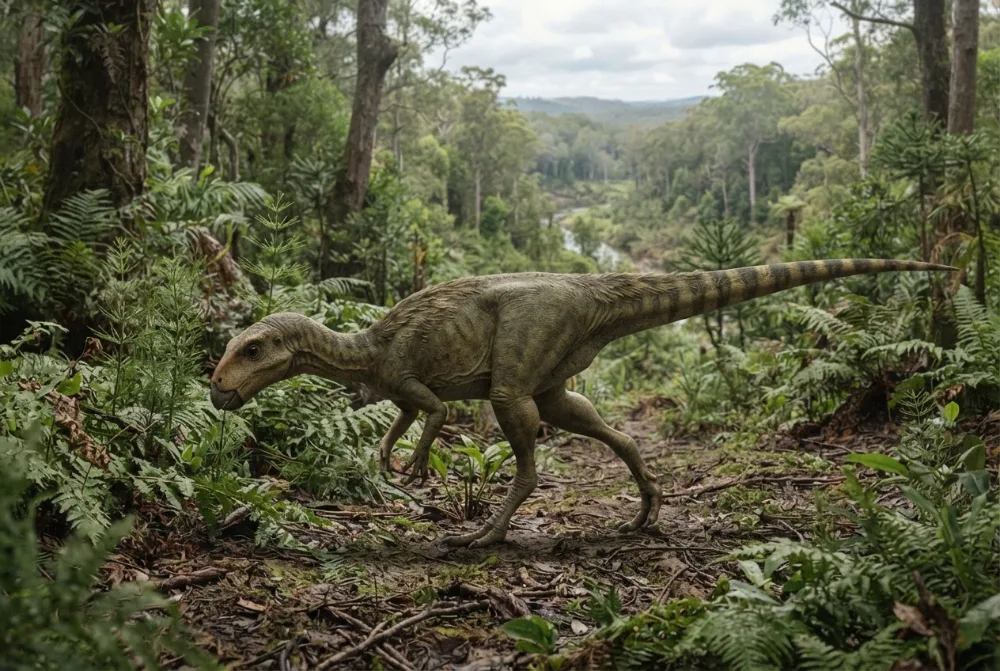
This dinosaur was a small ornithopod, about the size of a large dog.1
Weewarrasaurus shared its home with other ornithopods of different sizes, including a larger iguanodontian.1
Ibibazo bibazwa cyane kuri Weewarrasaurus
?How big was Weewarrasaurus?
About the size of a Labrador retriever, or a large dog. It walked on its hind legs.3
?What did Weewarrasaurus eat?
It was a plant-eater. It had a beak and teeth for nibbling vegetation like ferns.3
?Why is Weewarrasaurus preserved in opal?
The fossil was preserved in opal because silica-rich solutions underground turned into the gemstone over millions of years. This happened in the Lightning Ridge area of Australia.3
Ku bazobereye muri dinozore
- Izina rya siyansi
- Weewarrasaurus
- Yiswe na
- Bell et al. 20184
- Itsinda
- Izirya ibimera zifite umunwa w'inyoni
- Umuryango / ishami
- Elasmaria4
- Ishyirwa mu byiciro
- Ornithischia > Ornithopoda > Iguanodontia4
- Imyaka y'amabuye
- imyaka miliyoni 100 kugeza 94 (Cenomanian)4
- Inzego z'amabuye
- Griman Creek4
- Ibihugu
- Ositaraliya4
- Ibisigazwa byanditswe
- 2 muri The Paleobiology Database4
- Ivumburwa
- Weewarrasaurus was named in 2018 by Phil Bell and colleagues based on a jawbone found by opal miner Mike Poben near Lightning Ridge, Australia.12
- Biracyagibwaho impaka
- Scientists are not sure exactly how big Weewarrasaurus grew, because only jawbones have been found so far.1
Aho amakuru yakuwe
- Ornithopod diversity in the Griman Creek Formation (Cenomanian), New South Wales, Australia (pmc.ncbi.nlm.nih.gov)
- Weewarrasaurus (en.wikipedia.org)
- Exclusive: Sparkly, opal-filled fossils reveal new dinosaur species | National Geographic (nationalgeographic.com)
- Weewarrasaurus in The Paleobiology Database (CC BY 4.0): imyaka, ahantu, inzego z'amabuye, ishyirwa mu byiciro.
Buri kintu kiri kuri uru rupapuro gifite nimero yerekana aho cyakuwe. Niba hari icyo twibeshye, tubabarire, turi abakunzi ba dinozore, ntituri ikinyamakuru cya siyansi. Tubwire kuri [email protected] tuzagikosora.
 Rex arashonje! Dino Wiki ni umushinga wa papa umwe yakoreye umuhungu we ukunda dinozore, ni ubuntu, nta matangazo kandi nta bigukurikirana. Abantu bakuru bashobora guha Rex akantu ko kurya kugira ngo Dino Wiki ikomeze kuboneka kuri interineti.Gaburira Rex
 Iguanodon
 Tenontosaurus
 Thescelosaurus
 Zalmoxes
 Camptosaurus
 Rhabdodon
 Tyrannosaurus
 Triceratops
 Velociraptor
 Spinosaurus
 Ankylosaurus
 Parasaurolophus