 Uri dinozore iyihe? Umukino w'ibibazo
 Intambara ya dinozore
 Isiganwa rya dinozore
 Imikino mito ya dinozore
 Alubumu ya sitikeri
 Intonde za TOP za dinozore
 Ntungura!
Zhejiangopterus
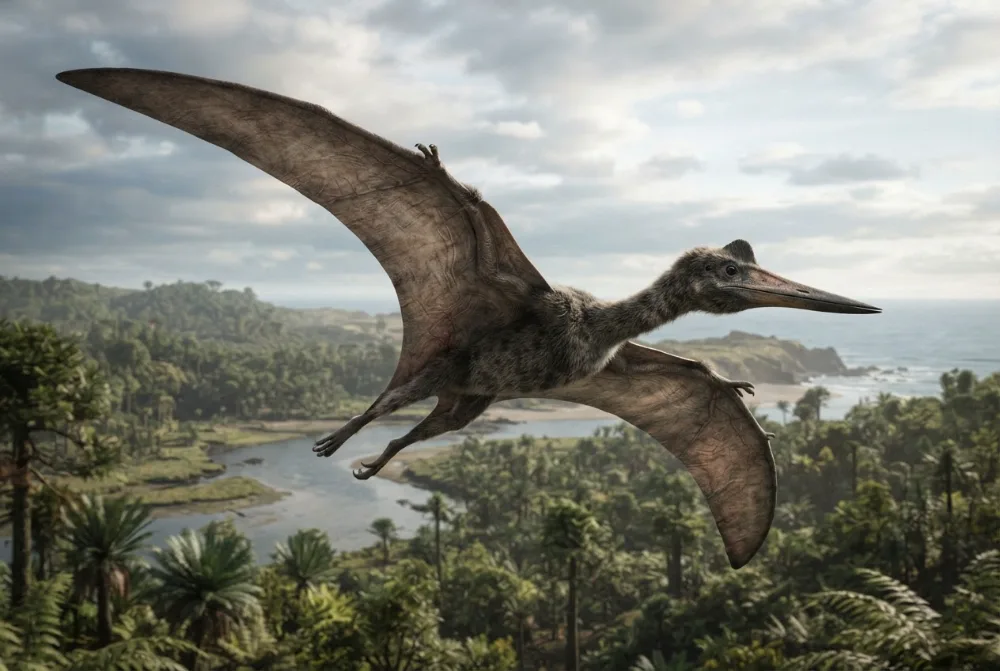
Zhejiangopterus was a huge flying reptile that lived in ancient China. It had a long, toothless beak like a modern bird and a wingspan wider than a car is long. It soared over the Late Cretaceous skies hunting for fish.31
Yabayeho ryari?
Yanganaga ite?
Amababa yayo yari arambuye angana iki?
Yari iremereye ite?
 amababa agari nk'amagare 3 akurikiranye
 iremereye nk'injangwe yo mu rugo🍌iremereye nk'imineke 66⚽yashoboraga kuguruka ikambuka ikibuga cyose cy'umupira w'amaguru mu masegonda 5,5
Zhejiangopterus yanganaga ite ugereranyije NAWE?
Ni imibare gusa ibarirwa muri mushakisha yawe. Nta kintu kibikwa cyangwa cyoherezwa ahandi.
Yihutaga ite?


Utuntu dushimishije
Zhejiangopterus had no teeth at all. Its beak was long, thin and pointed, perfect for grabbing fish.1
Its skull was long and low, with a single large oval opening that took up nearly half the length of the head.1
The wing finger metacarpal bone was longer than the combined radius and ulna bones in the arm.1
Its thigh bone was about one and a half times longer than its upper arm bone.1
Zhejiangopterus lived around 81.5 million years ago, during the Late Cretaceous period.1
It was discovered by a local villager named Chengfa Xu in 1986 while he was splitting rocks in a quarry.1
Ibibazo bibazwa cyane kuri Zhejiangopterus
?How big was Zhejiangopterus?
Its wingspan was first estimated at 5 meters (16.4 feet), but later estimates reduced it to about 3.5 meters (11.5 feet). Its body mass was around 7.9 kilograms (roughly 17 pounds).2
?Did Zhejiangopterus have teeth?
No, it had no teeth at all. Its beak was long, thin, and sharply pointed.2
?What did Zhejiangopterus eat?
It likely ate fish, grabbing them with its long, toothless beak.2
?When did Zhejiangopterus live?
It lived about 81.5 million years ago, during the Late Cretaceous Period.2
?Where was Zhejiangopterus found?
It was discovered in Zhejiang Province, China, near the city of Linhai.2
?Is Zhejiangopterus a dinosaur?
No, it is a pterosaur, a flying reptile that is not a dinosaur.2
Ku bazobereye muri dinozore
- Izina rya siyansi
- Zhejiangopterus
- Yiswe na
- Cai and Wei 19943
- Itsinda
- Ibikururanda biguruka
- Umuryango / ishami
- Azhdarchidae3
- Ishyirwa mu byiciro
- Pterosauria > Pterodactyloidea > Azhdarchidae3
- Imyaka y'amabuye
- imyaka miliyoni 84 kugeza 72 (Campanian)3
- Inzego z'amabuye
- Tangshang3
- Ibihugu
- Ubushinwa3
- Ibisigazwa byanditswe
- 1 muri The Paleobiology Database3
- Ivumburwa
- Zhejiangopterus was named in 1994 by Chinese paleontologists Cai Zhengquan and Wei Feng. The first fossils were found in 1986 by a villager named Chengfa Xu in a quarry near Linhai, Zhejiang, China.31
- Biracyagibwaho impaka
- Scientists are not sure whether Zhejiangopterus belongs to the family Nyctosauridae or Azhdarchidae. Different studies place it in different groups.31
Aho amakuru yakuwe
- Zhejiangopterus linhaiensis (Pterosauria) from the Upper Cretaceous of Linhai, Zhejiang, China (naturalhistory.si.edu)
- Zhejiangopterus (en.wikipedia.org)
- Zhejiangopterus in The Paleobiology Database (CC BY 4.0): imyaka, ahantu, inzego z'amabuye, ishyirwa mu byiciro.
Buri kintu kiri kuri uru rupapuro gifite nimero yerekana aho cyakuwe. Niba hari icyo twibeshye, tubabarire, turi abakunzi ba dinozore, ntituri ikinyamakuru cya siyansi. Tubwire kuri [email protected] tuzagikosora.
 Rex arashonje! Dino Wiki ni umushinga wa papa umwe yakoreye umuhungu we ukunda dinozore, ni ubuntu, nta matangazo kandi nta bigukurikirana. Abantu bakuru bashobora guha Rex akantu ko kurya kugira ngo Dino Wiki ikomeze kuboneka kuri interineti.Gaburira Rex
 Pteranodon
 Quetzalcoatlus
 Dorygnathus
 Rhamphorhynchus
 Anhanguera
 Pterodactylus
 Tyrannosaurus
 Triceratops
 Velociraptor
 Spinosaurus
 Ankylosaurus
 Parasaurolophus