 Uri dinozore iyihe? Umukino w'ibibazo
 Intambara ya dinozore
 Isiganwa rya dinozore
 Imikino mito ya dinozore
 Alubumu ya sitikeri
 Intonde za TOP za dinozore
 Ntungura!
Zhongjianornis
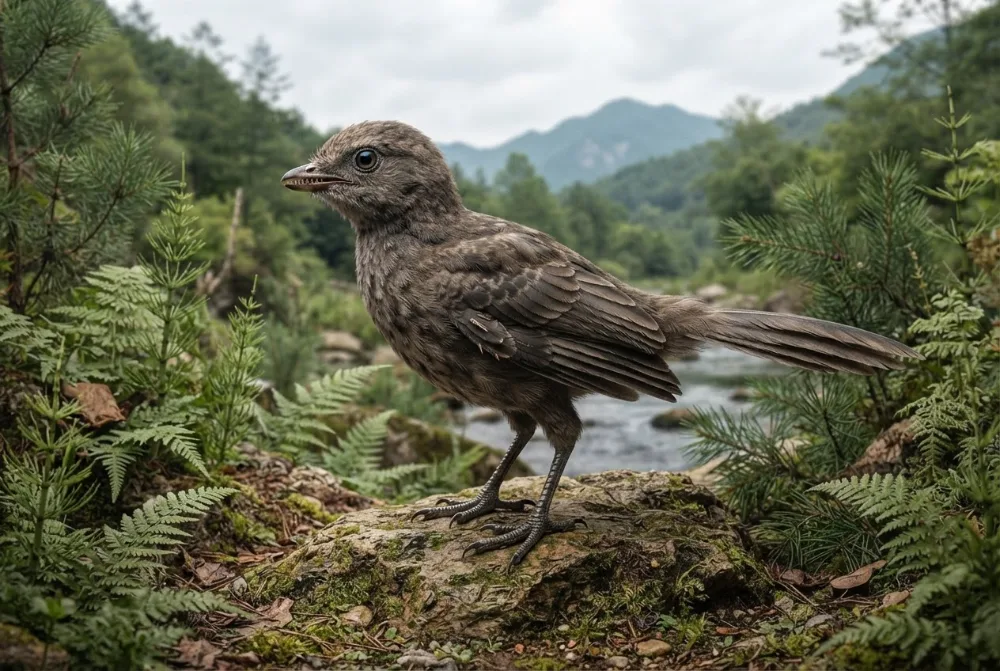
Zhongjianornis was a pigeon-sized bird that lived in China during the Early Cretaceous, about 120 million years ago. It had a toothless beak and strong wing muscles, making it a good flier. This little bird helps scientists understand how early birds evolved and lost their teeth.12
Yabayeho ryari?
Yanganaga ite?
Yari ndende ite?
Ubutumburuke bwayo bwanganaga iki?
igereranya
Yari iremereye ite?
Zhongjianornis yanganaga ite ugereranyije NAWE?
Ni imibare gusa ibarirwa muri mushakisha yawe. Nta kintu kibikwa cyangwa cyoherezwa ahandi.
Yihutaga ite?


Utuntu dushimishije
Zhongjianornis is one of the most primitive birds known to have completely lost its teeth, developing a beak instead.2
Its humerus had a large, robust deltopectoral crest, which was as wide as the bone shaft and more than one-third the total length of the humerus, indicating strong flight muscles.3
The only known fossil of Zhongjianornis is a nearly complete skeleton with some poorly preserved feather imprints.3
Zhongjianornis lived during the Aptian age of the Early Cretaceous, about 121 to 113 million years ago.3
Scientists initially thought Zhongjianornis was very primitive, but later research in 2012 suggested it was more similar to advanced euornithean birds like Chaoyangia.1
The species name yangi honors Yang Zhongjian, the founder of the Institute of Vertebrate Paleontology and Paleoanthropology in Beijing.1
Ibibazo bibazwa cyane kuri Zhongjianornis
?How big was Zhongjianornis?
About the size of a pigeon. It was a small bird.1
?Did Zhongjianornis have teeth?
No, it had a toothless beak. It is one of the most primitive birds known to have completely lost its teeth.12
?What did Zhongjianornis eat?
Scientists are not sure, but its toothless beak suggests it may have eaten seeds or small insects.1
Gusenya ibinyoma
Ibivugwa: Zhongjianornis was the most primitive toothless bird.
Ukuri: While initially thought to be very primitive, later analysis in 2012 showed that Zhongjianornis is more closely related to advanced euornithean birds, not the most primitive.1
Ku bazobereye muri dinozore
- Izina rya siyansi
- Zhongjianornis
- Yiswe na
- Zhou et al. 20104
- Itsinda
- Inyoni za mbere
- Umuryango / ishami
- Ornithuromorpha4
- Ishyirwa mu byiciro
- Theropoda > Avialae4
- Imyaka y'amabuye
- imyaka miliyoni 121 kugeza 113 (Aptian)4
- Inzego z'amabuye
- Jiufotang4
- Ibihugu
- Ubushinwa4
- Ibisigazwa byanditswe
- 1 muri The Paleobiology Database4
- Ivumburwa
- Zhongjianornis was named and described by Zhou, Zhang, and Li in a paper published in January 2010 (though it appeared online in 2009). The only fossil, a nearly complete skeleton, was found at Jianchang in Liaoning Province, China.12
- Biracyagibwaho impaka
- Scientists still debate whether Zhongjianornis was a very primitive bird or a more advanced euornithean, due to conflicting interpretations of its fossil's anatomy.1
Aho amakuru yakuwe
- Zhongjianornis (en.wikipedia.org)
- A new Lower Cretaceous bird from China and tooth reduction in early avian evolution (royalsocietypublishing.org)
- PBDB Taxon (paleobiodb.org)
- Zhongjianornis in The Paleobiology Database (CC BY 4.0): imyaka, ahantu, inzego z'amabuye, ishyirwa mu byiciro.
Buri kintu kiri kuri uru rupapuro gifite nimero yerekana aho cyakuwe. Niba hari icyo twibeshye, tubabarire, turi abakunzi ba dinozore, ntituri ikinyamakuru cya siyansi. Tubwire kuri [email protected] tuzagikosora.
 Rex arashonje! Dino Wiki ni umushinga wa papa umwe yakoreye umuhungu we ukunda dinozore, ni ubuntu, nta matangazo kandi nta bigukurikirana. Abantu bakuru bashobora guha Rex akantu ko kurya kugira ngo Dino Wiki ikomeze kuboneka kuri interineti.Gaburira Rex
 Archaeopteryx
 Hesperornis
 Ichthyornis
 Baptornis
 Jurapteryx
 Gobipteryx
 Stegosaurus
 Iguanodon
 Giganotosaurus
 Microraptor
 Deinonychus
 Baryonyx