 Uri dhino ripi? Kwizi
 Hondo yemadhino
 Mujaho wemadhino
 Mitambo midiki yemadhino
 Arubhamu yemasitika
 Rondedzero dzeTOP dzemadhino
 Ndishamise!
Baryonyx
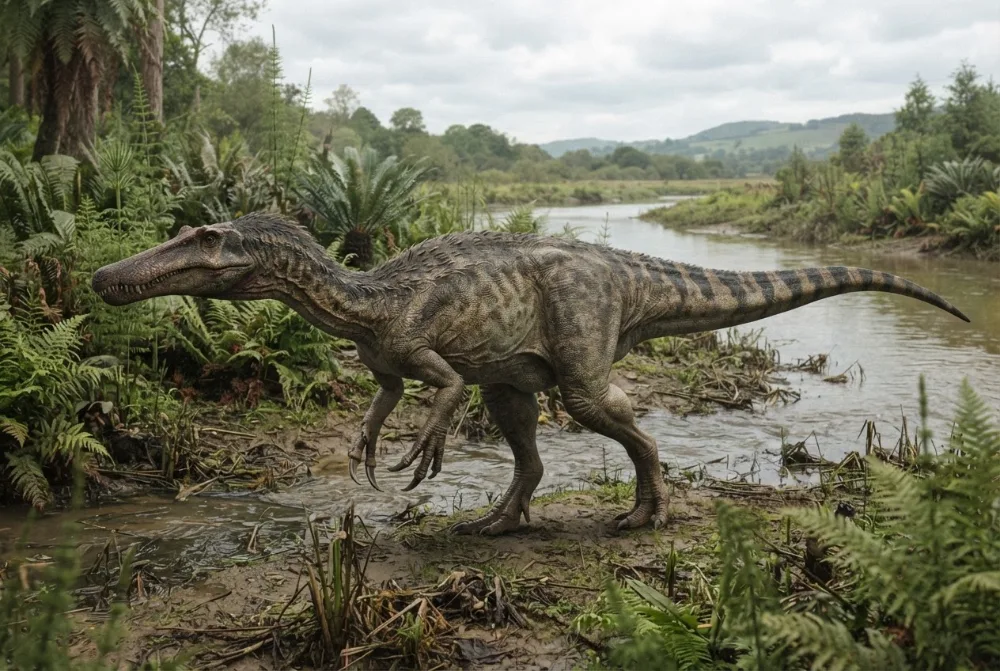
Baryonyx was a big, fish-eating dinosaur with a long snout like a crocodile and a huge claw on each hand. It lived about 130 to 125 million years ago in what is now England and other parts of Europe. It was one of the first dinosaurs shown to eat fish!1
Rairarama rini?
Raiva hombe sei?
Raiva refu zvakadii?
Raiva rakakwirira zvakadii?
Rairema zvakadii?
 kureba semotokari 2 dzakamiswa dzakatevedzana🍌kureba semabhanana 56 akatevedzana
 kurema seimbwa 100🍉kurema semanwiwa 400🎒kurema semakirasi 2.5 akazara evana vechikoro🐻❄️kurema semabere echando 4🏃raigona kumhanya mamita 100 mumasekonzi 14 (munhu anomhanya kupfuura vose anoda 9.6)
Baryonyx raiva hombe sei kana richienzaniswa NEWE?
Masvomhu chete mubrowser yako. Hapana chinochengetwa kana kutumirwa kupi zvako.
Raimhanya zvakadii?


Zvinonakidza
Baryonyx had a huge claw on its first finger, about 30 centimeters (12 inches) long, which it may have used to catch fish.1
Its snout was long and narrow, like a crocodile's, with many small, serrated teeth, perfect for gripping slippery fish.1
The first Baryonyx skeleton was found in 1983 in a clay pit in Surrey, England, by an amateur fossil collector named William Walker.1
Baryonyx was the first theropod dinosaur proven to eat fish, because fish scales were found in its stomach area.1
It lived in a warm, swampy environment with rivers and lakes, alongside other dinosaurs like Iguanodon and small sauropods.1
Some scientists think Baryonyx may have waded in water like a heron, using its long snout to snap up fish.1
Baryonyx also had a notch in its upper jaw, similar to a gharial, which helped it hold onto wriggling prey.1
Mibvunzo inonyanya kubvunzwa nezve Baryonyx
?How big was Baryonyx?
About 7.5 to 10 metres (25 to 33 feet) long and weighed 1.2 to 2 metric tons (1.3 to 2.2 short tons).12
?What did Baryonyx eat?
It mainly ate fish, but also scavenged and ate young Iguanodon. Fish scales and bones were found in its stomach.12
?Did Baryonyx have feathers?
Nobody knows for sure. No feathers have been found with Baryonyx fossils, but some related dinosaurs may have had simple feathers.1
?Could Baryonyx swim?
It may have waded in shallow water and was probably a good swimmer, like a crocodile. It lived in a swampy environment.12
?Was Baryonyx bigger than T. rex?
No, Baryonyx was smaller. T. rex was about 12 metres (40 feet) long and weighed over 8 metric tons, while Baryonyx was up to 10 metres (33 feet) and 2 metric tons.1
?Why did Baryonyx have a big claw?
It used its 31-centimetre (12-inch) claw to catch fish and tear apart prey. The claw was on its thumb.12
?When did Baryonyx live?
It lived during the Early Cretaceous period, about 130 to 125 million years ago.12
?Where was Baryonyx found?
The first skeleton was found in 1983 in a clay pit in Surrey, England. Fossils have also been found in Spain.12
?Is Baryonyx a dinosaur?
Yes, Baryonyx is a theropod dinosaur. It is not a marine reptile or pterosaur.12
?How fast could Baryonyx run?
Scientists do not know its exact speed, but as a large theropod it probably ran at a moderate pace, maybe 25 to 40 km/h (15 to 25 mph).1
Mubvisi wengano
Ngano: Baryonyx was a slow, clumsy dinosaur that only ate fish.
Chokwadi: While it ate fish, Baryonyx was also an active predator and scavenger, and it could probably move well on land.1
Zvevanyanzvi vemadhino
- Zita resainzi
- Baryonyx
- Akaripa zita:
- Charig and Milner 19863
- Boka
- Maspinosauro
- Mhuri / boka
- Spinosauridae3
- Kurongwa kwemhuka
- Theropoda > Spinosauridae3
- Zera rematombo
- makore mamiriyoni 139 kusvika 110 (Berriasian / Albian)3
- Mapoka ematombo
- Pinilla de los Moros, Weald Clay, Wessex3
- Nyika
- Spain, United Kingdom, Portugal, Tunisia3
- Zvinyorwa zvemafosiri
- 12 mu The Paleobiology Database3
- Kuwanikwa
- The first Baryonyx skeleton was discovered in 1983 by amateur fossil collector William J. Walker in a clay pit in Surrey, England. It was named by Alan J. Charig and Angela C. Milner in 1986.1
- Zvichiri kupokanwa
- Scientists still debate whether Baryonyx mainly hunted fish or also scavenged on land, and whether some fossils from other places really belong to this genus.1
Kunobva chokwadi
- Baryonyx (en.wikipedia.org)
- Baryonyx | Natural History Museum (nhm.ac.uk)
- Baryonyx in The Paleobiology Database (CC BY 4.0): zera, nzvimbo, mapoka ematombo, kurongwa kwemhuka.
Chokwadi chega chega papeji ino chine nhamba inoratidza kwachakabva. Kana takakanganisa chimwe chinhu, ruregerero, tiri vanoda madhino, kwete magazini yesainzi. Tiudze pa [email protected] tichazvigadzirisa.
 Rex ane nzara! Dino Wiki ipurojekiti yababa yemwanakomana wavo anoda madhino, mahara, pasina kushambadza uye pasina zvinokutevera. Vakuru vanogona kupa Rex chekudyadya kuti vabatsire kuchengeta saiti iri pamhepo.Fudza Rex
 Spinosaurus
 Suchomimus
 Angaturama
 Camarillasaurus
 Ceratosuchops
 Iberospinus
 Stegosaurus
 Iguanodon
 Archaeopteryx
 Giganotosaurus
 Microraptor
 Deinonychus