 Uri dhino ripi? Kwizi
 Hondo yemadhino
 Mujaho wemadhino
 Mitambo midiki yemadhino
 Arubhamu yemasitika
 Rondedzero dzeTOP dzemadhino
 Ndishamise!
Rairarama rini?

Raiva hombe sei?
Raiva refu zvakadii?
Raiva rakakwirira zvakadii?
Rairema zvakadii?
 kureba semotokari 2 dzakamiswa dzakatevedzana🍌kureba semabhanana 50 akatevedzana
 kurema seimbwa 100🍉kurema semanwiwa 400🎒kurema semakirasi 2.5 akazara evana vechikoro🐻❄️kurema semabere echando 4🏃raigona kumhanya mamita 100 mumasekonzi 13 (munhu anomhanya kupfuura vose anoda 9.6)
Ceratosuchops raiva hombe sei kana richienzaniswa NEWE?
Masvomhu chete mubrowser yako. Hapana chinochengetwa kana kutumirwa kupi zvako.
Raimhanya zvakadii?


Zvinonakidza
Ceratosuchops was named in 2021, making it a very recently discovered dinosaur.2
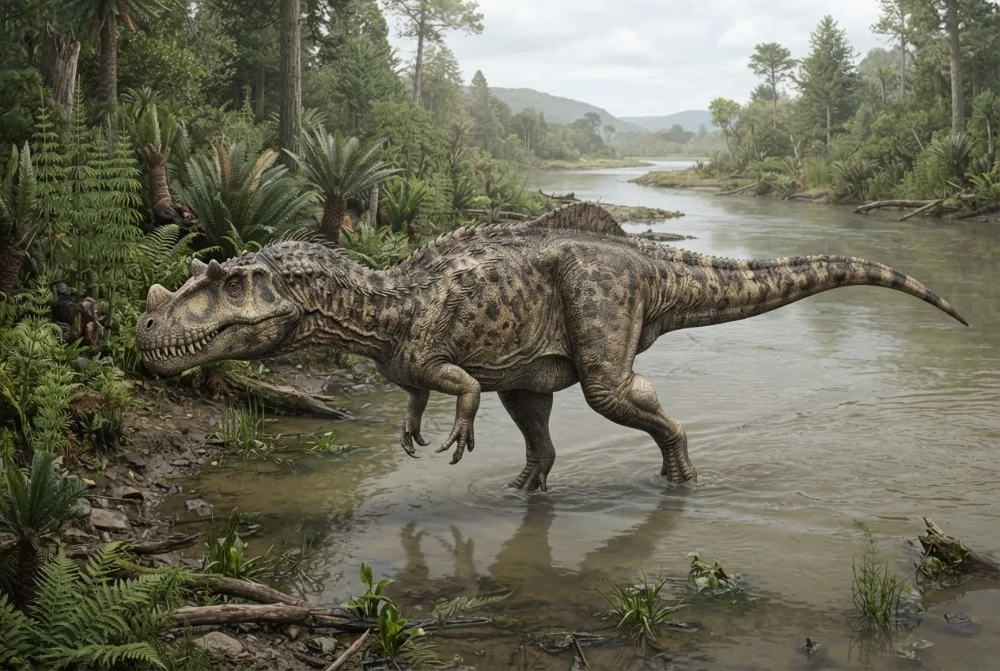
Its name means 'horned crocodile face' because of the bumpy horns above its eyes and its long, crocodile-like snout.1
It lived about 125 to 121 million years ago during the Early Cretaceous period.2
Ceratosuchops belonged to a group of spinosaurid dinosaurs that often had crocodile-like skulls and may have eaten fish.1
Its fossils were found on the Isle of Wight, a famous place for dinosaur discoveries in England.1
Scientists think Ceratosuchops lived near rivers and hunted like a modern heron, wading in shallow water to catch prey.1
Mibvunzo inonyanya kubvunzwa nezve Ceratosuchops
?How big was Ceratosuchops?
About 9 metres (30 feet) long, with a skull about 1 metre (3.3 feet) long.3
?What did Ceratosuchops eat?
It ate fish, small turtles, young crocodiles, baby dinosaurs, and mammals.4
?When was Ceratosuchops discovered?
It was named in 2021, based on fossils found between 2013 and 2017.4
?Why does Ceratosuchops have horns?
The bony bumps above its eyes might have been used for signalling to other animals or for fighting.4
?Is Ceratosuchops a dinosaur?
Yes, it is a theropod dinosaur in the spinosaurid group.4
Zvevanyanzvi vemadhino
- Zita resainzi
- Ceratosuchops
- Akaripa zita:
- Barker et al. 20216
- Boka
- Maspinosauro
- Mhuri / boka
- Spinosauridae6
- Kurongwa kwemhuka
- Theropoda > Spinosauridae6
- Zera rematombo
- makore mamiriyoni 126 kusvika 121 (Barremian)6
- Mapoka ematombo
- Wessex6
- Nyika
- United Kingdom6
- Zvinyorwa zvemafosiri
- 1 mu The Paleobiology Database6
- Kuwanikwa
- Ceratosuchops was named by Barker and colleagues in 2021 based on fossils found on the Isle of Wight, England, between 2013 and 2017.1
- Zvichiri kupokanwa
- Scientists are not sure exactly how big Ceratosuchops grew, because only a few skull bones have been found so far.2
Kunobva chokwadi
- New spinosaurids from the Wessex Formation (Early Cretaceous, UK) and the European origins of Spinosauridae (pmc.ncbi.nlm.nih.gov)
- PBDB Taxon (paleobiodb.org)
- Two New Species Of Large Predatory Dinosaur Discovered On Isle of Wight | University of Southampton (southampton.ac.uk)
- Ceratosuchops (en.wikipedia.org)
- New spinosaurids from the Wessex Formation (Early Cretaceous, UK) and the European origins of Spinosauridae | Scientific Reports (nature.com)
- Ceratosuchops in The Paleobiology Database (CC BY 4.0): zera, nzvimbo, mapoka ematombo, kurongwa kwemhuka.
Chokwadi chega chega papeji ino chine nhamba inoratidza kwachakabva. Kana takakanganisa chimwe chinhu, ruregerero, tiri vanoda madhino, kwete magazini yesainzi. Tiudze pa [email protected] tichazvigadzirisa.
 Rex ane nzara! Dino Wiki ipurojekiti yababa yemwanakomana wavo anoda madhino, mahara, pasina kushambadza uye pasina zvinokutevera. Vakuru vanogona kupa Rex chekudyadya kuti vabatsire kuchengeta saiti iri pamhepo.Fudza Rex
 Spinosaurus
 Baryonyx
 Suchomimus
 Angaturama
 Camarillasaurus
 Iberospinus
 Stegosaurus
 Iguanodon
 Archaeopteryx
 Giganotosaurus
 Microraptor
 Deinonychus