 Uri dhino ripi? Kwizi
 Hondo yemadhino
 Mujaho wemadhino
 Mitambo midiki yemadhino
 Arubhamu yemasitika
 Rondedzero dzeTOP dzemadhino
 Ndishamise!
Changzhousaurus
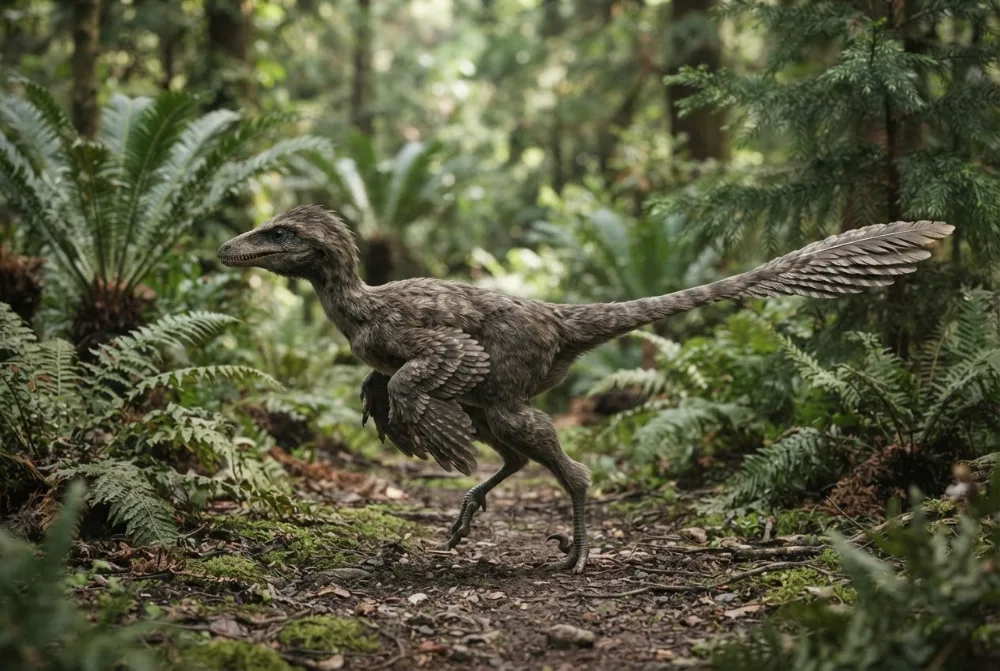
Changzhousaurus was a tiny, feathered dinosaur that lived about 120 million years ago in what is now China. It had big wings on its arms, smaller wings on its legs, and a fan of long tail feathers, kind of like a peacock. This little hunter is a close cousin of Velociraptor and Microraptor.12
Rairarama rini?
Raiva hombe sei?
Raiva refu zvakadii?
Raiva rakakwirira zvakadii?
fungidziro
Changzhousaurus raiva hombe sei kana richienzaniswa NEWE?
Masvomhu chete mubrowser yako. Hapana chinochengetwa kana kutumirwa kupi zvako.
Raimhanya zvakadii?


Zvinonakidza
Changzhousaurus is the only known early bird relative that had both large foot feathers and very long tail feathers at the same time.32
It had about 16 long tail feathers, which were about four times as long as its thigh bone, and they fanned out like a peacock's tail.32
Even though its arm bones were short, its wing feathers were the largest ever seen on a dinosaur that wasn't a bird, compared to its body size.3
The fossil is so well preserved that you can see clear imprints of feathers all around its skeleton.2
Mibvunzo inonyanya kubvunzwa nezve Changzhousaurus
?How big was Changzhousaurus?
It was very small, about 34 centimeters (13 inches) long from snout to tail tip. That is about the size of a crow.1
?Did Changzhousaurus have feathers?
Yes, it had feathers all over its body. It had large wing feathers on its arms, smaller wing feathers on its legs, and a fan of long tail feathers similar to a peacock.1
?What did Changzhousaurus eat?
It was a meat-eating theropod dinosaur. It had sharp, curved claws and teeth with serrations on some of them to help catch and eat small prey.1
?Could Changzhousaurus fly?
Scientists are not sure. It had large feathered wings, but its arm bones were short, so it may have glided or used its wings for other purposes like display.4
?When did Changzhousaurus live?
It lived about 120 million years ago during the Early Cretaceous period. Its fossils were found in the Jiufotang Formation in China.1
Mubvisi wengano
Ngano: Some people think Changzhousaurus could fly like a modern bird because of its big wings.
Chokwadi: Scientists think it was a four-winged dinosaur that likely glided or parachuted from trees, not a true flier. Its exact flying ability is still being studied.3
Zvevanyanzvi vemadhino
- Zita resainzi
- Changzhousaurus
- Akaripa zita:
- Xu 20265
- Boka
- Madhino anodya nyama
- Mhuri / boka
- Paraves5
- Kurongwa kwemhuka
- Theropoda5
- Zera rematombo
- makore mamiriyoni 121 kusvika 113 (Aptian)5
- Mapoka ematombo
- Jiufotang5
- Nyika
- China5
- Zvinyorwa zvemafosiri
- 1 mu The Paleobiology Database5
- Kuwanikwa
- The fossil was found in the Jiufotang Formation in Liaoning, China, and was named by Xu Xing in 2026. The name honors the city of Changzhou and China, where it was found.12
- Zvichiri kupokanwa
- Scientists are still debating exactly where Changzhousaurus fits in the dinosaur family tree, because it has features of several different groups like troodontids, dromaeosaurids, and early birds.1
Kunobva chokwadi
- Changzhousaurus (en.wikipedia.org)
- Chinese Scientists Discover New Feathered Dinosaur Species----Chinese Academy of Sciences (english.cas.cn)
- Advanced online publication (dinosaurier-info.de)
- Advanced online publication - Dinodata.de (dinodata.de)
- Changzhousaurus in The Paleobiology Database (CC BY 4.0): zera, nzvimbo, mapoka ematombo, kurongwa kwemhuka.
Chokwadi chega chega papeji ino chine nhamba inoratidza kwachakabva. Kana takakanganisa chimwe chinhu, ruregerero, tiri vanoda madhino, kwete magazini yesainzi. Tiudze pa [email protected] tichazvigadzirisa.
 Rex ane nzara! Dino Wiki ipurojekiti yababa yemwanakomana wavo anoda madhino, mahara, pasina kushambadza uye pasina zvinokutevera. Vakuru vanogona kupa Rex chekudyadya kuti vabatsire kuchengeta saiti iri pamhepo.Fudza Rex
 Allosaurus
 Carnotaurus
 Dilophosaurus
 Giganotosaurus
 Compsognathus
 Paronychodon
 Stegosaurus
 Iguanodon
 Archaeopteryx
 Microraptor
 Deinonychus
 Baryonyx