 Uri dhino ripi? Kwizi
 Hondo yemadhino
 Mujaho wemadhino
 Mitambo midiki yemadhino
 Arubhamu yemasitika
 Rondedzero dzeTOP dzemadhino
 Ndishamise!
Rairarama rini?

Raiva hombe sei?
Raiva refu zvakadii?
Raiva rakakwirira zvakadii?
Rairema zvakadii?

 kureba semotokari 6 dzakamiswa dzakatevedzana🍌kureba semabhanana 140 akatevedzana🍉kurema semanwiwa 9800🎒kurema semakirasi 61 akazara evana vechikoro🐻❄️kurema semabere echando 110🏢rakakwirira zvekudongorera muhwindo riri pafuroo nhamba 3🏃raigona kumhanya mamita 100 mumasekonzi 40 (munhu anomhanya kupfuura vose anoda 9.6)
Dreadnoughtus raiva hombe sei kana richienzaniswa NEWE?
Masvomhu chete mubrowser yako. Hapana chinochengetwa kana kutumirwa kupi zvako.
Raimhanya zvakadii?


Zvinonakidza
Dreadnoughtus is known from more complete skeletons than any other gigantic titanosaur, with about 70% of the bones behind the skull preserved.13
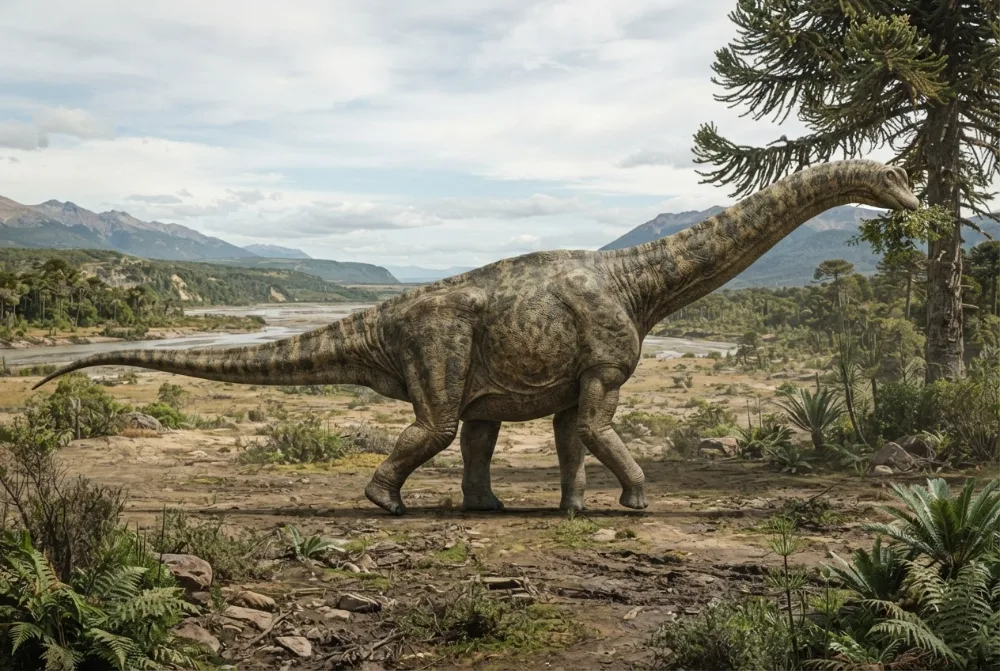
Its neck was super long, about 11.3 metres (37 feet), which is almost half of its total body length.1
The type specimen was still growing when it died, so adults might have been even bigger.1
Its bones were buried quickly in a flood, which is why they are so well preserved.1
Small theropod teeth found with the bones suggest scavengers, maybe megaraptorans, nibbled on the carcass.1
Dreadnoughtus lived about 76 to 70 million years ago, during the Late Cretaceous.1
Mibvunzo inonyanya kubvunzwa nezve Dreadnoughtus
?How big was Dreadnoughtus?
About 26 metres long and weighed around 48 to 49 metric tons, though some estimates range higher or lower.14
?What did Dreadnoughtus eat?
It was a plant-eater (herbivore). Its long neck helped it reach lots of different plants without moving much.51
?Was Dreadnoughtus bigger than T. rex?
Yes, Dreadnoughtus was much bigger. It was about 26 metres long and weighed up to 49 metric tons, while T. rex was about 12 metres long and weighed around 8 metric tons.15
?Did Dreadnoughtus have any predators?
Healthy adults were probably too big to be attacked, but small theropod teeth found with the bones suggest scavengers like megaraptorans nibbled on the carcass.15
?How fast could Dreadnoughtus run?
Nobody knows for sure, but because it was so huge and walked on four legs, it probably moved slowly, like a modern elephant.5
?Where was Dreadnoughtus found?
In Patagonia, Argentina, in the Cerro Fortaleza Formation of Santa Cruz Province.14
Mubvisi wengano
Ngano: Some people think Dreadnoughtus was the biggest dinosaur ever.
Chokwadi: It was one of the largest known from fairly complete remains, but other titanosaurs like Argentinosaurus might have been heavier, though they are known from much less complete fossils.1
Zvevanyanzvi vemadhino
- Zita resainzi
- Dreadnoughtus
- Akaripa zita:
- Lacovara et al. 20146
- Boka
- Madhino emitsipa mirefu
- Mhuri / boka
- Eutitanosauria6
- Kurongwa kwemhuka
- Sauropodomorpha > Sauropoda > Titanosauria > Macronaria6
- Zera rematombo
- makore mamiriyoni 84 kusvika 72 (Campanian)6
- Mapoka ematombo
- Cerro Fortaleza6
- Nyika
- Ajentina6
- Zvinyorwa zvemafosiri
- 2 mu The Paleobiology Database6
- Kuwanikwa
- Paleontologist Kenneth Lacovara discovered Dreadnoughtus in 2005 in the Cerro Fortaleza Formation in Argentina. It took four summers to dig out the huge bones, using mules and ropes to move them.1
- Zvichiri kupokanwa
- Scientists still debate exactly where Dreadnoughtus fits in the titanosaur family tree, because it has a mix of advanced and primitive features.1
Kunobva chokwadi
- Dreadnoughtus (en.wikipedia.org)
- PBDB Taxon (paleobiodb.org)
- A Gigantic, Exceptionally Complete Titanosaurian Sauropod Dinosaur from Southern Patagonia, Argentina (exa.ai)
- A Gigantic, Exceptionally Complete Titanosaurian Sauropod Dinosaur from Southern Patagonia, Argentina | Scientific Reports (nature.com)
- Dreadnoughtus (nhm.ac.uk)
- Dreadnoughtus in The Paleobiology Database (CC BY 4.0): zera, nzvimbo, mapoka ematombo, kurongwa kwemhuka.
Chokwadi chega chega papeji ino chine nhamba inoratidza kwachakabva. Kana takakanganisa chimwe chinhu, ruregerero, tiri vanoda madhino, kwete magazini yesainzi. Tiudze pa [email protected] tichazvigadzirisa.
 Rex ane nzara! Dino Wiki ipurojekiti yababa yemwanakomana wavo anoda madhino, mahara, pasina kushambadza uye pasina zvinokutevera. Vakuru vanogona kupa Rex chekudyadya kuti vabatsire kuchengeta saiti iri pamhepo.Fudza Rex
 Brachiosaurus
 Diplodocus
 Brontosaurus
 Argentinosaurus
 Camarasaurus
 Morosaurus
 Tyrannosaurus
 Triceratops
 Velociraptor
 Spinosaurus
 Ankylosaurus
 Parasaurolophus