 Uri dhino ripi? Kwizi
 Hondo yemadhino
 Mujaho wemadhino
 Mitambo midiki yemadhino
 Arubhamu yemasitika
 Rondedzero dzeTOP dzemadhino
 Ndishamise!
Parasaurolophus
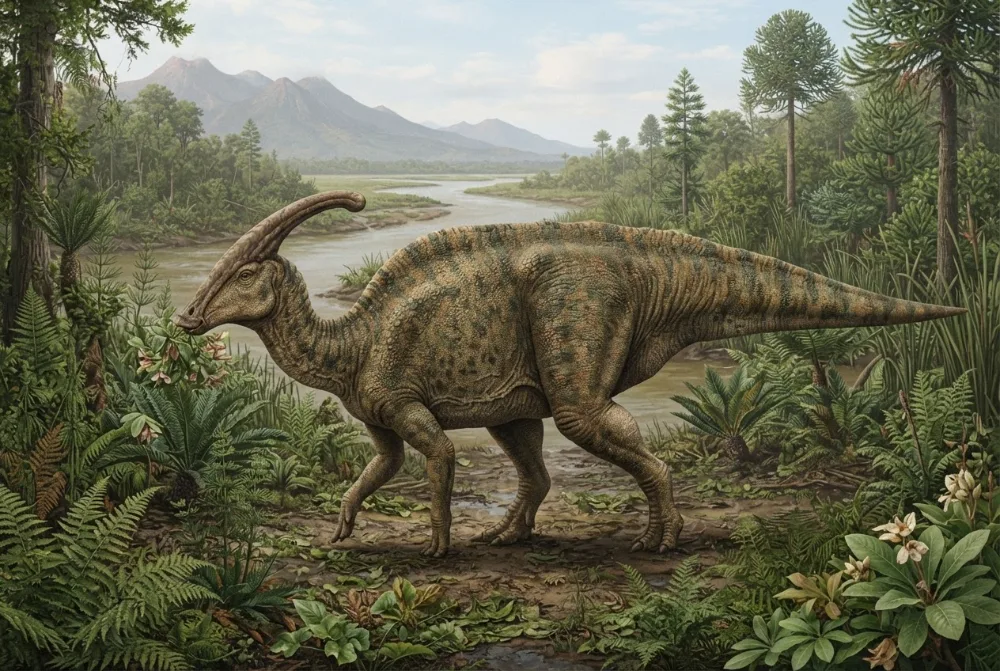
Parasaurolophus was a duck-billed dinosaur with a long, curved crest on its head. It lived in North America during the Late Cretaceous Period, about 77 to 73 million years ago. This plant-eater could walk on two legs or all fours.21
Rairarama rini?
Raiva hombe sei?
Raiva refu zvakadii?
Raiva rakakwirira zvakadii?
Rairema zvakadii?
 kureba semotokari 2 dzakamiswa dzakatevedzana🍌kureba semabhanana 50 akatevedzana
 kurema kunenge senzou🍉kurema semanwiwa 1000🎒kurema semakirasi 6 akazara evana vechikoro🐻❄️kurema semabere echando 11🏃raigona kumhanya mamita 100 mumasekonzi 17 (munhu anomhanya kupfuura vose anoda 9.6)
Parasaurolophus raiva hombe sei kana richienzaniswa NEWE?
Masvomhu chete mubrowser yako. Hapana chinochengetwa kana kutumirwa kupi zvako.
Raimhanya zvakadii?


Zvinonakidza
Parasaurolophus had a huge, hollow crest on its head that was shaped like a long tube. Scientists think it may have used the crest to make sounds like a trumpet.1
It had a beak like a duck and cheeks to hold food while chewing. Its teeth were constantly replaced, with hundreds packed together in a 'dental battery'.21
Parasaurolophus could walk on two legs or on all fours. It probably spent most of its time on all fours but could stand on its back legs when needed.2
Three species are known: P. walkeri, P. tubicen, and P. cyrtocristatus. P. tubicen was the largest and had the longest, straightest crest.1
The first Parasaurolophus fossil was found in 1920 near Sand Creek in Alberta, Canada. It was named in 1922 by William Parks.1
Parasaurolophus lived in a warm, swampy environment near the shore of a huge inland sea that split North America in two.1
Mibvunzo inonyanya kubvunzwa nezve Parasaurolophus
?How big was Parasaurolophus?
Parasaurolophus could reach over 9 metres (30 ft) long and weigh over 5 metric tons (5.5 short tons).1
?What did Parasaurolophus eat?
Parasaurolophus was a herbivore, eating plants like leaves, twigs, and pine needles. It used its beak to crop plants and its many teeth to grind them.12
?Why did Parasaurolophus have a crest?
Nobody knows for sure. Scientists think it may have been used for making loud sounds, for visual recognition, or for controlling body temperature, and it probably had more than one use.21
?Could Parasaurolophus swim?
The sources do not say whether Parasaurolophus could swim. It lived in a warm, swampy environment near a huge inland sea, but its swimming ability is not mentioned.1
?How fast could Parasaurolophus run?
Probably up to about 21 km/h (13 mph), about as fast as a grown-up riding a bike. This is an estimate from its size. It could walk on two legs or four, and probably ran on two legs.12
?Was Parasaurolophus bigger than T. rex?
No, Parasaurolophus was smaller than T. rex. Parasaurolophus was about 9 metres (30 ft) long, while T. rex could be over 12 metres (40 ft) long.1
?Did Parasaurolophus have feathers?
The sources do not mention feathers on Parasaurolophus. Skin impressions show scales, not feathers.1
?When did Parasaurolophus live?
Parasaurolophus lived during the Late Cretaceous Period, about 76.5 to 73 million years ago.1
?Where was Parasaurolophus found?
Parasaurolophus fossils have been found in Alberta, New Mexico, and Utah in North America, and possibly in Asia.1
Zvevanyanzvi vemadhino
- Zita resainzi
- Parasaurolophus
- Akaripa zita:
- Parks 19225
- Boka
- Miromo-yedhadha
- Mhuri / boka
- Hadrosauridae5
- Kurongwa kwemhuka
- Ornithischia > Ornithopoda > Iguanodontia > Hadrosauridae5
- Zera rematombo
- makore mamiriyoni 84 kusvika 72 (Campanian)5
- Mapoka ematombo
- Kirtland, Dinosaur Park, Fruitland5
- Nyika
- Amerika, Kanada5
- Zvinyorwa zvemafosiri
- 20 mu The Paleobiology Database5
- Kuwanikwa
- The first Parasaurolophus fossil, a skull and partial skeleton, was found in 1920 by a University of Toronto field party near Sand Creek in Alberta, Canada. William Parks named it Parasaurolophus walkeri in 1922.1
- Zvichiri kupokanwa
- Scientists debate whether the different crest shapes belong to separate species or are just males and females of the same species.1
Kunobva chokwadi
- Parasaurolophus (en.wikipedia.org)
- Parasaurolophus | Natural History Museum (nhm.ac.uk)
- PARASAUROLOPHUS : DinoChecker dinosaur archive (dinochecker.com)
- Parasaurolophus Size: How Big Was It and What Did It Look Like? (extinctatlas.org)
- Parasaurolophus in The Paleobiology Database (CC BY 4.0): zera, nzvimbo, mapoka ematombo, kurongwa kwemhuka.
Chokwadi chega chega papeji ino chine nhamba inoratidza kwachakabva. Kana takakanganisa chimwe chinhu, ruregerero, tiri vanoda madhino, kwete magazini yesainzi. Tiudze pa [email protected] tichazvigadzirisa.
 Rex ane nzara! Dino Wiki ipurojekiti yababa yemwanakomana wavo anoda madhino, mahara, pasina kushambadza uye pasina zvinokutevera. Vakuru vanogona kupa Rex chekudyadya kuti vabatsire kuchengeta saiti iri pamhepo.Fudza Rex
 Edmontosaurus
 Saurolophus
 Hypacrosaurus
 Corythosaurus
 Kritosaurus
 Gryposaurus
 Tyrannosaurus
 Triceratops
 Velociraptor
 Spinosaurus
 Ankylosaurus
 Pteranodon