 Uri dhino ripi? Kwizi
 Hondo yemadhino
 Mujaho wemadhino
 Mitambo midiki yemadhino
 Arubhamu yemasitika
 Rondedzero dzeTOP dzemadhino
 Ndishamise!
Triceratops
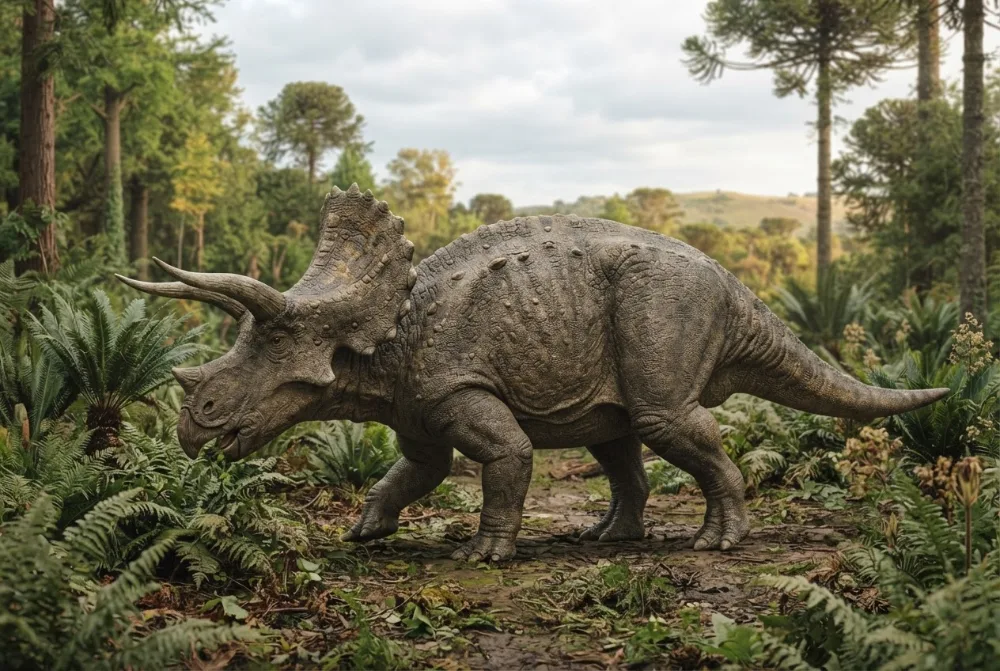
Triceratops was a huge plant-eater with a big frill on its head and three horns. It lived at the very end of the age of dinosaurs, about 66 million years ago. It was one of the last horned dinosaurs to walk the Earth.1
Rairarama rini?
Raiva hombe sei?
Raiva refu zvakadii?
Raiva rakakwirira zvakadii?
Rairema zvakadii?

 kureba semotokari 2 dzakamiswa dzakatevedzana🍌kureba semabhanana 50 akatevedzanakurema semotokari 8🍉kurema semanwiwa 2400🎒kurema semakirasi 15 akazara evana vechikoro🐻❄️kurema semabere echando 27🏃raigona kumhanya mamita 100 mumasekonzi 12 (munhu anomhanya kupfuura vose anoda 9.6)
Triceratops raiva hombe sei kana richienzaniswa NEWE?
Masvomhu chete mubrowser yako. Hapana chinochengetwa kana kutumirwa kupi zvako.
Raimhanya zvakadii?


Zvinonakidza
Triceratops had a huge frill made of solid bone at the back of its skull, which may have been used to attract mates or scare off rivals.1
Its name means 'three-horned face' because it had two long brow horns and a smaller horn on its nose.1
Triceratops lived right up to the mass extinction that killed the non-bird dinosaurs, about 66 million years ago.1
Fossils of Triceratops have been found in huge bonebeds, with many individuals together, suggesting they may have lived in herds.1
Triceratops had a strong beak like a parrot's, which it used to bite off tough plants.1
Some scientists think Triceratops could have fought predators like Tyrannosaurus rex using its sharp horns.1
Mibvunzo inonyanya kubvunzwa nezve Triceratops
?How big was Triceratops?
Triceratops was about 8 to 9 metres (26 to 30 feet) long and weighed between 6 and 10 tonnes (13,000 to 22,000 pounds). That is roughly as long as a school bus and as heavy as a large elephant.12
?What did Triceratops eat?
Triceratops was a plant-eater that ate low-growing plants like ferns, cycads and palms. It used its sharp, parrot-like beak to snip off tough leaves and had up to 800 teeth to grind them up.23
?Did Triceratops live in herds?
Most Triceratops fossils are found alone, so scientists think they usually lived alone. However, a few young Triceratops were found together, which suggests they might have stayed in small groups sometimes.23
?Could Triceratops fight T. rex?
Yes, Triceratops probably fought Tyrannosaurus rex. One fossil shows a Triceratops horn that was bitten by a T. rex and then healed, proving these dinosaurs really did battle.21
?Why did Triceratops have a frill?
The frill may have helped protect its neck, but it was not always enough since T. rex bite marks have been found on frills. It was also used to attract mates and help Triceratops recognize each other.23
?How fast could Triceratops run?
Up to about 30 km/h (19 mph) for a short dash, about as fast as a fast human runner. This is an estimate: nobody knows for sure. Triceratops was very heavy and walked on four legs, but its legs were strong, a bit like a rhino's.1
?When did Triceratops go extinct?
Triceratops died out about 66 million years ago, at the same time as the big mass extinction that killed all non-bird dinosaurs. It was one of the last horned dinosaurs alive.21
?Where was Triceratops found?
Triceratops fossils have been found in western North America, especially in the United States (Wyoming, Montana, Colorado, South Dakota) and in Canada (Alberta and Saskatchewan).23
?How many horns did Triceratops have?
Triceratops had three horns: two long ones above its eyes, each up to 1 metre (3.3 feet) long, and a shorter one on its nose. Its name means 'three-horned face'.24
?Was Triceratops bigger than T. rex?
Triceratops was generally smaller than T. rex. Triceratops was about 8 to 9 metres long, while T. rex could reach over 12 metres in length.1
Mubvisi wengano
Ngano: Triceratops was a slow, clumsy animal that could barely move.
Chokwadi: Triceratops was actually quite fast for its size, able to run at speeds of up to 30 km/h (about 20 mph) on its strong legs.1
Zvevanyanzvi vemadhino
- Zita resainzi
- Triceratops
- Akaripa zita:
- Marsh 18895
- Boka
- Madhino ane nyanga
- Mhuri / boka
- Ceratopsidae5
- Kurongwa kwemhuka
- Ornithischia > Ceratopsia > Ceratopsidae5
- Zera rematombo
- makore mamiriyoni 84 kusvika 66 (Campanian / Maastrichtian)5
- Mapoka ematombo
- Lance, Hell Creek, Frenchman5
- Nyika
- Amerika, Kanada5
- Zvinyorwa zvemafosiri
- 166 mu The Paleobiology Database5
- Rinonziwo
- Diceratops, Diceratus, Nedoceratops, Sterrholophus (mazita ekare zvino oonekwa semhuka imwe chete)5
- Kuwanikwa
- Triceratops was named by paleontologist Othniel Charles Marsh in 1889, based on fossils found in Wyoming, USA.5
- Zvichiri kupokanwa
- Scientists still debate whether some fossils belong to Triceratops or to a separate, related dinosaur called Torosaurus.1
Kunobva chokwadi
- Triceratops (en.wikipedia.org)
- Triceratops | Natural History Museum (nhm.ac.uk)
- Triceratops | The Canadian Encyclopedia (thecanadianencyclopedia.ca)
- Triceratops summary | Britannica (britannica.com)
- Triceratops in The Paleobiology Database (CC BY 4.0): zera, nzvimbo, mapoka ematombo, kurongwa kwemhuka.
Chokwadi chega chega papeji ino chine nhamba inoratidza kwachakabva. Kana takakanganisa chimwe chinhu, ruregerero, tiri vanoda madhino, kwete magazini yesainzi. Tiudze pa [email protected] tichazvigadzirisa.
 Rex ane nzara! Dino Wiki ipurojekiti yababa yemwanakomana wavo anoda madhino, mahara, pasina kushambadza uye pasina zvinokutevera. Vakuru vanogona kupa Rex chekudyadya kuti vabatsire kuchengeta saiti iri pamhepo.Fudza Rex
 Protoceratops
 Ojoceratops
 Tatankaceratops
 Psittacosaurus
 Centrosaurus
 Chasmosaurus
 Tyrannosaurus
 Velociraptor
 Spinosaurus
 Ankylosaurus
 Parasaurolophus
 Pteranodon