 Uri dhino ripi? Kwizi
 Hondo yemadhino
 Mujaho wemadhino
 Mitambo midiki yemadhino
 Arubhamu yemasitika
 Rondedzero dzeTOP dzemadhino
 Ndishamise!
Epidexipteryx
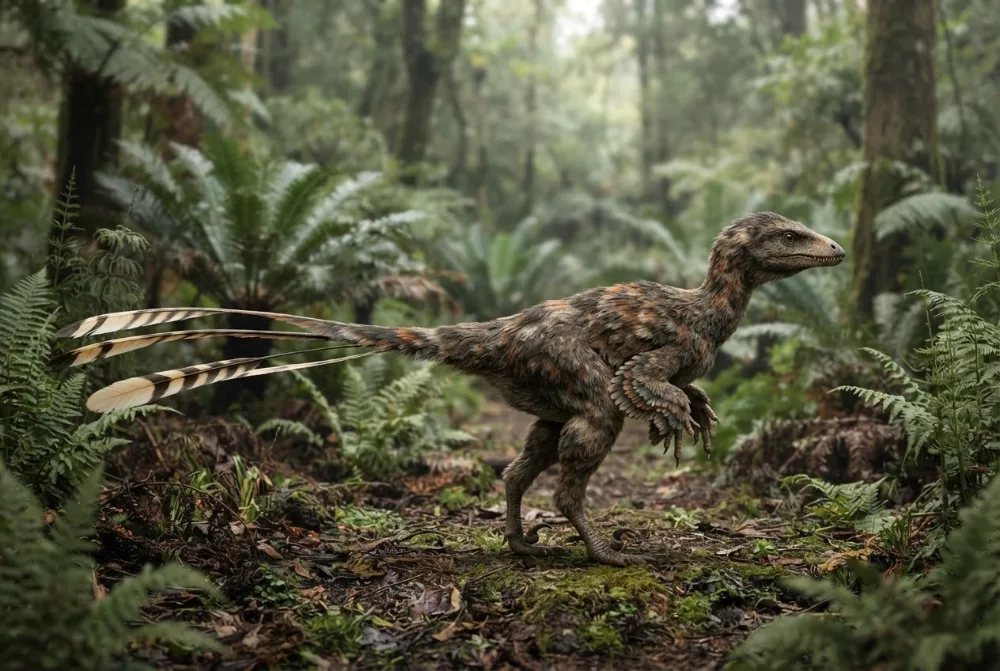
Epidexipteryx was a tiny, pigeon-sized dinosaur that lived in the Jurassic period. It had four long, ribbon-like feathers on its tail that it probably used to show off, not to fly. This little dinosaur was a meat-eater and is one of the oldest known dinosaurs with display feathers.1
Rairarama rini?
Raiva hombe sei?
Raiva refu zvakadii?
Raiva rakakwirira zvakadii?
fungidziro
Rairema zvakadii?
Epidexipteryx raiva hombe sei kana richienzaniswa NEWE?
Masvomhu chete mubrowser yako. Hapana chinochengetwa kana kutumirwa kupi zvako.
Raimhanya zvakadii?


Zvinonakidza
Epidexipteryx had four long, ribbon-like feathers on its tail that were probably used for display, not for flying.1
It weighed only about 164 grams, which is less than a can of soda.1
Its front teeth were much larger than its back teeth, and they stuck out forward, similar to the dinosaur Masiakasaurus.1
Epidexipteryx lived about 165 to 161 million years ago, during the Middle to Late Jurassic.6
The only known fossil is a nearly complete skeleton of a young individual, found in Inner Mongolia, China.1
It had a short tail compared to its close relative Epidendrosaurus, with only 16 tail bones instead of more than 40.1
Epidexipteryx could not fly because it lacked the long flight feathers on its arms that birds use.1
Mibvunzo inonyanya kubvunzwa nezve Epidexipteryx
?How big was Epidexipteryx?
It was tiny, about 25 to 30 cm long, not counting the tail feathers. That is about the size of a pigeon.3
?Did Epidexipteryx have feathers?
Yes, it had four long, ribbon-like feathers on its tail and a covering of simpler body feathers. The tail feathers were probably used for display, not for flying.34
?Could Epidexipteryx fly?
No, it could not fly. It lacked the long flight feathers on its arms that birds use, though it may have had a membrane wing for gliding.35
?What did Epidexipteryx eat?
It was a meat-eater. It may have used its long claws to rummage through trees for grubs, like an aye-aye.3
?When did Epidexipteryx live?
It lived during the Middle to Late Jurassic, about 165 to 154 million years ago, in what is now Inner Mongolia, China.3
Zvevanyanzvi vemadhino
- Zita resainzi
- Epidexipteryx
- Akaripa zita:
- Zhang et al. 20086
- Boka
- Madhino anodya nyama
- Mhuri / boka
- Paraves6
- Kurongwa kwemhuka
- Theropoda6
- Zera rematombo
- makore mamiriyoni 165 kusvika 162 (Callovian)6
- Mapoka ematombo
- Tiaojishan6
- Nyika
- China6
- Zvinyorwa zvemafosiri
- 1 mu The Paleobiology Database6
- Kuwanikwa
- Epidexipteryx was named in 2008 by scientists Fucheng Zhang, Zhonghe Zhou, Xing Xu, Xiaolin Wang, and Corwin Sullivan. The name honors the late paleontologist Yaoming Hu. The fossil was found in the Daohugou area of Inner Mongolia, China.1
- Zvichiri kupokanwa
- Scientists are not sure exactly how old the rocks where Epidexipteryx was found are. They could be from the Middle Jurassic or the Late Jurassic, between 152 and 168 million years old.1
Kunobva chokwadi
- LETTERS (ivpp.cas.cn)
- Epidexipteryx Zhang et al. 2008 - Encyclopedia of Life (eol.org)
- Epidexipteryx (en.wikipedia.org)
- Access : A bizarre Jurassic maniraptoran from China with elongate ribbon-like feathers : Nature (web.archive.org)
- nature.com (nature.com)
- Epidexipteryx in The Paleobiology Database (CC BY 4.0): zera, nzvimbo, mapoka ematombo, kurongwa kwemhuka.
Chokwadi chega chega papeji ino chine nhamba inoratidza kwachakabva. Kana takakanganisa chimwe chinhu, ruregerero, tiri vanoda madhino, kwete magazini yesainzi. Tiudze pa [email protected] tichazvigadzirisa.
 Rex ane nzara! Dino Wiki ipurojekiti yababa yemwanakomana wavo anoda madhino, mahara, pasina kushambadza uye pasina zvinokutevera. Vakuru vanogona kupa Rex chekudyadya kuti vabatsire kuchengeta saiti iri pamhepo.Fudza Rex
 Allosaurus
 Carnotaurus
 Dilophosaurus
 Giganotosaurus
 Compsognathus
 Paronychodon
 Ichthyosaurus
 Khudiakovia
 Ophthalmosaurus
 Pterodactylus
 Peloneustes
 Rhamphocephalus