 Uri dhino ripi? Kwizi
 Hondo yemadhino
 Mujaho wemadhino
 Mitambo midiki yemadhino
 Arubhamu yemasitika
 Rondedzero dzeTOP dzemadhino
 Ndishamise!
Gongshuilong
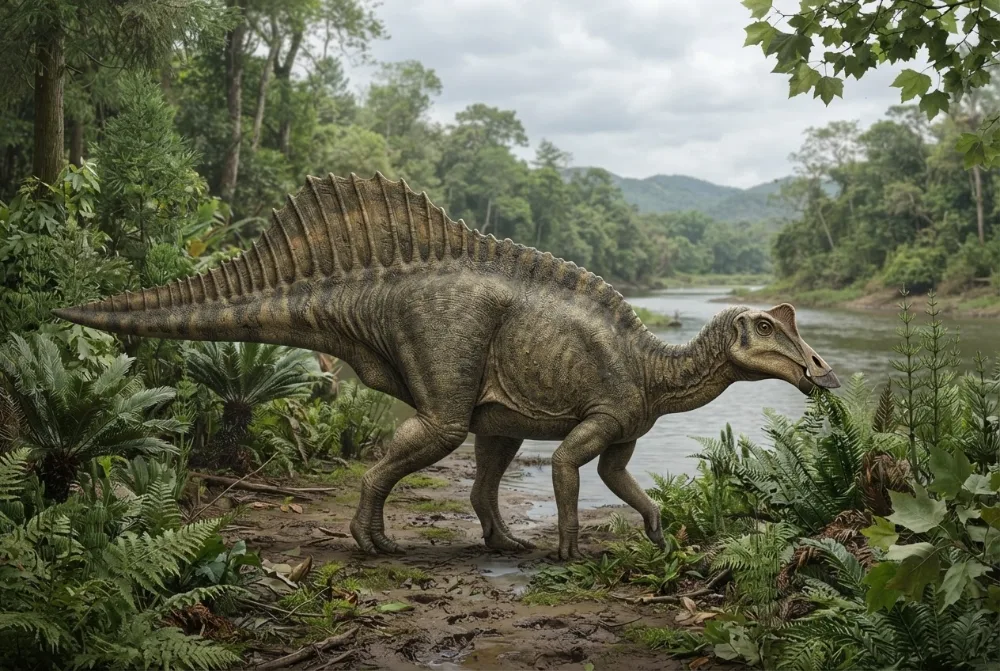
Gongshuilong was a duck-billed dinosaur that lived in China near the end of the Age of Dinosaurs. It had a tall, sail-like tail made of extra-long bones, which made it look really cool. This plant-eater is special because it is the first named hadrosaur from South China!1
Rairarama rini?
Raiva hombe sei?
Raiva refu zvakadii?
Raiva rakakwirira zvakadii?
fungidziro
 kureba seimbwa 7 kubva pamhino kusvika kumuswe🍌kureba semabhanana 39 akatevedzana🏃raigona kumhanya mamita 100 mumasekonzi 13 (munhu anomhanya kupfuura vose anoda 9.6)
Gongshuilong raiva hombe sei kana richienzaniswa NEWE?
Masvomhu chete mubrowser yako. Hapana chinochengetwa kana kutumirwa kupi zvako.
Raimhanya zvakadii?


Zvinonakidza
Gongshuilong's tail bones were super long, making the tail look like a sail. The neural spines were 8.5 times as tall as the bones they attached to, which is unique among all iguanodontian dinosaurs.1
It was a medium-sized hadrosaur, about 7 metres (23 feet) long, which is about as long as a small school bus.1
Gongshuilong is the second brachylophosaurin found in Asia, after Wulagasaurus. Most of its close relatives lived in North America, so it helps show that this group might have started in Asia.1
The fossils were found in a bonebed with at least two individuals, because scientists found two left lower jaws, two shoulder blades, and two shin bones of different sizes.1
Its name, Gongshuilong, comes from the Gong River near where it was found, and 'long' means dragon in Chinese.1
The species name 'fanwei' refers to the sail-like tail, because 'fan' means sail in Chinese.1
Mibvunzo inonyanya kubvunzwa nezve Gongshuilong
?What did Gongshuilong eat?
Gongshuilong was a plant-eater, like other duck-billed dinosaurs. It used its beak and many teeth to chew plants.1
?How big was Gongshuilong?
Gongshuilong was a medium sized hadrosaur, about 7 metres (23 feet) long, roughly the length of a small school bus.1
?When did Gongshuilong live?
Gongshuilong lived during the Late Cretaceous period, specifically in the Maastrichtian age, near the end of the Age of Dinosaurs.1
Mubvisi wengano
Ngano: Some people think all duck-billed dinosaurs lived in North America.
Chokwadi: Gongshuilong shows that duck-billed dinosaurs also lived in Asia, and it is the first named hadrosaur from South China.1
Zvevanyanzvi vemadhino
- Zita resainzi
- Gongshuilong
- Akaripa zita:
- Yao et al. 20263
- Boka
- Miromo-yedhadha
- Mhuri / boka
- Hadrosauridae3
- Kurongwa kwemhuka
- Ornithischia > Ornithopoda > Iguanodontia > Hadrosauridae3
- Zera rematombo
- makore mamiriyoni 72 kusvika 66 (Maastrichtian)3
- Mapoka ematombo
- Lianhe3
- Nyika
- China3
- Zvinyorwa zvemafosiri
- 1 mu The Paleobiology Database3
- Kuwanikwa
- In March 2021, construction workers found a bonebed in Ganzhou, China. Scientists from the Jiangxi Geological Survey and Exploration Institute dug out the fossils in two blocks, and in 2026 Han Yao and colleagues named the new species Gongshuilong fanwei.12
- Zvichiri kupokanwa
- Scientists are still debating exactly how Gongshuilong is related to other brachylophosaurins, because the family tree shows a polytomy, meaning the relationships are not fully resolved.1
Kunobva chokwadi
- Gongshuilong (en.wikipedia.org)
- MorphoBank V4 (beta.morphobank.org)
- Gongshuilong in The Paleobiology Database (CC BY 4.0): zera, nzvimbo, mapoka ematombo, kurongwa kwemhuka.
Chokwadi chega chega papeji ino chine nhamba inoratidza kwachakabva. Kana takakanganisa chimwe chinhu, ruregerero, tiri vanoda madhino, kwete magazini yesainzi. Tiudze pa [email protected] tichazvigadzirisa.
 Rex ane nzara! Dino Wiki ipurojekiti yababa yemwanakomana wavo anoda madhino, mahara, pasina kushambadza uye pasina zvinokutevera. Vakuru vanogona kupa Rex chekudyadya kuti vabatsire kuchengeta saiti iri pamhepo.Fudza Rex
 Parasaurolophus
 Edmontosaurus
 Saurolophus
 Hypacrosaurus
 Corythosaurus
 Kritosaurus
 Tyrannosaurus
 Triceratops
 Velociraptor
 Spinosaurus
 Ankylosaurus
 Pteranodon