 Uri dhino ripi? Kwizi
 Hondo yemadhino
 Mujaho wemadhino
 Mitambo midiki yemadhino
 Arubhamu yemasitika
 Rondedzero dzeTOP dzemadhino
 Ndishamise!
Hesperonyx
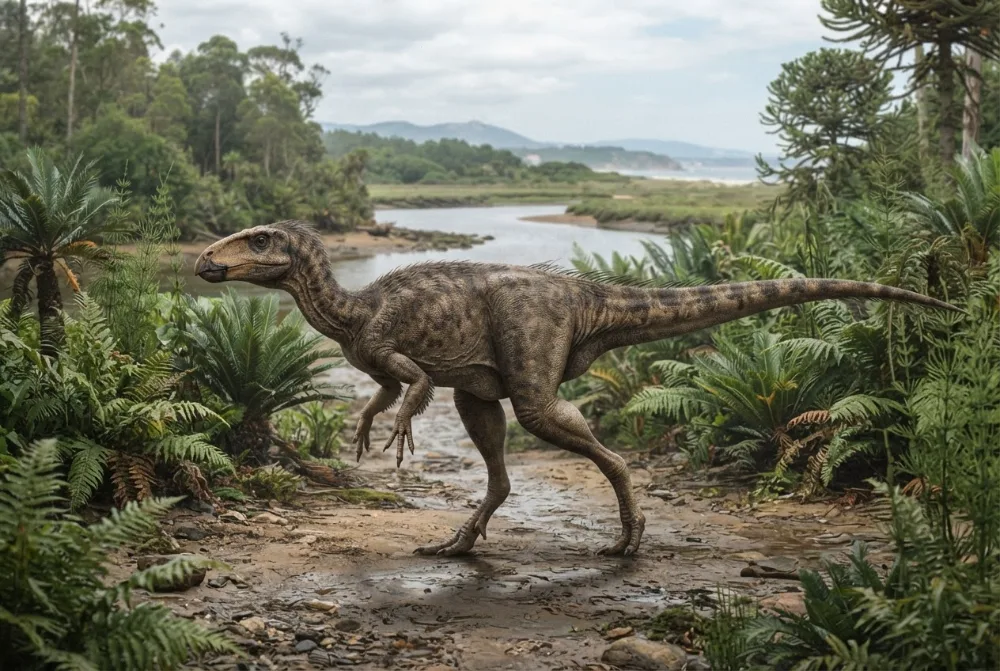
Hesperonyx was a small, plant-eating dinosaur that lived in what is now Portugal during the Late Jurassic. It walked on two legs and used its beak to nibble on plants. Scientists know it from just a few leg and hand bones found on a beach.12
Rairarama rini?
Raiva hombe sei?
Raiva refu zvakadii?
Raiva rakakwirira zvakadii?
fungidziro
 kureba seimbwa 4 kubva pamhino kusvika kumuswe🍌kureba semabhanana 22 akatevedzana🏃raigona kumhanya mamita 100 mumasekonzi 8.4 (munhu anomhanya kupfuura vose anoda 9.6)
Hesperonyx raiva hombe sei kana richienzaniswa NEWE?
Masvomhu chete mubrowser yako. Hapana chinochengetwa kana kutumirwa kupi zvako.
Raimhanya zvakadii?


Zvinonakidza
Hesperonyx lived about 152 to 149 million years ago, during the Kimmeridgian stage of the Late Jurassic.3
Its name means 'western claw' because it was found in the western region of Portugal and its fossils include a claw.1
The only known skeleton, called ML 2700, includes bones from the left forelimb and hindlimb, such as a hand claw, shin bone, and foot bones.1
Hesperonyx was a dryomorphan, a group of plant-eating dinosaurs that are close relatives of the larger iguanodonts.3
The fossils were found in 2021 during a joint field season by FCT NOVA and Museu da Lourinhã.2
It lived in a warm, seasonal climate with rivers and floodplains, alongside other dinosaurs like Draconyx and Eousdryosaurus.2
Hesperonyx had a reduced first toe (metatarsal I), which is unusual and helps scientists tell it apart from other dinosaurs.2
Mibvunzo inonyanya kubvunzwa nezve Hesperonyx
?How big was Hesperonyx?
About 3 to 4 metres (9.8 to 13.1 feet) long, which is roughly the size of a small car.12
?What did Hesperonyx eat?
It was a plant-eater (herbivore) that used its beak to nibble on plants.4
Zvevanyanzvi vemadhino
- Zita resainzi
- Hesperonyx
- Akaripa zita:
- Rotatori et al. 20244
- Boka
- Vanodya miriwo vane miromo
- Mhuri / boka
- Dryomorpha4
- Kurongwa kwemhuka
- Ornithischia > Ornithopoda > Iguanodontia4
- Zera rematombo
- makore mamiriyoni 152 kusvika 149 (Kimmeridgian)4
- Mapoka ematombo
- Lourinhã4
- Nyika
- Portugal4
- Zvinyorwa zvemafosiri
- 1 mu The Paleobiology Database4
- Kuwanikwa
- Hesperonyx was named in 2024 by Rotatori and colleagues. The fossils were found in 2021 on Porto Dinheiro Beach in Portugal by a team from FCT NOVA and Museu da Lourinhã.12
- Zvichiri kupokanwa
- Scientists are not sure exactly where Hesperonyx fits in the dinosaur family tree. It is definitely a dryomorphan, but its exact relationships are still debated.2
Kunobva chokwadi
- Hesperonyx (en.wikipedia.org)
- An unexpected early-diverging iguanodontian dinosaur (Ornithischia, Ornithopoda) from the Upper Jura (docentes.fct.unl.pt)
- PBDB Taxon (paleobiodb.org)
- Hesperonyx in The Paleobiology Database (CC BY 4.0): zera, nzvimbo, mapoka ematombo, kurongwa kwemhuka.
Chokwadi chega chega papeji ino chine nhamba inoratidza kwachakabva. Kana takakanganisa chimwe chinhu, ruregerero, tiri vanoda madhino, kwete magazini yesainzi. Tiudze pa [email protected] tichazvigadzirisa.
 Rex ane nzara! Dino Wiki ipurojekiti yababa yemwanakomana wavo anoda madhino, mahara, pasina kushambadza uye pasina zvinokutevera. Vakuru vanogona kupa Rex chekudyadya kuti vabatsire kuchengeta saiti iri pamhepo.Fudza Rex
 Iguanodon
 Tenontosaurus
 Thescelosaurus
 Zalmoxes
 Camptosaurus
 Rhabdodon
 Brachiosaurus
 Diplodocus
 Allosaurus
 Brontosaurus
 Compsognathus
 Camarasaurus