 Uri dhino ripi? Kwizi
 Hondo yemadhino
 Mujaho wemadhino
 Mitambo midiki yemadhino
 Arubhamu yemasitika
 Rondedzero dzeTOP dzemadhino
 Ndishamise!
Rairarama rini?

Raiva hombe sei?
Raiva refu zvakadii?
Raiva rakakwirira zvakadii?
Rairema zvakadii?
 kureba seimbwa 7 kubva pamhino kusvika kumuswe🍌kureba semabhanana 39 akatevedzana🍉kurema semanwiwa 180🧸kurema sevana vekireshi 47🎒kurema sevana vechikoro 28🐻❄️kurema semabere echando 2🏃raigona kumhanya mamita 100 mumasekonzi 11 (munhu anomhanya kupfuura vose anoda 9.6)
Tenontosaurus raiva hombe sei kana richienzaniswa NEWE?
Masvomhu chete mubrowser yako. Hapana chinochengetwa kana kutumirwa kupi zvako.
Raimhanya zvakadii?


Zvinonakidza
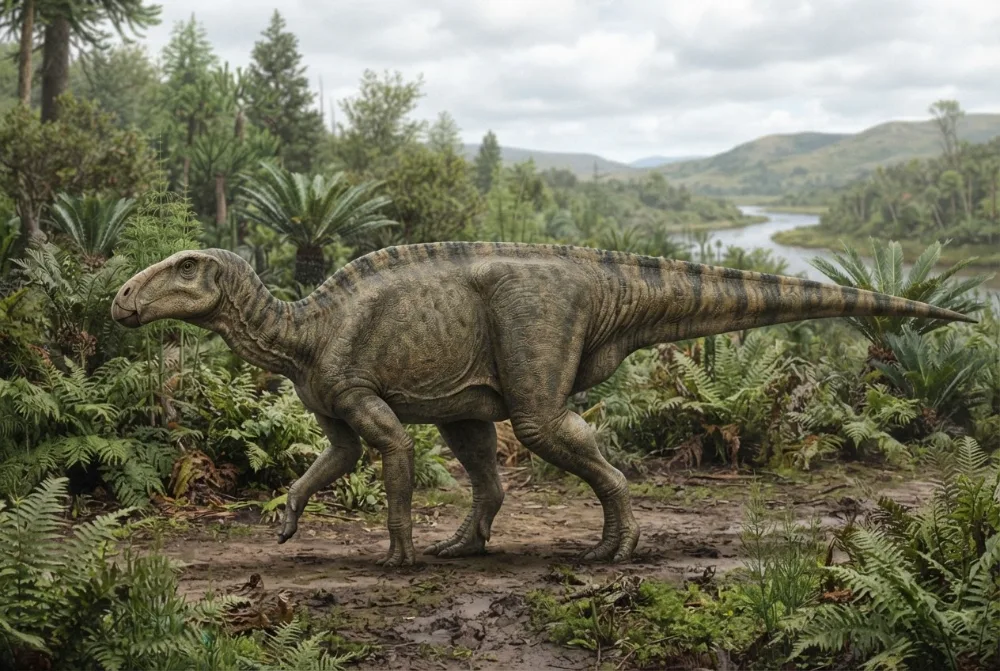
Tenontosaurus had an unusually long and broad tail, stiffened by a network of bony tendons, which is why it is called 'sinew lizard'.1
An adult Tenontosaurus could reach a browsing height of about 3 meters (10 feet) if it stood on its hind legs, but it usually walked on all fours.1
Its beak was U-shaped and thick, and its lower jaw had a special bone called a predentary that helped form the lower beak.1
Tenontosaurus lived alongside the predator Deinonychus, and fossils of both are common in the same rocks.1
The first Tenontosaurus fossil was found in 1903 in Montana, but it was not named until 1970.1
There are two species: Tenontosaurus tilletti and Tenontosaurus dossi. T. dossi is known from only a few specimens in Texas.1
Mibvunzo inonyanya kubvunzwa nezve Tenontosaurus
?How big was Tenontosaurus?
About 6 to 8 metres long and around 1,000 kilograms, though estimates vary by species and study.12
?What did Tenontosaurus eat?
It was a plant-eater. It used its U-shaped beak and chopping teeth to eat leaves, wood, fruit, and low-growing ferns and shrubs.12
?Did Tenontosaurus walk on two legs or four?
It usually walked on all four legs, but could stand on its hind legs to reach higher plants, up to about 3 metres.12
?Was Tenontosaurus bigger than Deinonychus?
Yes, adult Tenontosaurus were much larger than adult Deinonychus. Deinonychus probably hunted young or sick Tenontosaurus.1
?When did Tenontosaurus live?
It lived during the Early Cretaceous period, about 115 to 108 million years ago, in western North America.12
?Why did Tenontosaurus have a long tail?
Its tail was unusually long and broad, stiffened by bony tendons. This helped support the tail, but scientists aren't sure of its exact purpose.1
Mubvisi wengano
Ngano: Some people think Tenontosaurus was a slow, clumsy dinosaur.
Chokwadi: Scientists think it was a common and successful herbivore, and its stiff tail may have helped it balance.1
Zvevanyanzvi vemadhino
- Zita resainzi
- Tenontosaurus
- Akaripa zita:
- Ostrom 19704
- Boka
- Vanodya miriwo vane miromo
- Mhuri / boka
- Tenontosauridae4
- Kurongwa kwemhuka
- Ornithischia > Ornithopoda > Iguanodontia4
- Zera rematombo
- makore mamiriyoni 121 kusvika 94 (Aptian / Cenomanian)4
- Mapoka ematombo
- Cloverly, Antlers, Cedar Mountain4
- Nyika
- Amerika4
- Zvinyorwa zvemafosiri
- 83 mu The Paleobiology Database4
- Kuwanikwa
- The first fossil was found in 1903 by an American Museum of Natural History expedition in Montana. John Ostrom named it Tenontosaurus tilletti in 1970 after studying many specimens.1
- Zvichiri kupokanwa
- Scientists still debate exactly how Tenontosaurus moved, whether it was mostly quadrupedal or could run on two legs.1
Kunobva chokwadi
- Tenontosaurus (en.wikipedia.org)
- Tenontosaurus | Natural History Museum (nhm.ac.uk)
- All about Tenontosaurus (animalia.bio)
- Tenontosaurus in The Paleobiology Database (CC BY 4.0): zera, nzvimbo, mapoka ematombo, kurongwa kwemhuka.
Chokwadi chega chega papeji ino chine nhamba inoratidza kwachakabva. Kana takakanganisa chimwe chinhu, ruregerero, tiri vanoda madhino, kwete magazini yesainzi. Tiudze pa [email protected] tichazvigadzirisa.
 Rex ane nzara! Dino Wiki ipurojekiti yababa yemwanakomana wavo anoda madhino, mahara, pasina kushambadza uye pasina zvinokutevera. Vakuru vanogona kupa Rex chekudyadya kuti vabatsire kuchengeta saiti iri pamhepo.Fudza Rex
 Iguanodon
 Thescelosaurus
 Zalmoxes
 Camptosaurus
 Rhabdodon
 Nanosaurus
 Stegosaurus
 Archaeopteryx
 Giganotosaurus
 Microraptor
 Deinonychus
 Baryonyx