 Uri dhino ripi? Kwizi
 Hondo yemadhino
 Mujaho wemadhino
 Mitambo midiki yemadhino
 Arubhamu yemasitika
 Rondedzero dzeTOP dzemadhino
 Ndishamise!
Kaijutitan
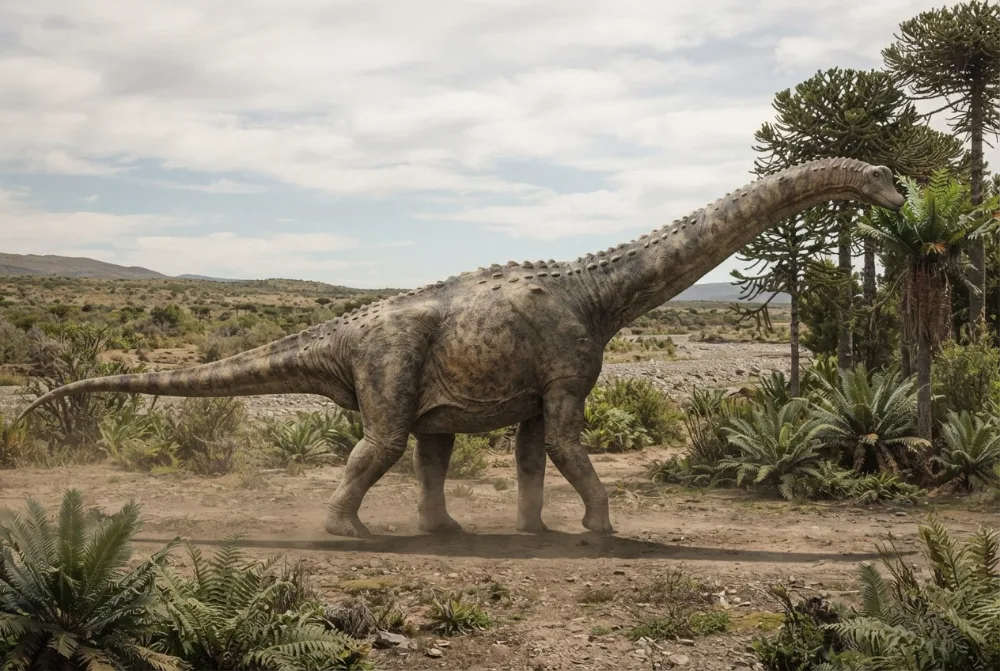
Kaijutitan was a giant, long-necked plant-eater that lived in what is now Argentina. It is one of the earliest known titanosaurs, a group that includes the biggest dinosaurs ever. Its neck bones had a strange split shape, like a fork.42
Rairarama rini?
Raiva hombe sei?
Rairema zvakadii?

Kaijutitan raiva hombe sei kana richienzaniswa NEWE?
Masvomhu chete mubrowser yako. Hapana chinochengetwa kana kutumirwa kupi zvako.
Raimhanya zvakadii?


Zvinonakidza
Kaijutitan is the latest known basal titanosaur, meaning it lived near the end of the time when early titanosaurs existed.2
Its neck vertebrae had bifid (split) neural spines, a feature that evolved several times among sauropods but is rare in titanosaurs.2
The fossil includes part of the skull, which is very unusual for large titanosaurs because their skulls are rarely preserved.2
Kaijutitan lived about 89 to 86 million years ago, during the Coniacian stage of the Late Cretaceous.4
Its bones were found scattered in an area of about 20 square metres, suggesting the carcass fell apart before being buried.2
The species name maui honors the Museo Municipal Argentino Urquiza (MAU), where the fossil is stored.1
Mibvunzo inonyanya kubvunzwa nezve Kaijutitan
?How big was Kaijutitan?
Scientists don't know its exact size yet, but it was a huge sauropod, one of the giant titanosaurs. Its bones show it was an adult of huge body size.31
?What did Kaijutitan eat?
Kaijutitan was a plant-eater, like all sauropods. It used its long neck to reach leaves from tall trees.1
Zvevanyanzvi vemadhino
- Zita resainzi
- Kaijutitan
- Akaripa zita:
- Filippi et al. 20194
- Boka
- Madhino emitsipa mirefu
- Mhuri / boka
- Lithostrotia4
- Kurongwa kwemhuka
- Sauropodomorpha > Sauropoda > Titanosauria > Macronaria4
- Zera rematombo
- makore mamiriyoni 90 kusvika 86 (Coniacian)4
- Mapoka ematombo
- Sierra Barrosa4
- Nyika
- Ajentina4
- Zvinyorwa zvemafosiri
- 1 mu The Paleobiology Database4
- Kuwanikwa
- Kaijutitan was named in 2019 by paleontologists Leonardo Filippi, Leonardo Salgado, and Alberto Garrido. The skeleton was found by a team from the Museo Municipal Argentino Urquiza and the Museo Provincial de Ciencias Naturales in Argentina.42
- Zvichiri kupokanwa
- Scientists are not sure exactly how big Kaijutitan was, because only a partial skeleton has been found.2
Kunobva chokwadi
- Kaijutitan (en.wikipedia.org)
- A new giant basal titanosaur sauropod in the Upper Cretaceous (Coniacian) of the NeuquEn Basin, Argentina (rid.unrn.edu.ar)
- KAIJUTITAN MAUI, A SAUROPOD TITANOSAUR FROM THE UPPER CRETACEOUS (SIERRA BARROSA FORMATION, NEUQUÉN BASIN) OF NORTHERN PATAGONIA ARGENTINA: HISTOLOGICAL AND TAPHONOMIC CONSIDERATIONS | Publicación Electrónica de la Asociación Paleontológica Argentina (peapaleontologica.org.ar)
- Kaijutitan in The Paleobiology Database (CC BY 4.0): zera, nzvimbo, mapoka ematombo, kurongwa kwemhuka.
Chokwadi chega chega papeji ino chine nhamba inoratidza kwachakabva. Kana takakanganisa chimwe chinhu, ruregerero, tiri vanoda madhino, kwete magazini yesainzi. Tiudze pa [email protected] tichazvigadzirisa.
 Rex ane nzara! Dino Wiki ipurojekiti yababa yemwanakomana wavo anoda madhino, mahara, pasina kushambadza uye pasina zvinokutevera. Vakuru vanogona kupa Rex chekudyadya kuti vabatsire kuchengeta saiti iri pamhepo.Fudza Rex
 Brachiosaurus
 Diplodocus
 Brontosaurus
 Argentinosaurus
 Camarasaurus
 Morosaurus
 Tyrannosaurus
 Triceratops
 Velociraptor
 Spinosaurus
 Ankylosaurus
 Parasaurolophus