 Uri dhino ripi? Kwizi
 Hondo yemadhino
 Mujaho wemadhino
 Mitambo midiki yemadhino
 Arubhamu yemasitika
 Rondedzero dzeTOP dzemadhino
 Ndishamise!
Kaiwhekea
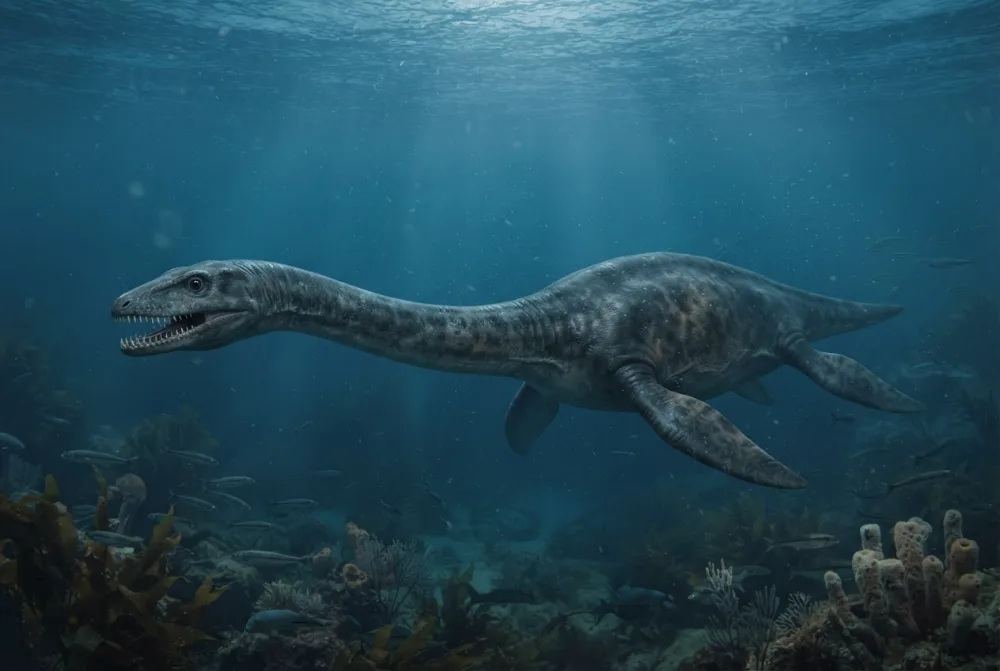
Kaiwhekea was a plesiosaur, a long-necked marine reptile that lived in the seas around New Zealand. It had a big head, large eyes and lots of small teeth for catching squid and other soft prey. This creature swam near the Antarctic polar circle during the time of the dinosaurs.1
Rairarama rini?
Raiva hombe sei?
Raiva refu zvakadii?
 kureba seimbwa 7 kubva pamhino kusvika kumuswe🍌kureba semabhanana 39 akatevedzana🏊raigona kushambira kureba kwedziva guru rekushambira (50 m) mumasekonzi 6.9
Kaiwhekea raiva hombe sei kana richienzaniswa NEWE?
Masvomhu chete mubrowser yako. Hapana chinochengetwa kana kutumirwa kupi zvako.
Raimhanya zvakadii?


Zvinonakidza
Kaiwhekea is one of the most complete fossil reptiles ever found in New Zealand, with its skull, jaws, vertebrae and ribs still connected almost as they were in life.1
Its name comes from Maori words meaning 'squid eater', because scientists think it fed on squid and other soft animals.1
Kaiwhekea had about 43 teeth in each upper jaw and 42 in each lower jaw, all small, slim and slightly curved.3
The fossil was found inside a large rock called a concretion, which was cracked and had to be dug out bit by bit over 30 days.1
When Kaiwhekea lived, the Otago region was close to the polar circle, with long summer days and long winter nights.1
Its large forward-facing eyes suggest it had good binocular vision, which might have helped it hunt in deep or dark water.1
Kaiwhekea is thought to have been a fast swimmer, based on the shape of its hind flippers.1
Mibvunzo inonyanya kubvunzwa nezve Kaiwhekea
Zvevanyanzvi vemadhino
- Zita resainzi
- Kaiwhekea
- Akaripa zita:
- Cruickshank and Fordyce 20026
- Boka
- Mapresiosauro
- Mhuri / boka
- Elasmosauridae6
- Kurongwa kwemhuka
- Plesiosauria > Elasmosauridae > Sauropterygia6
- Zera rematombo
- makore mamiriyoni 84 kusvika 66 (Campanian / Maastrichtian)6
- Mapoka ematombo
- Katiki6
- Nyika
- New Zealand6
- Zvinyorwa zvemafosiri
- 1 mu The Paleobiology Database6
- Kuwanikwa
- Kaiwhekea was named by Arthur Cruickshank and Ewan Fordyce in 2002, based on a single nearly complete skeleton found in the Katiki Formation near Shag Point, New Zealand.21
- Zvichiri kupokanwa
- Scientists are not sure which family Kaiwhekea belongs to. Some say it is a cryptoclidid, others place it with elasmosaurids or other groups.21
Kunobva chokwadi
- Kaiwhekea katiki, a Late Cretaceous plesiosaur from high southern latitudes (otago.ac.nz)
- PBDB Taxon (paleobiodb.org)
- A New Marine Reptile (Sauropterygia) from New Zealand: Further Evidence for A Late Cretaceous Austral Radiation of Cryptoclidid Plesiosaurs (onlinelibrary.wiley.com)
- Kaiwhekea (en.wikipedia.org)
- Most complete dinosaur-aged reptile from Aotearoa – Fossil Treasures of the Geology Museum (oercollective.caul.edu.au)
- Kaiwhekea in The Paleobiology Database (CC BY 4.0): zera, nzvimbo, mapoka ematombo, kurongwa kwemhuka.
Chokwadi chega chega papeji ino chine nhamba inoratidza kwachakabva. Kana takakanganisa chimwe chinhu, ruregerero, tiri vanoda madhino, kwete magazini yesainzi. Tiudze pa [email protected] tichazvigadzirisa.
 Rex ane nzara! Dino Wiki ipurojekiti yababa yemwanakomana wavo anoda madhino, mahara, pasina kushambadza uye pasina zvinokutevera. Vakuru vanogona kupa Rex chekudyadya kuti vabatsire kuchengeta saiti iri pamhepo.Fudza Rex
 Elasmosaurus
 Pliosaurus
 Plesiosaurus
 Cimoliasaurus
 Colymbosaurus
 Trinacromerum
 Tyrannosaurus
 Triceratops
 Velociraptor
 Spinosaurus
 Ankylosaurus
 Parasaurolophus