 Uri dhino ripi? Kwizi
 Hondo yemadhino
 Mujaho wemadhino
 Mitambo midiki yemadhino
 Arubhamu yemasitika
 Rondedzero dzeTOP dzemadhino
 Ndishamise!
Rairarama rini?

Raiva hombe sei?
Raiva refu zvakadii?
Raiva rakakwirira zvakadii?
Rairema zvakadii?

 kureba seimbwa 9 kubva pamhino kusvika kumuswe🍌kureba semabhanana 48 akatevedzanakurema seimbwa 190🍉kurema semanwiwa 750🎒kurema semakirasi 5 akazara evana vechikoro🐻❄️kurema semabere echando 8🏃raigona kumhanya mamita 100 mumasekonzi 16 (munhu anomhanya kupfuura vose anoda 9.6)
Latirhinus raiva hombe sei kana richienzaniswa NEWE?
Masvomhu chete mubrowser yako. Hapana chinochengetwa kana kutumirwa kupi zvako.
Raimhanya zvakadii?


Zvinonakidza
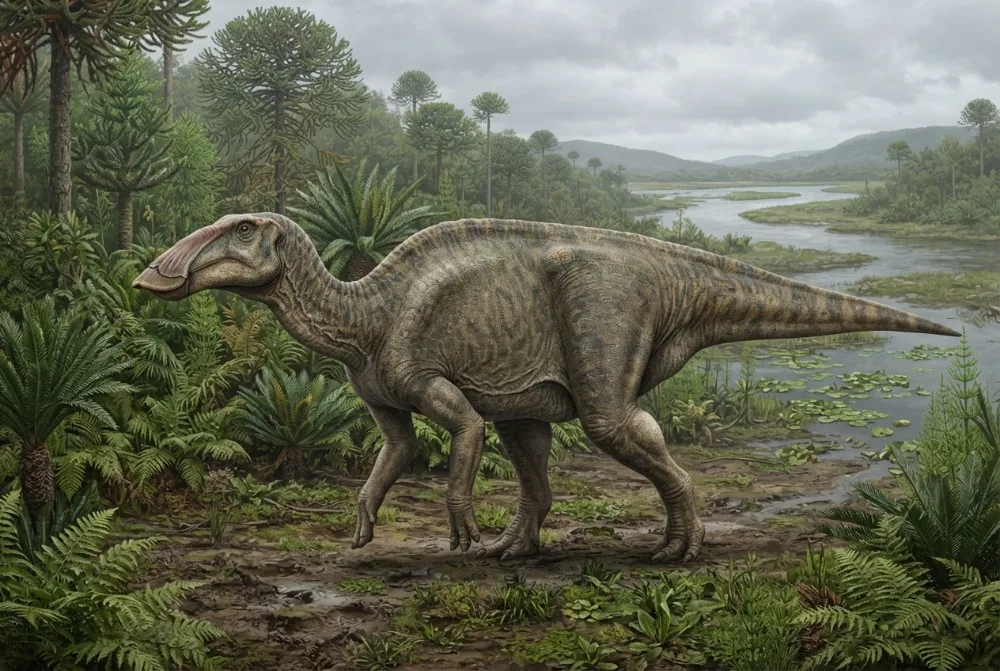
Latirhinus means 'broad nose' in Latin, because its nasal bone was wide and flat.1
The first skeleton of Latirhinus was found in the 1980s by a team from UNAM in Mexico.1
This dinosaur lived about 83 to 72 million years ago, during the Campanian age of the Late Cretaceous.13
The type species is named Latirhinus uitstlani, where 'uitstlani' means 'southern' in the Náhuatl language.1
Some scientists think Latirhinus was a lambeosaurine, a group of duck-billed dinosaurs with hollow head crests.1
The holotype skeleton includes parts of the nose, backbone, arms, legs, and feet.1
Mibvunzo inonyanya kubvunzwa nezve Latirhinus
?How big was Latirhinus?
It was about 8.7 metres (29 feet) long and weighed around 3.75 metric tons (4.13 short tons). That is roughly as long as a school bus.1
?What did Latirhinus eat?
It was a plant-eater. It munched on plants with its many teeth, like other duck-billed dinosaurs.1
?Where was Latirhinus found?
Its fossils were found in Coahuila, Mexico, in the Cerro del Pueblo Formation. The first skeleton was discovered in the 1980s near the town of Presa de San Antonio.1
?Did Latirhinus have a crest?
Some scientists think it was a lambeosaurine, a group of duck-billed dinosaurs that often had hollow head crests. But its crest is not well known from the fossils.1
Zvevanyanzvi vemadhino
- Zita resainzi
- Latirhinus
- Akaripa zita:
- Prieto-Márquez and Serrano Brañas 20124
- Boka
- Miromo-yedhadha
- Mhuri / boka
- Hadrosauridae4
- Kurongwa kwemhuka
- Ornithischia > Ornithopoda > Iguanodontia > Hadrosauridae4
- Zera rematombo
- makore mamiriyoni 84 kusvika 72 (Campanian)4
- Mapoka ematombo
- Cerro del Pueblo4
- Nyika
- Mexico4
- Zvinyorwa zvemafosiri
- 1 mu The Paleobiology Database4
- Kuwanikwa
- Latirhinus was named in 2012 by Albert Prieto-Márquez and Claudia Inés Serrano Brañas. The first fossils were found in the 1980s near Presa de San Antonio, Coahuila, Mexico, and were originally thought to be a different dinosaur called Kritosaurus.1
- Zvichiri kupokanwa
- Scientists still debate whether Latirhinus was a basal or a more advanced lambeosaurine within its family.1
Kunobva chokwadi
- Latirhinus (en.wikipedia.org)
- Latirhinus Prieto-Márquez & Serrano Brañas 2012 - Encyclopedia of Life (eol.org)
- PBDB Taxon (paleobiodb.org)
- Latirhinus in The Paleobiology Database (CC BY 4.0): zera, nzvimbo, mapoka ematombo, kurongwa kwemhuka.
Chokwadi chega chega papeji ino chine nhamba inoratidza kwachakabva. Kana takakanganisa chimwe chinhu, ruregerero, tiri vanoda madhino, kwete magazini yesainzi. Tiudze pa [email protected] tichazvigadzirisa.
 Rex ane nzara! Dino Wiki ipurojekiti yababa yemwanakomana wavo anoda madhino, mahara, pasina kushambadza uye pasina zvinokutevera. Vakuru vanogona kupa Rex chekudyadya kuti vabatsire kuchengeta saiti iri pamhepo.Fudza Rex
 Parasaurolophus
 Edmontosaurus
 Saurolophus
 Hypacrosaurus
 Corythosaurus
 Kritosaurus
 Tyrannosaurus
 Triceratops
 Velociraptor
 Spinosaurus
 Ankylosaurus
 Pteranodon