 Uri dhino ripi? Kwizi
 Hondo yemadhino
 Mujaho wemadhino
 Mitambo midiki yemadhino
 Arubhamu yemasitika
 Rondedzero dzeTOP dzemadhino
 Ndishamise!
Mauriciosaurus
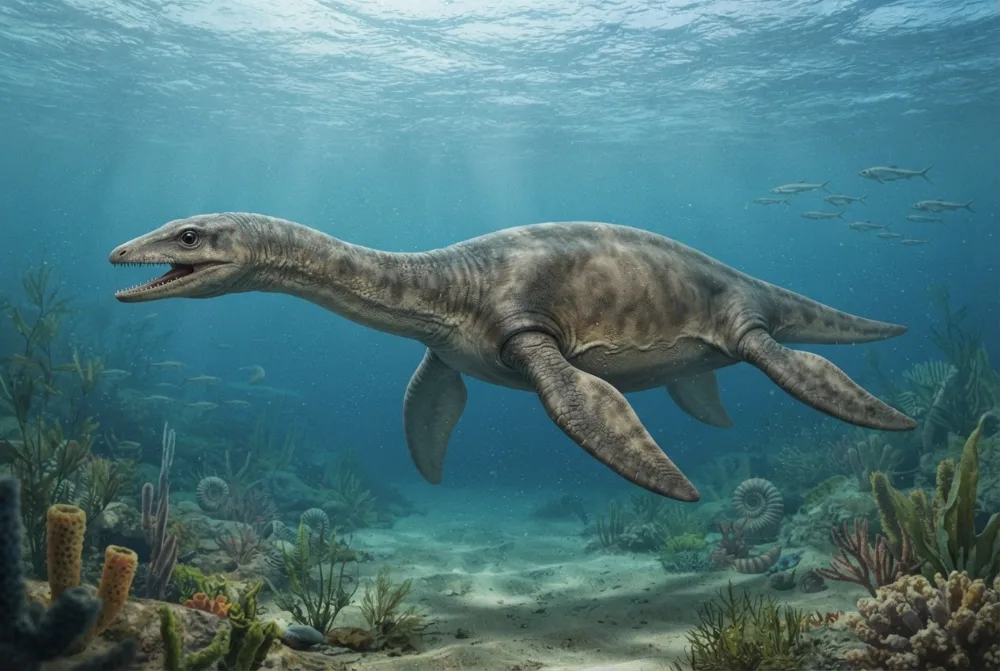
Mauriciosaurus was a short-necked plesiosaur that swam in the warm seas of Mexico 90 million years ago. It had a streamlined body and four flippers, and its fossil is so well preserved that scientists could see its skin and muscles!14
Rairarama rini?
Raiva hombe sei?
Raiva refu zvakadii?
Rairema zvakadii?

 kureba sekatsi dzemumba 4 kubva pamhino kusvika kumuswe🍌kureba semabhanana 11 akatevedzana🍉kurema semanwiwa 16🧸kurema sevana vekireshi 4🎒kurema sevana vechikoro 2.5🏊raigona kushambira kureba kwedziva guru rekushambira (50 m) mumasekonzi 8.2
Mauriciosaurus raiva hombe sei kana richienzaniswa NEWE?
Masvomhu chete mubrowser yako. Hapana chinochengetwa kana kutumirwa kupi zvako.
Raimhanya zvakadii?


Zvinonakidza
Mauriciosaurus is the first complete polycotylid plesiosaur ever found in Mexico.1
Its fossil preserves soft tissues like skin, muscles, and even scale-like structures, which is extremely rare for plesiosaurs.1
The body shape from the preserved soft tissues suggests it swam at speeds similar to modern leatherback turtles.1
It lived during the Early Turonian stage of the Late Cretaceous, about 93.9 to 89.8 million years ago.4
The fossil was discovered in 2011 by workmen in a limestone quarry near Vallecillo, Mexico.1
Mauriciosaurus had a flipper span of 1.15 meters (3.8 feet), making it a relatively small plesiosaur.2
Mibvunzo inonyanya kubvunzwa nezve Mauriciosaurus
?How big was Mauriciosaurus?
About 1.9 to 2.1 metres long, with a flipper span of 1.15 metres. It was a relatively small plesiosaur.31
?What did Mauriciosaurus eat?
Scientists don't know for sure, but as a polycotylid plesiosaur it likely ate fish and other small marine animals.3
?Could Mauriciosaurus swim fast?
Yes. Its body shape and soft tissues suggest it swam at speeds similar to modern leatherback turtles, making it a fast swimmer.31
?Is Mauriciosaurus a dinosaur?
No. Mauriciosaurus is a plesiosaur, a marine reptile that lived in the sea, not a dinosaur.3
Zvevanyanzvi vemadhino
- Zita resainzi
- Mauriciosaurus
- Akaripa zita:
- Frey et al. 20174
- Boka
- Mapresiosauro
- Mhuri / boka
- Polycotylidae4
- Kurongwa kwemhuka
- Plesiosauria > Sauropterygia4
- Zera rematombo
- makore mamiriyoni 94 kusvika 90 (Turonian)4
- Mapoka ematombo
- Agua Nueva4
- Nyika
- Mexico4
- Zvinyorwa zvemafosiri
- 1 mu The Paleobiology Database4
- Kuwanikwa
- Mauriciosaurus was named in 2017 by Frey and colleagues based on a nearly complete skeleton found in 2011 by quarry workers in Vallecillo, Mexico. The species name fernandezi honors Mauricio Fernández, a Mexican paleontology enthusiast.1
- Zvichiri kupokanwa
- Scientists are still debating exactly how Mauriciosaurus used its flippers to swim, and whether its skin patterns were for camouflage or display.1
Kunobva chokwadi
- 6901-(5)Frey (boletinsgm.igeolcu.unam.mx)
- A new polycotylid plesiosaur with extensive soft tissue preservation from the early Late Cretaceous of northeast Mexico (redalyc.org)
- Mauriciosaurus (en.wikipedia.org)
- Mauriciosaurus in The Paleobiology Database (CC BY 4.0): zera, nzvimbo, mapoka ematombo, kurongwa kwemhuka.
Chokwadi chega chega papeji ino chine nhamba inoratidza kwachakabva. Kana takakanganisa chimwe chinhu, ruregerero, tiri vanoda madhino, kwete magazini yesainzi. Tiudze pa [email protected] tichazvigadzirisa.
 Rex ane nzara! Dino Wiki ipurojekiti yababa yemwanakomana wavo anoda madhino, mahara, pasina kushambadza uye pasina zvinokutevera. Vakuru vanogona kupa Rex chekudyadya kuti vabatsire kuchengeta saiti iri pamhepo.Fudza Rex
 Elasmosaurus
 Pliosaurus
 Plesiosaurus
 Cimoliasaurus
 Colymbosaurus
 Trinacromerum
 Tyrannosaurus
 Triceratops
 Velociraptor
 Spinosaurus
 Ankylosaurus
 Parasaurolophus