 Uri dhino ripi? Kwizi
 Hondo yemadhino
 Mujaho wemadhino
 Mitambo midiki yemadhino
 Arubhamu yemasitika
 Rondedzero dzeTOP dzemadhino
 Ndishamise!
Mikadocephalus
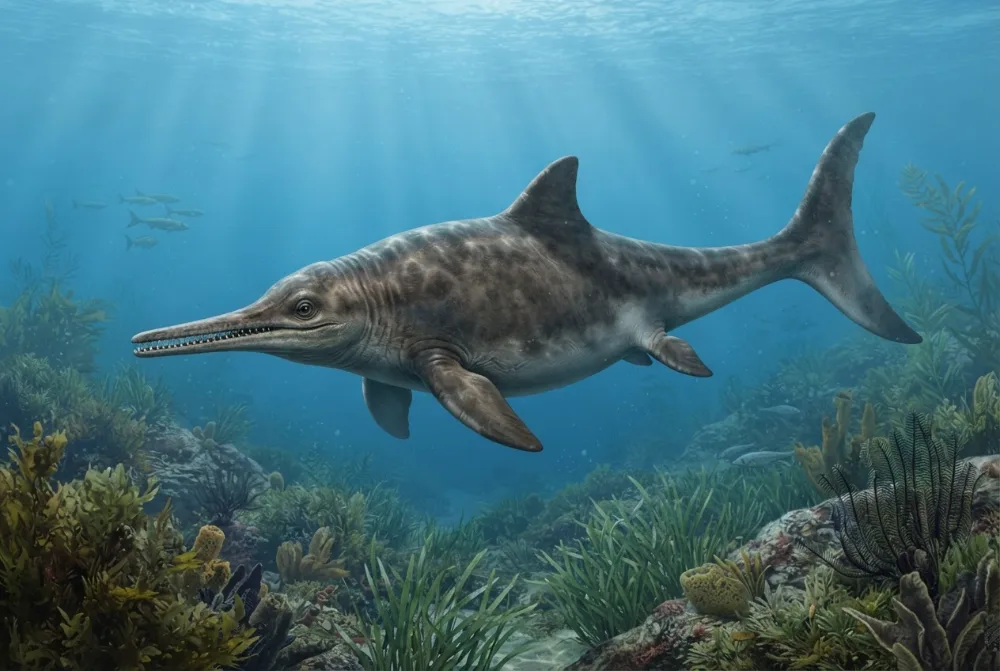
Mikadocephalus was a big, fish-shaped marine reptile that swam in warm seas during the Triassic Period. It was not a dinosaur, but a kind of ichthyosaur, with a long snout full of teeth for catching fish and squid.14
Rairarama rini?
Raiva hombe sei?
Raiva refu zvakadii?
 kureba seimbwa 8 kubva pamhino kusvika kumuswe🍌kureba semabhanana 44 akatevedzana🏊raigona kushambira kureba kwedziva guru rekushambira (50 m) mumasekonzi 4.6
Mikadocephalus raiva hombe sei kana richienzaniswa NEWE?
Masvomhu chete mubrowser yako. Hapana chinochengetwa kana kutumirwa kupi zvako.
Raimhanya zvakadii?


Zvinonakidza
Mikadocephalus is known from a skull that was so crushed and jumbled that it looked like a game of pick-up sticks, which is how it got its name.1
It lived about 247 to 237 million years ago, during the Middle Triassic, making it one of the earliest big ichthyosaurs.4
Its fossils were found in the Besano Formation, which was once a warm, shallow lagoon with poor oxygen at the bottom.1
Scientists think Mikadocephalus might actually be the same animal as another ichthyosaur called Besanosaurus, because they look very similar.1
The species name gracilirostris means 'slender snout', because its jaws were long and thin.1
Mibvunzo inonyanya kubvunzwa nezve Mikadocephalus
?How big was Mikadocephalus?
About 8 metres (26 feet) long, based on the largest known specimen of Besanosaurus, which scientists think is the same animal.2
?What did Mikadocephalus eat?
It ate small fish and squid, catching them with its long, slender snout and tiny pointed teeth.2
?Is Mikadocephalus a dinosaur?
No, it is not a dinosaur. It is a kind of ichthyosaur, a fish-shaped marine reptile that lived in the sea.1
?Why is it called Mikadocephalus?
Its name means 'Mikado head,' because its skull was so crushed and jumbled that it looked like a game of pick-up sticks.1
Mubvisi wengano
Ngano: Some people think Mikadocephalus was a dinosaur because it lived long ago and had a long snout.
Chokwadi: Mikadocephalus was an ichthyosaur, a marine reptile that lived in the sea. Ichthyosaurs are not dinosaurs.1
Zvevanyanzvi vemadhino
- Zita resainzi
- Mikadocephalus
- Akaripa zita:
- Maisch and Matzke 19974
- Boka
- Maikitiyosauro
- Mhuri / boka
- Guanlingsauridae4
- Kurongwa kwemhuka
- Ichthyosauria > Ichthyosauromorpha4
- Zera rematombo
- makore mamiriyoni 247 kusvika 237 ()4
- Mapoka ematombo
- Monte San Giorgio bituminous shales, Tschermakfjellet4
- Nyika
- Switzerland, Svalbard4
- Zvinyorwa zvemafosiri
- 2 mu The Paleobiology Database4
- Kuwanikwa
- The skull was found in Switzerland, in the Besano Formation, and was named by Michael Maisch and Andreas Matzke in 1997.1
- Zvichiri kupokanwa
- Scientists still debate whether Mikadocephalus is its own species or the same as Besanosaurus, since the skull is so crushed.1
Kunobva chokwadi
- Besanosaurus (en.wikipedia.org)
- Besanosaurus (Wikipedia) (Wikipedia)
- Cranial anatomy of Besanosaurus leptorhynchus Dal Sasso & Pinna, 1996 (Reptilia: Ichthyosauria) from the Middle Triassic Besano Formation of Monte San Giorgio, Italy/Switzerland: taxonomic and palaeobiological implications [PeerJ] (peerj.com)
- Mikadocephalus in The Paleobiology Database (CC BY 4.0): zera, nzvimbo, mapoka ematombo, kurongwa kwemhuka.
Chokwadi chega chega papeji ino chine nhamba inoratidza kwachakabva. Kana takakanganisa chimwe chinhu, ruregerero, tiri vanoda madhino, kwete magazini yesainzi. Tiudze pa [email protected] tichazvigadzirisa.
 Rex ane nzara! Dino Wiki ipurojekiti yababa yemwanakomana wavo anoda madhino, mahara, pasina kushambadza uye pasina zvinokutevera. Vakuru vanogona kupa Rex chekudyadya kuti vabatsire kuchengeta saiti iri pamhepo.Fudza Rex
 Ichthyosaurus
 Platypterygius
 Stenopterygius
 Khudiakovia
 Ophthalmosaurus
 Chonespondylus
 Placodus
 Lariosaurus
 Cyamodus
 Cymatosaurus
 Proneusticosaurus
 Neusticosaurus