 Uri dhino ripi? Kwizi
 Hondo yemadhino
 Mujaho wemadhino
 Mitambo midiki yemadhino
 Arubhamu yemasitika
 Rondedzero dzeTOP dzemadhino
 Ndishamise!
Opisthocoelicaudia
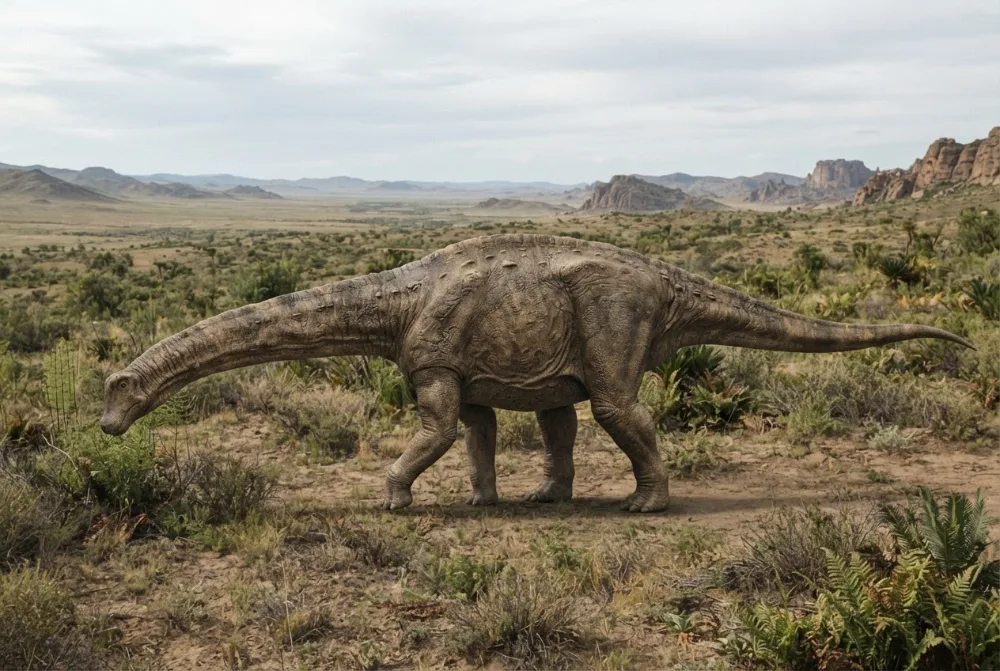
Opisthocoelicaudia was a big, long-necked plant eater that lived in the Late Cretaceous. It had a barrel-shaped body and four thick legs, like an elephant. Scientists found a nearly complete skeleton without the head and neck, so they know a lot about its body.1
Rairarama rini?
Raiva hombe sei?
Raiva refu zvakadii?
Raiva rakakwirira zvakadii?
Rairema zvakadii?

 kureba semotokari 3 dzakamiswa dzakatevedzana🍌kureba semabhanana 72 akatevedzanakurema semotokari 17🍉kurema semanwiwa 5100🎒kurema semakirasi 32 akazara evana vechikoro🐻❄️kurema semabere echando 56🏃raigona kumhanya mamita 100 mumasekonzi 28 (munhu anomhanya kupfuura vose anoda 9.6)
Opisthocoelicaudia raiva hombe sei kana richienzaniswa NEWE?
Masvomhu chete mubrowser yako. Hapana chinochengetwa kana kutumirwa kupi zvako.
Raimhanya zvakadii?


Zvinonakidza
Its tail vertebrae were shaped like ball-and-socket joints, which is unusual and gives it the name 'posterior cavity tail'.1
The skeleton had tooth marks from big meat-eating dinosaurs, which probably ate the carcass and carried away the head and neck.1
It could probably rear up on its hind legs to reach higher food, because its tail was strong and could act like a tripod.12
Its back vertebrae had split spines, creating a double row of bumps along its spine, a feature also seen in Diplodocus.1
It had six hip vertebrae, one more than most sauropods, which made its hips extra strong.1
The neck was about 5 meters (16 feet) long, which is medium for a sauropod.1
Mibvunzo inonyanya kubvunzwa nezve Opisthocoelicaudia
?How big was Opisthocoelicaudia?
It was a relatively small sauropod, measuring about 11.4 to 13 metres (37 to 43 feet) long. Its body mass has been estimated at between 8.4 and 25.4 tonnes in different studies.1
?What did Opisthocoelicaudia eat?
Like other sauropods, it was a herbivore that ate plants. It probably fed on a variety of vegetation in its floodplain and riverine environment.3
?When did Opisthocoelicaudia live?
It lived during the Late Cretaceous Period, specifically in the ?Upper Campanian or Lower Maastrichtian, about 72 to 66 million years ago.12
?Where was Opisthocoelicaudia found?
Its fossils were discovered in the Gobi Desert of Mongolia, in the Nemegt Formation. The type specimen was found at Altan Uul in Ömnögovi Province.1
?Could Opisthocoelicaudia rear up on its hind legs?
Yes, scientists think it could rear up on its hind legs to reach higher food. Its strong tail could act like a tripod to support its weight.1
?Is Opisthocoelicaudia a dinosaur?
Yes, it is a sauropod dinosaur. It belongs to the group Titanosauria and lived during the Late Cretaceous.1
Mubvisi wengano
Ngano: Some people think Opisthocoelicaudia was a kind of camarasaur, but scientists now know it was a titanosaur.
Chokwadi: It was first classified as a camarasaurid, but later studies placed it in Titanosauria, a group of sauropods.1
Zvevanyanzvi vemadhino
- Zita resainzi
- Opisthocoelicaudia
- Akaripa zita:
- Borsuk-Bialynicka 19774
- Boka
- Madhino emitsipa mirefu
- Mhuri / boka
- Saltasauridae4
- Kurongwa kwemhuka
- Sauropodomorpha > Sauropoda > Titanosauria > Macronaria4
- Zera rematombo
- makore mamiriyoni 72 kusvika 66 (Maastrichtian)4
- Mapoka ematombo
- Nemegt4
- Nyika
- Mongolia4
- Zvinyorwa zvemafosiri
- 1 mu The Paleobiology Database4
- Kuwanikwa
- It was discovered in 1965 by a Polish-Mongolian expedition in the Gobi Desert. Polish paleontologist Maria Magdalena Borsuk-Białynicka named it in 1977.12
- Zvichiri kupokanwa
- Scientists debate whether Opisthocoelicaudia and Nemegtosaurus are actually the same species, because only the skull of Nemegtosaurus is known and Opisthocoelicaudia lacks a skull.1
Kunobva chokwadi
- Opisthocoelicaudia (en.wikipedia.org)
- A NEW CAMARASAURID SAUROPOD OPISTHOCOELICAUDIA SKARZYNSKII GEN. N., SP. N. FROM THE UPPER CRETACEOUS OF MONGOLIA (palaeontologia.pan.pl)
- Opisthocoelicaudia: a Late Cretaceous Mongolian titanosaur (en.alegsaonline.com)
- Opisthocoelicaudia in The Paleobiology Database (CC BY 4.0): zera, nzvimbo, mapoka ematombo, kurongwa kwemhuka.
Chokwadi chega chega papeji ino chine nhamba inoratidza kwachakabva. Kana takakanganisa chimwe chinhu, ruregerero, tiri vanoda madhino, kwete magazini yesainzi. Tiudze pa [email protected] tichazvigadzirisa.
 Rex ane nzara! Dino Wiki ipurojekiti yababa yemwanakomana wavo anoda madhino, mahara, pasina kushambadza uye pasina zvinokutevera. Vakuru vanogona kupa Rex chekudyadya kuti vabatsire kuchengeta saiti iri pamhepo.Fudza Rex
 Brachiosaurus
 Diplodocus
 Brontosaurus
 Argentinosaurus
 Camarasaurus
 Morosaurus
 Tyrannosaurus
 Triceratops
 Velociraptor
 Spinosaurus
 Ankylosaurus
 Parasaurolophus