 Uri dhino ripi? Kwizi
 Hondo yemadhino
 Mujaho wemadhino
 Mitambo midiki yemadhino
 Arubhamu yemasitika
 Rondedzero dzeTOP dzemadhino
 Ndishamise!
Platecarpus
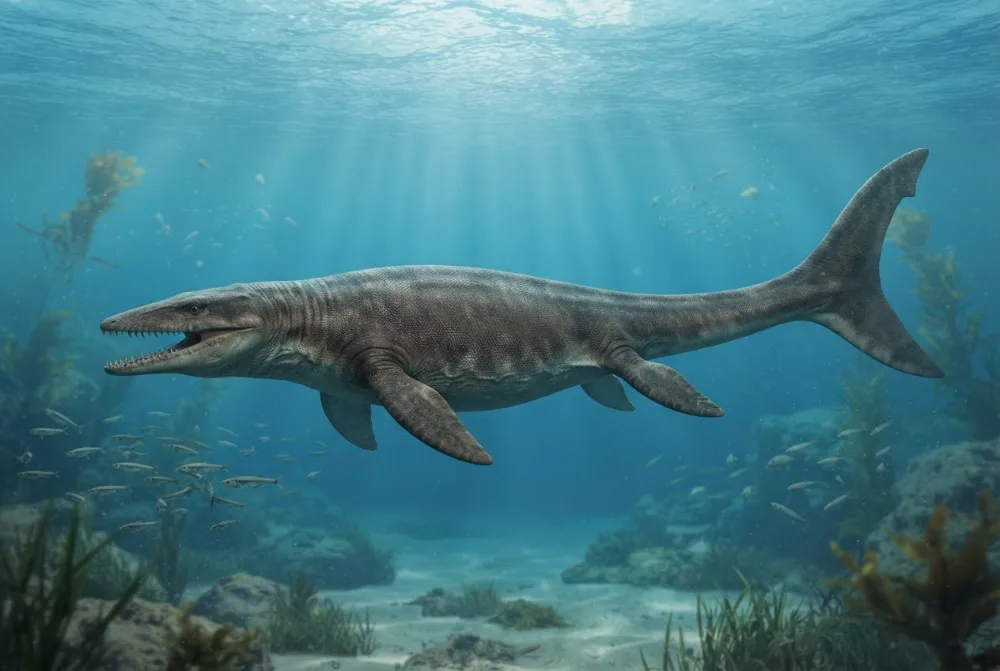
Platecarpus was a fast-swimming marine lizard that lived in the sea during the time of the dinosaurs. It had a long tail with a shark-like fin and ate fish and squid. Platecarpus was not a dinosaur, but a mosasaur, a kind of giant sea lizard.1
Rairarama rini?
Raiva hombe sei?
Raiva refu zvakadii?
 kureba seimbwa 6 kubva pamhino kusvika kumuswe🍌kureba semabhanana 32 akatevedzana🏊raigona kushambira kureba kwedziva guru rekushambira (50 m) mumasekonzi 4.7
Platecarpus raiva hombe sei kana richienzaniswa NEWE?
Masvomhu chete mubrowser yako. Hapana chinochengetwa kana kutumirwa kupi zvako.
Raimhanya zvakadii?


Zvinonakidza
Platecarpus had a short skull and fewer teeth than any other mosasaur, with only about 10 teeth in each lower jaw bone.1
A well-preserved fossil shows skin impressions, pigments near the nostrils, and even the shape of the tail fluke, which was like a shark's tail.1
Platecarpus swam by moving its tail side to side, but its deep tail fin made it a powerful, fast swimmer, not like an eel.1
Fossilized stomach contents show that Platecarpus ate fish and did not digest its food completely, passing bones and scales quickly.1
A 2026 study of tooth chemistry suggests that Platecarpus was warm-blooded, like modern sharks and whales.1
Platecarpus fossils are very common in the Smoky Hill Chalk of Kansas, which was once the bottom of a shallow sea.1
Mibvunzo inonyanya kubvunzwa nezve Platecarpus
?How big was Platecarpus?
About 5.7 metres (18.7 feet) long, based on a complete fossil. That is roughly the length of a small bus.1
?What did Platecarpus eat?
It ate medium-sized fish, and probably also squid and ammonites. Fossil stomach contents show it swallowed fish whole and digested them quickly.1
?When did Platecarpus live?
It lived about 84 to 81 million years ago, during the Late Cretaceous period. That was the time of the dinosaurs.1
?Is Platecarpus a dinosaur?
No, it is not a dinosaur. It is a mosasaur, a kind of giant marine lizard that lived in the sea.1
?Where have Platecarpus fossils been found?
Mostly in the United States, especially in Kansas. Fossils have also been found in Belgium, Australia, and Africa.1
Mubvisi wengano
Ngano: Many people think mosasaurs like Platecarpus swam like eels, wiggling their whole body.
Chokwadi: Platecarpus had a crescent-shaped tail fluke and swam more like a shark, using its tail for powerful thrusts.1
Zvevanyanzvi vemadhino
- Zita resainzi
- Platecarpus
- Akaripa zita:
- Cope 18692
- Boka
- Mamosasauro
- Mhuri / boka
- Mosasauridae2
- Kurongwa kwemhuka
- Mosasauroidea2
- Zera rematombo
- makore mamiriyoni 100 kusvika 66 (Cenomanian / Maastrichtian)2
- Mapoka ematombo
- Pierre Shale, Niobrara, Molecap Greensand2
- Nyika
- Amerika, Kanada, Sweden, Brazil, Australia, Russia2
- Zvinyorwa zvemafosiri
- 60 mu The Paleobiology Database2
- Kuwanikwa
- Platecarpus was named by the famous paleontologist Edward Drinker Cope in 1869, based on fossils found in Mississippi, USA.12
- Zvichiri kupokanwa
- Scientists still debate whether some fossils belong to Platecarpus or to other closely related mosasaurs, and some species have been moved to different genera.1
Kunobva chokwadi
- Platecarpus (en.wikipedia.org)
- Platecarpus in The Paleobiology Database (CC BY 4.0): zera, nzvimbo, mapoka ematombo, kurongwa kwemhuka.
Chokwadi chega chega papeji ino chine nhamba inoratidza kwachakabva. Kana takakanganisa chimwe chinhu, ruregerero, tiri vanoda madhino, kwete magazini yesainzi. Tiudze pa [email protected] tichazvigadzirisa.
 Rex ane nzara! Dino Wiki ipurojekiti yababa yemwanakomana wavo anoda madhino, mahara, pasina kushambadza uye pasina zvinokutevera. Vakuru vanogona kupa Rex chekudyadya kuti vabatsire kuchengeta saiti iri pamhepo.Fudza Rex
 Mosasaurus
 Prognathodon
 Tylosaurus
 Clidastes
 Globidens
 Halisaurus
 Tyrannosaurus
 Triceratops
 Velociraptor
 Spinosaurus
 Ankylosaurus
 Parasaurolophus