 Uri dhino ripi? Kwizi
 Hondo yemadhino
 Mujaho wemadhino
 Mitambo midiki yemadhino
 Arubhamu yemasitika
 Rondedzero dzeTOP dzemadhino
 Ndishamise!
Protoceratops
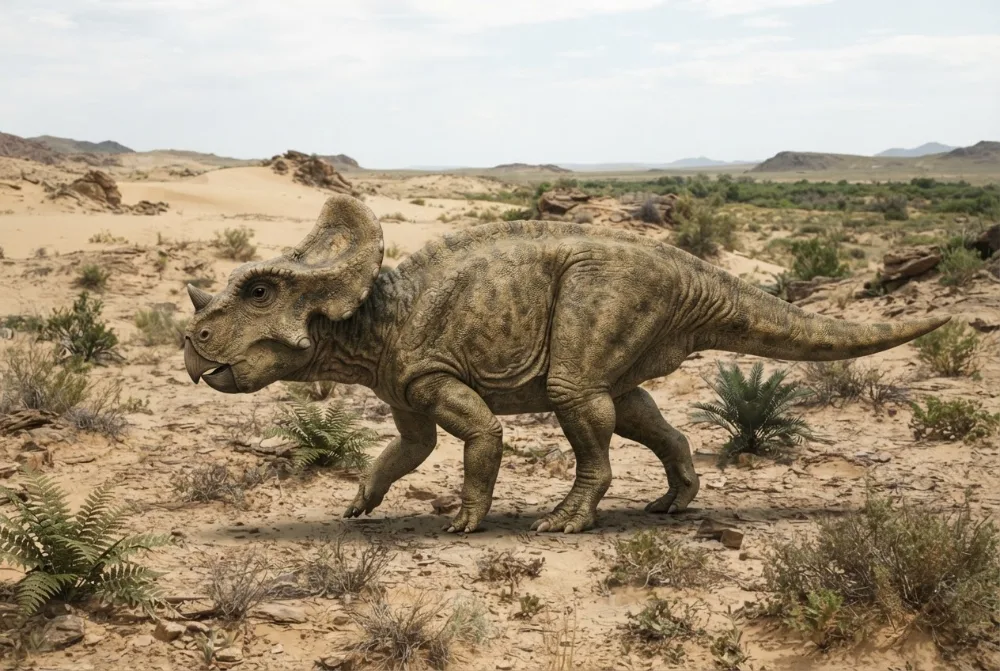
Protoceratops was a small, plant-eating dinosaur that lived in the Gobi Desert about 80 million years ago. It had a parrot-like beak and a bony frill on its neck, but no big horns like its later cousin Triceratops. It walked on all fours and was about the size of a large sheep.12
Rairarama rini?
Raiva hombe sei?
Raiva refu zvakadii?
Raiva rakakwirira zvakadii?
Rairema zvakadii?
 kureba seimbwa 2.5 kubva pamhino kusvika kumuswe🍌kureba semabhanana 14 akatevedzana🍉kurema semanwiwa 21🧸kurema sevana vekireshi 5🎒kurema sevana vechikoro 3🏃raigona kumhanya mamita 100 mumasekonzi 9.5 (munhu anomhanya kupfuura vose anoda 9.6)
Protoceratops raiva hombe sei kana richienzaniswa NEWE?
Masvomhu chete mubrowser yako. Hapana chinochengetwa kana kutumirwa kupi zvako.
Raimhanya zvakadii?


Zvinonakidza
Protoceratops laid soft-shelled eggs, which is rare for dinosaurs.1
A famous fossil called the Fighting Dinosaurs shows a Protoceratops locked in battle with a Velociraptor.1
Juvenile Protoceratops could walk on two legs, but adults walked on all fours.1
The frill on its neck was probably used for display or to protect the neck during fights.1
Protoceratops had a horn on its nose, and one species, P. hellenikorhinus, had two small horns side by side.1
Its feet had wide, flat claws that were good for digging in sand.1
Protoceratops lived in groups and may have cared for its young.1
Mibvunzo inonyanya kubvunzwa nezve Protoceratops
?How big was Protoceratops?
Protoceratops was about 2 to 2.5 metres (6.6 to 8.2 feet) long and weighed around 62 to 104 kilograms (137 to 229 pounds). That is roughly the size of a large sheep.12
?What did Protoceratops eat?
Protoceratops was a herbivore. It used its parrot-like beak and strong jaws to chop and grind tough plant material.14
?Did Protoceratops have horns?
It had a small horn on its nose, not big horns like Triceratops. One species, P. hellenikorhinus, had two small horns side by side on its nose.1
?When did Protoceratops live?
Protoceratops lived during the Late Cretaceous Period, about 75 to 71 million years ago.14
?Where did Protoceratops live?
Protoceratops lived in the Gobi Desert of Mongolia and China. Back then it was a dry, sandy environment.12
?Did Protoceratops fight Velociraptor?
Yes. A famous fossil called the Fighting Dinosaurs shows a Protoceratops and a Velociraptor locked in combat. They probably died together in a struggle.1
?Could Protoceratops walk on two legs?
Juvenile Protoceratops could walk on two legs if needed, but adults walked on all fours.1
Zvevanyanzvi vemadhino
- Zita resainzi
- Protoceratops
- Akaripa zita:
- Granger and Gregory 19235
- Boka
- Madhino ane nyanga
- Mhuri / boka
- Protoceratopsidae5
- Kurongwa kwemhuka
- Ornithischia > Ceratopsia5
- Zera rematombo
- makore mamiriyoni 121 kusvika 72 (Aptian / Campanian)5
- Mapoka ematombo
- Djadokhta, Bayan Mandahu, Baruungoyot5
- Nyika
- Mongolia, China5
- Zvinyorwa zvemafosiri
- 38 mu The Paleobiology Database5
- Rinonziwo
- Bainoceratops (mazita ekare zvino oonekwa semhuka imwe chete)5
- Kuwanikwa
- Protoceratops was named in 1923 by Walter Granger and William K. Gregory based on fossils found in the Gobi Desert of Mongolia.15
- Zvichiri kupokanwa
- Scientists are not sure whether the sail on its tail was used for display, swimming, or to help control body temperature.1
Kunobva chokwadi
- Protoceratops (en.wikipedia.org)
- Protoceratops | Mongolia, Late Cretaceous, Herbivore | Britannica (britannica.com)
- Protoceratops andrewsi (carnegiemnh.org)
- Protoceratops | Natural History Museum (nhm.ac.uk)
- Protoceratops in The Paleobiology Database (CC BY 4.0): zera, nzvimbo, mapoka ematombo, kurongwa kwemhuka.
Chokwadi chega chega papeji ino chine nhamba inoratidza kwachakabva. Kana takakanganisa chimwe chinhu, ruregerero, tiri vanoda madhino, kwete magazini yesainzi. Tiudze pa [email protected] tichazvigadzirisa.
 Rex ane nzara! Dino Wiki ipurojekiti yababa yemwanakomana wavo anoda madhino, mahara, pasina kushambadza uye pasina zvinokutevera. Vakuru vanogona kupa Rex chekudyadya kuti vabatsire kuchengeta saiti iri pamhepo.Fudza Rex
 Triceratops
 Ojoceratops
 Tatankaceratops
 Psittacosaurus
 Centrosaurus
 Chasmosaurus
 Tyrannosaurus
 Velociraptor
 Spinosaurus
 Ankylosaurus
 Parasaurolophus
 Pteranodon