 Uri dhino ripi? Kwizi
 Hondo yemadhino
 Mujaho wemadhino
 Mitambo midiki yemadhino
 Arubhamu yemasitika
 Rondedzero dzeTOP dzemadhino
 Ndishamise!
Tuarangisaurus
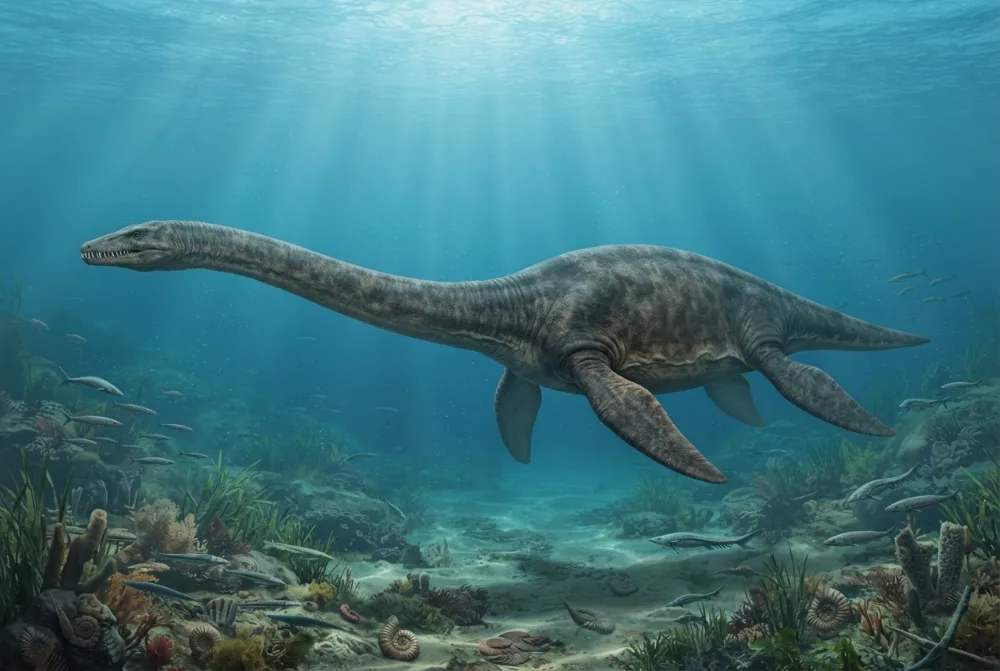
Tuarangisaurus was a long-necked marine reptile that swam in the seas around New Zealand 83 to 66 million years ago. It was not a dinosaur, but a plesiosaur, and it used its four flippers to paddle through the water. With a skull full of sharp teeth, it was a fierce hunter of fish and other sea creatures.51
Rairarama rini?
Raiva hombe sei?
Raiva refu zvakadii?
 kureba seimbwa 8 kubva pamhino kusvika kumuswe🍌kureba semabhanana 44 akatevedzana🏊raigona kushambira kureba kwedziva guru rekushambira (50 m) mumasekonzi 7.5
Tuarangisaurus raiva hombe sei kana richienzaniswa NEWE?
Masvomhu chete mubrowser yako. Hapana chinochengetwa kana kutumirwa kupi zvako.
Raimhanya zvakadii?


Zvinonakidza
Tuarangisaurus had a skull that was 37 centimetres (about 15 inches) long, with fused premaxillary bones and a low ridge on top.2
It had five large teeth in the upper jaw (premaxilla) and about 15 smaller teeth in the maxilla, plus 19 to 20 teeth in the lower jaw.2
The name Tuarangisaurus means 'ancient lizard' in the Māori language, reflecting its New Zealand discovery.1
Fossils of Tuarangisaurus have been found in marine rocks that were once part of a shallow sea, showing it lived in coastal waters.2
Scientists think Tuarangisaurus gave birth to live young, like other plesiosaurs, because it could not crawl onto land to lay eggs.2
The first fossils of Tuarangisaurus were found in the Mangahouanga Stream on the North Island of New Zealand, and included both adult and juvenile skull material.1
Tuarangisaurus is part of a group called elasmosaurids, which were plesiosaurs with very long necks.5
Mibvunzo inonyanya kubvunzwa nezve Tuarangisaurus
?How big was Tuarangisaurus?
Tuarangisaurus was a medium sized plesiosaur, measuring over 8 metres long, about the length of a school bus.43
?When did Tuarangisaurus live?
Tuarangisaurus lived during the Late Cretaceous period, about 78 million years ago, in the seas around New Zealand.4
?Was Tuarangisaurus a dinosaur?
No, Tuarangisaurus was not a dinosaur. It was a plesiosaur, a type of marine reptile with a very long neck, related to other elasmosaurids like Elasmosaurus.4
?What did Tuarangisaurus eat?
Tuarangisaurus was a hunter with sharp teeth, and it likely ate fish and other sea creatures, as mentioned in the page intro.3
Zvevanyanzvi vemadhino
- Zita resainzi
- Tuarangisaurus
- Akaripa zita:
- Wiffen and Moisley 19865
- Boka
- Mapresiosauro
- Mhuri / boka
- Elasmosauridae5
- Kurongwa kwemhuka
- Plesiosauria > Elasmosauridae > Sauropterygia5
- Zera rematombo
- makore mamiriyoni 84 kusvika 66 (Campanian / Maastrichtian)5
- Mapoka ematombo
- Tahora, Mocuio, Conway5
- Nyika
- New Zealand, Angola, Ajentina5
- Zvinyorwa zvemafosiri
- 7 mu The Paleobiology Database5
- Kuwanikwa
- Tuarangisaurus was named in 1986 by Joan Wiffen and W. L. Moisley based on fossils found in the Mangahouanga Stream, North Island, New Zealand. The type species is Tuarangisaurus keyesi.51
- Zvichiri kupokanwa
- Scientists are still debating exactly how Tuarangisaurus is related to other elasmosaurids, and whether fossils from Argentina and Angola belong to the same species.52
Kunobva chokwadi
- Late Cretaceous reptiles (Families Elasmosauridae and Pliosauridae) from the Mangahouanga Stream, North Island, New Zealand (tandfonline.com)
- PBDB Taxon (paleobiodb.org)
- Tuarangisaurus (Wikipedia) (Wikipedia)
- Tuarangisaurus Facts for Kids (kids.kiddle.co)
- Tuarangisaurus in The Paleobiology Database (CC BY 4.0): zera, nzvimbo, mapoka ematombo, kurongwa kwemhuka.
Chokwadi chega chega papeji ino chine nhamba inoratidza kwachakabva. Kana takakanganisa chimwe chinhu, ruregerero, tiri vanoda madhino, kwete magazini yesainzi. Tiudze pa [email protected] tichazvigadzirisa.
 Rex ane nzara! Dino Wiki ipurojekiti yababa yemwanakomana wavo anoda madhino, mahara, pasina kushambadza uye pasina zvinokutevera. Vakuru vanogona kupa Rex chekudyadya kuti vabatsire kuchengeta saiti iri pamhepo.Fudza Rex
 Elasmosaurus
 Pliosaurus
 Plesiosaurus
 Cimoliasaurus
 Colymbosaurus
 Trinacromerum
 Tyrannosaurus
 Triceratops
 Velociraptor
 Spinosaurus
 Ankylosaurus
 Parasaurolophus