 Kuizi: Çfarë dinozauri je?
 Beteja e dinozaurëve
 Gara e dinozaurëve
 Minilojëra me dinozaurë
 Albumi i stikerave
 Listat TOP të dinozaurëve
 Më surprizo!
Cycnorhamphus
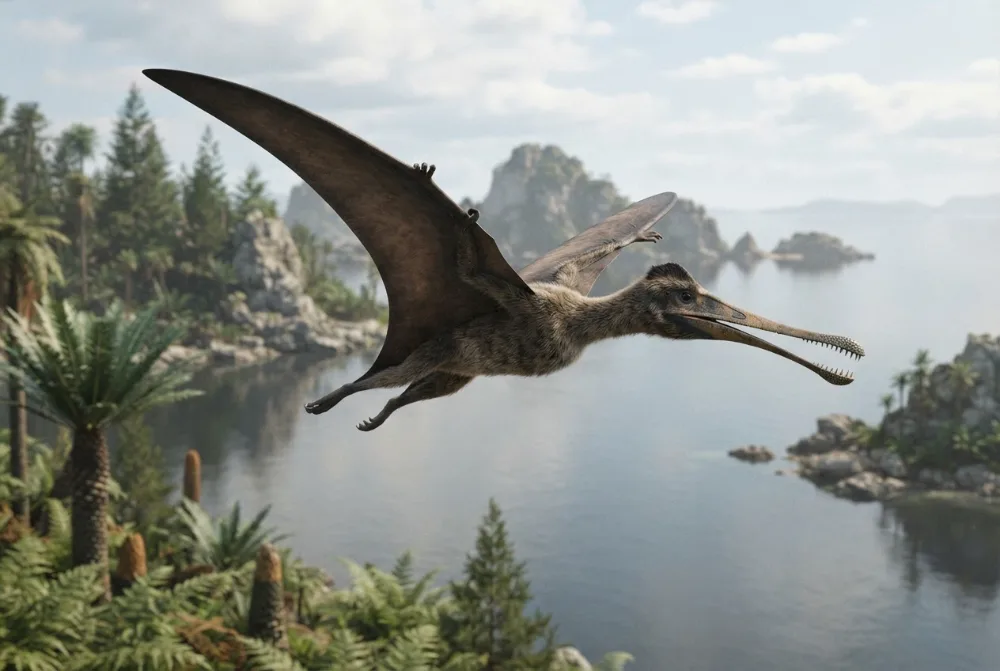
Cycnorhamphus was a pterosaur, a flying reptile that lived during the Late Jurassic. It had a strange beak with peg-like teeth at the tips and curved jaws that left a gap. Scientists think it might have used its beak to crush hard-shelled animals like mollusks.1
Kur jetoi?
Sa i madh ishte?
Sa të hapur ishin krahët e tij?
 i gjatë sa 2,5 mace shtëpiake nga hunda te bishti⚽mund të fluturonte përmes një fushe të tërë futbolli për 9,5 sekonda
Sa i madh ishte Cycnorhamphus krahasuar me TY?
Vetëm matematikë në shfletuesin tënd. Asgjë nuk ruhet dhe asgjë nuk dërgohet askund.
Sa i shpejtë ishte?


Fakte argëtuese
Cycnorhamphus lived about 152 million years ago during the Late Jurassic.1
Its name means 'swan beak' because of the shape of its snout.1
The first fossil was found in Germany in 1855 and named Pterodactylus suevicus by Friedrich August Quenstedt.1
A well-preserved skull nicknamed 'The Painten Pelican' helped scientists understand its unusual jaw.1
Adult Cycnorhamphus had blunter, stouter teeth at the tips of their jaws than juveniles.1
The jaws had a gap behind the teeth, and soft tissue structures filled that gap in the upper jaw.1
Some scientists think Cycnorhamphus used its beak like openbill storks to crush hard invertebrates.1
Pyetjet më të shpeshta për Cycnorhamphus
?How big was Cycnorhamphus?
Cycnorhamphus had a wingspan of about 1.5 metres (4.9 feet).4
?What did Cycnorhamphus eat?
Scientists think it probably ate shellfish, using its beak to crush hard invertebrates like mollusks, similar to openbill storks.14
?Why did Cycnorhamphus have a gap in its jaws?
Nobody knows for sure. Ideas include trapping jellyfish, opening seashells, or just for show.4
?Is Cycnorhamphus a dinosaur?
No, Cycnorhamphus is a pterosaur, a flying reptile that lived during the Late Jurassic, not a dinosaur.1
Shkatërruesi i miteve
Miti: Cycnorhamphus had long jaws with many teeth like other pterosaurs.
E vërteta: It actually had short, peg-like teeth only at the tips of its jaws, with a curved gap behind them.1
Për ekspertët e dinozaurëve
- Emri shkencor
- Cycnorhamphus
- Emërtuar nga
- Seeley 18705
- Grupi
- Zvarranikët fluturues
- Familja / klada
- Lophocratia5
- Klasifikimi
- Pterosauria > Pterodactyloidea5
- Mosha e shkëmbinjve
- 152 deri në 145 milionë vjet (Kimmeridgian / Tithonian)5
- Formacionet shkëmbore
- Nusplingen Limestone, Liegende Bankkalk, Solnhofen5
- Vendet
- Gjermania5
- Gjetjet fosile
- 3 në The Paleobiology Database5
- Zbulimi
- The first fossil was found near Nusplingen in Germany and named Pterodactylus suevicus by Friedrich August Quenstedt in 1855. In 1870, Harry Govier Seeley gave it the new genus name Cycnorhamphus.1
- Ende i diskutueshëm
- Scientists are still unsure exactly how Cycnorhamphus used its unusual beak and jaw gap.1
Nga vijnë faktet
- Cycnorhamphus (en.wikipedia.org)
- PBDB Taxon (paleobiodb.org)
- Cycnorhamphus, Pterofiltrus (reptileevolution.com)
- Cycnorhamphus - Thomas Henry Huxley Paleozoological Gardens (hpz.zhejiangopterus.org)
- Cycnorhamphus in The Paleobiology Database (CC BY 4.0): mosha, vendet, formacionet shkëmbore, klasifikimi.
Çdo fakt në këtë faqe ka një numër që të çon te burimi i tij. Nëse kemi gabuar diçka, na fal, ne jemi fansa dinozaurësh, jo revistë shkencore. Na shkruaj në [email protected] dhe do ta rregullojmë.
 Rexi ka uri! Dino Wiki është projekti i një babai për djalin e tij që i do dinozaurët, falas, pa reklama dhe pa gjurmues. Të rriturit mund t'i japin Rexit një meze për ta mbajtur online.Ushqe Rexin
 Pteranodon
 Quetzalcoatlus
 Dorygnathus
 Rhamphorhynchus
 Anhanguera
 Pterodactylus
 Brachiosaurus
 Diplodocus
 Allosaurus
 Brontosaurus
 Compsognathus
 Camarasaurus