 Kuizi: Çfarë dinozauri je?
 Beteja e dinozaurëve
 Gara e dinozaurëve
 Minilojëra me dinozaurë
 Albumi i stikerave
 Listat TOP të dinozaurëve
 Më surprizo!
Dsungaripterus
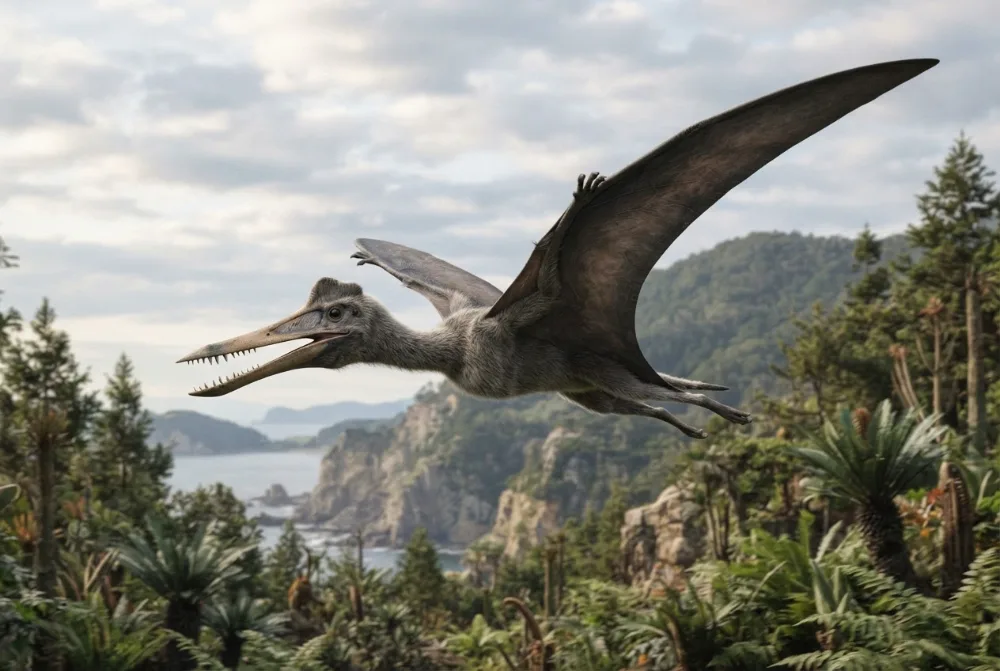
Dsungaripterus was a flying reptile with long, narrow, upturned jaws that worked like tweezers. It used its toothless beak tip to poke into cracks and grab hard-shelled prey, then crushed them with flat, knobbly teeth at the back of its mouth.12
Kur jetoi?
Sa i madh ishte?
Sa të hapur ishin krahët e tij?
 krahë të gjerë sa 2 biçikleta në rresht⚽mund të fluturonte përmes një fushe të tërë futbolli për 6,4 sekonda
Sa i madh ishte Dsungaripterus krahasuar me TY?
Vetëm matematikë në shfletuesin tënd. Asgjë nuk ruhet dhe asgjë nuk dërgohet askund.
Sa i shpejtë ishte?


Fakte argëtuese
Dsungaripterus had a skull over 46 centimeters (18 inches) long, and its head and neck together were almost 1 meter (3.3 feet) long.1
Its jaws curved upward at the tip, and the front part had no teeth, probably covered by a horny sheath.2
It had bulbous, flat teeth at the back of its jaws, perfect for crushing the armor of shellfish.1
The bones of Dsungaripterus were thick-walled and sturdy, suggesting it spent a lot of time walking on the ground.1
It likely landed abruptly and flapped a lot, rather than soaring for long distances.1
Dsungaripterus had a low bony crest on top of its skull, running from the base of the skull to halfway to the beak.1
Fossils show grooves on the jaws that might have held a horny covering, protecting the beak while it probed for food.2
Pyetjet më të shpeshta për Dsungaripterus
?How big was Dsungaripterus?
Dsungaripterus had a wingspan of 3 to 3.5 metres (9.8 to 11.5 feet). Its skull was over 46 centimetres (18 inches) long, and its head and neck together were almost 1 metre (3.3 feet) long.1
?What did Dsungaripterus eat?
It ate hard-shelled prey like shellfish. It used its toothless, upturned beak tip to poke into cracks and grab food, then crushed shells with its flat, knobbly back teeth.12
?Was Dsungaripterus a dinosaur?
No, Dsungaripterus was a pterosaur, a flying reptile, not a dinosaur. Pterosaurs were the first vertebrates to evolve powered flight.3
?Why did Dsungaripterus have an upturned beak?
The upturned, toothless beak tip was probably used to probe and remove prey from cracks in rocks or sandy, muddy environments. It may have been covered by a horny sheath for protection.12
?Could Dsungaripterus walk on the ground?
Yes, its thick-walled, sturdy bones suggest it was mostly terrestrial and spent a lot of time walking on the ground. Pterosaurs could walk on all four limbs.13
?When did Dsungaripterus live?
Dsungaripterus lived during the Early Cretaceous period, about 145 to 100 million years ago. Its fossils were found in China and possibly South Korea.1
Shkatërruesi i miteve
Miti: Dsungaripterus is often called a dinosaur.
E vërteta: It was actually a pterosaur, a flying reptile that lived alongside dinosaurs but is not a dinosaur.1
Për ekspertët e dinozaurëve
- Emri shkencor
- Dsungaripterus
- Emërtuar nga
- Young 19644
- Grupi
- Zvarranikët fluturues
- Familja / klada
- Dsungaripteridae4
- Klasifikimi
- Pterosauria > Pterodactyloidea4
- Mosha e shkëmbinjve
- 137 deri në 121 milionë vjet (Valanginian / Barremian)4
- Formacionet shkëmbore
- Lianmuqin, Tsagaantsav, Hutubihe4
- Vendet
- Kina, Mongolia4
- Gjetjet fosile
- 4 në The Paleobiology Database4
- Zbulimi
- Dsungaripterus was named by Yang Zhongjian in 1964, based on a partial skull and skeleton from the Lianmuqin Formation in China. The species name weii honors paleontologist C.M. Wei.1
- Ende i diskutueshëm
- Scientists are still debating whether Dsungaripterus and Noripterus lived in the same place at the same time, or in different layers.2
Nga vijnë faktet
- Dsungaripterus (en.wikipedia.org)
- New anatomical information on Dsungaripterus weii Young, 1964 with focus on the palatal region (pmc.ncbi.nlm.nih.gov)
- Pterosaurs: The truth about these ‘flying dinosaurs’ | Natural History Museum (nhm.ac.uk)
- Dsungaripterus in The Paleobiology Database (CC BY 4.0): mosha, vendet, formacionet shkëmbore, klasifikimi.
Çdo fakt në këtë faqe ka një numër që të çon te burimi i tij. Nëse kemi gabuar diçka, na fal, ne jemi fansa dinozaurësh, jo revistë shkencore. Na shkruaj në [email protected] dhe do ta rregullojmë.
 Rexi ka uri! Dino Wiki është projekti i një babai për djalin e tij që i do dinozaurët, falas, pa reklama dhe pa gjurmues. Të rriturit mund t'i japin Rexit një meze për ta mbajtur online.Ushqe Rexin
 Pteranodon
 Quetzalcoatlus
 Dorygnathus
 Rhamphorhynchus
 Anhanguera
 Pterodactylus
 Stegosaurus
 Iguanodon
 Archaeopteryx
 Giganotosaurus
 Microraptor
 Deinonychus