 Kwisi: O dinosaure efe?
 Ntwa ya didinosaure
 Peiso ya didinosaure
 Dipapadi tse nyane tsa didinosaure
 Albamo ya ditikara
 Manane a TOP a didinosaure
 Nkgethele!
Acamptonectes
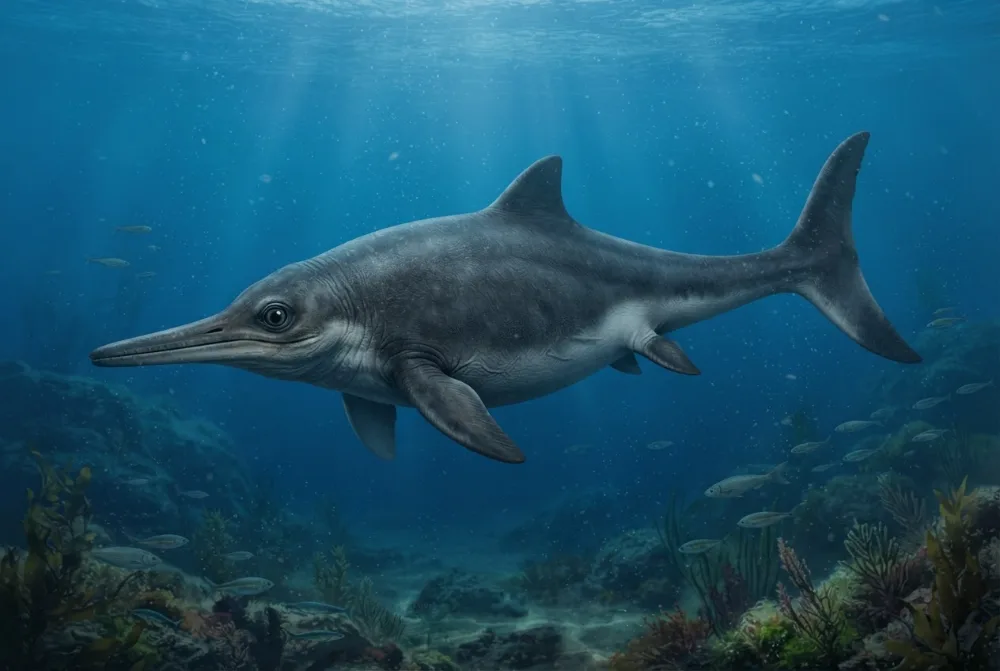
Acamptonectes was a fast-swimming marine reptile that lived in the Early Cretaceous seas. It had a stiff body and large eyes, perfect for hunting fish and squid in the deep ocean.12
E phetse neng?
E ne e le kgolo hakae?
E ne e le telele hakae?
 telele jwaloka dintja tse 3 ho tloha nkong ho isa mohatleng🍌telele jwaloka dibanana tse 17 di behilwe ka mola🏊e ne e ka sesa bolelele ba letamo le leholo la ho sesa (50 m) ka metsotswana e 3.8
Acamptonectes e ne e le kgolo hakae ha e bapiswa le WENA?
Ke dipalo feela ho browser ya hao. Ha ho letho le bolokwang kapa le romelwang kae kapa kae.
E ne e le lebelo hakae?


Dintlha tse monate
Acamptonectes belongs to a group called ophthalmosaurids, which had very large eyes for seeing in dark, deep water.12
Its name means 'stiff swimmer' because its body was unusually rigid, helping it move fast through the water.1
Acamptonectes lived about 133 to 129 million years ago, during the Hauterivian stage of the Early Cretaceous.1
Scientists once thought most ichthyosaurs died out at the end of the Jurassic, but Acamptonectes shows they survived and thrived into the Cretaceous.21
The first Acamptonectes fossil was found in 1958 by geology students near Speeton, England, but it was not named until 2012.21
Its teeth had tiny ridges along the length, which helped it grip slippery prey like fish and squid.1
Dipotso tse botswang haholo ka Acamptonectes
?Was Acamptonectes a dinosaur?
No, it was a marine reptile called an ichthyosaur, not a dinosaur.1
?How big was Acamptonectes?
It was about 3 metres (9.8 feet) long.1
?What did Acamptonectes eat?
It likely ate soft, fleshy prey like fish and squid, using its slender ridged teeth to impale them.1
?Why did Acamptonectes have a stiff body?
Its stiff body helped it swim fast like a tuna by making it more streamlined in the water.1
Bakeng sa ditsebi tsa didinosaure
- Lebitso la saense
- Acamptonectes
- E rehilwe ke
- Fischer et al. 20123
- Sehlopha
- Diikhthiosaure
- Lelapa / leloko
- Ophthalmosauridae3
- Tlhophiso
- Ichthyosauria > Ichthyosauromorpha3
- Dilemo tsa mafika
- dilemo tse dimilione tse 133 ho isa ho 126 (Hauterivian)3
- Dibopeho tsa mafika
- Speeton Clay3
- Dinaha
- United Kingdom, Jeremane3
- Direkoto tsa difosili
- 3 ho The Paleobiology Database3
- Ho sibollwa
- Acamptonectes was named in 2012 by a team of scientists including V. Fischer, M. W. Maisch, and D. Naish. The first specimen was collected in 1958 by geology students in Speeton, England, but it took decades to study and describe.23
- E sa ntse e phehwa kgang
- Scientists are still debating whether Acamptonectes had a different diet or lifestyle from other Cretaceous ichthyosaurs because of its unusual shallow snout and tooth shape.1
Moo dintlha di tswang teng
- Acamptonectes (en.wikipedia.org)
- New Ophthalmosaurid Ichthyosaurs from the European Lower Cretaceous Demonstrate Extensive Ichthyosaur Survival across the Jurassic, Cretaceous Boundary (pmc.ncbi.nlm.nih.gov)
- Acamptonectes in The Paleobiology Database (CC BY 4.0): dilemo, dibaka, dibopeho tsa mafika, tlhophiso.
Ntlha e nngwe le e nngwe leqepheng lena e na le nomoro e supang mohlodi wa yona. Haeba re fositse ho hong, re kopa tshwarelo, re balatedi ba didinosaure, ha re koranta ya saense. Re bolelle ho [email protected] mme re tla e lokisa.
 Rex o lapile! Dino Wiki ke projeke ya ntate bakeng sa mora wa hae ya ratang didinosaure, ke mahala, ha ho dipapatso, ha ho disebedi. Batho ba baholo ba ka fepa Rex seneke ho thusa hore e dule e le inthaneteng.Fepa Rex
 Ichthyosaurus
 Platypterygius
 Stenopterygius
 Khudiakovia
 Ophthalmosaurus
 Chonespondylus
 Stegosaurus
 Iguanodon
 Archaeopteryx
 Giganotosaurus
 Microraptor
 Deinonychus