 Kwisi: O dinosaure efe?
 Ntwa ya didinosaure
 Peiso ya didinosaure
 Dipapadi tse nyane tsa didinosaure
 Albamo ya ditikara
 Manane a TOP a didinosaure
 Nkgethele!
Stenopterygius
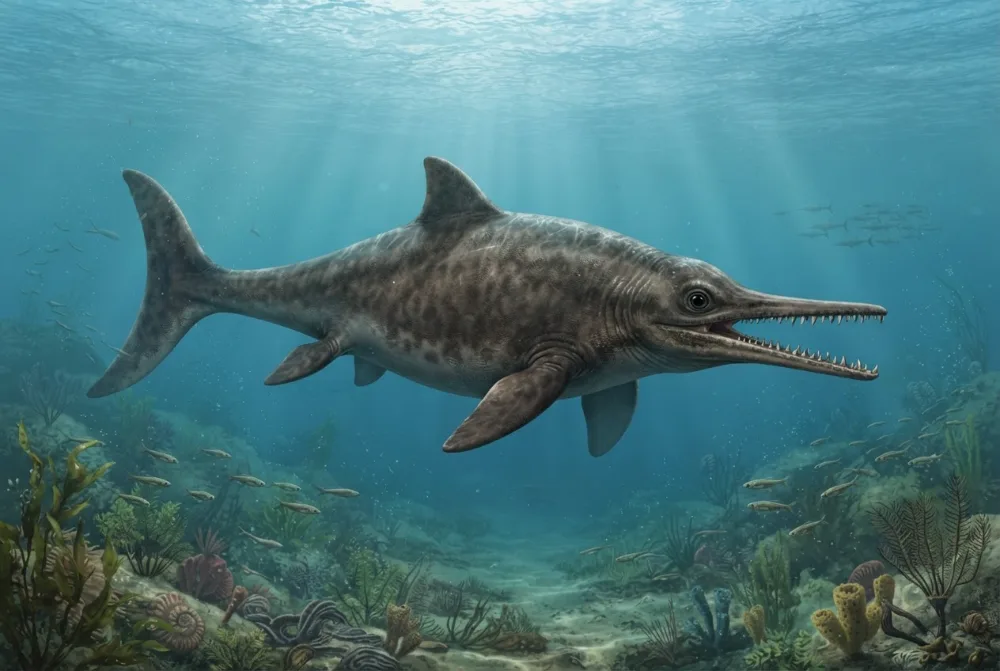
Stenopterygius was a fast-swimming marine reptile that lived in the Jurassic seas. It looked a bit like a dolphin but was actually an ichthyosaur, not a dinosaur. It had a long beak full of teeth and chased after fish and squid.1
E phetse neng?
E ne e le kgolo hakae?
E ne e le telele hakae?
 telele jwaloka dintja tse 4 ho tloha nkong ho isa mohatleng🍌telele jwaloka dibanana tse 22 di behilwe ka mola🏊e ne e ka sesa bolelele ba letamo le leholo la ho sesa (50 m) ka metsotswana e 3.8
Stenopterygius e ne e le kgolo hakae ha e bapiswa le WENA?
Ke dipalo feela ho browser ya hao. Ha ho letho le bolokwang kapa le romelwang kae kapa kae.
E ne e le lebelo hakae?


Dintlha tse monate
Stenopterygius had a small skull and narrow flippers compared to its relative Ichthyosaurus.1
One well-preserved fossil shows traces of skin, revealing that Stenopterygius was countershaded: darker on the back and lighter on the belly.1
Fossils of Stenopterygius often contain the remains of its last meal in the stomach area.1
The tail ended in a large, semicircular, leathery vertical fin, and it also had a triangular dorsal fin on its back.1
Stenopterygius lived during the Early and Middle Jurassic, about 183 to 173 million years ago.1
The type specimen of Stenopterygius quadriscissus is a complete skeleton that even preserved a very large embryo inside.1
Dipotso tse botswang haholo ka Stenopterygius
?How big was Stenopterygius?
Stenopterygius was a medium sized ichthyosaur, with most species reaching about 3.5 metres long, while the largest, S. uniter, could exceed 4 metres.1
?What did Stenopterygius eat?
Stenopterygius hunted fish, cephalopods, and other animals in the open sea. Fossils often contain the remains of its last meal in the stomach area.1
?Was Stenopterygius a dinosaur?
No, Stenopterygius was an ichthyosaur, a marine reptile, not a dinosaur. It looked a bit like a dolphin but was actually a different group of reptiles.1
?Did Stenopterygius give birth to live young?
Yes, Stenopterygius gave birth to live young, and one famous fossil shows a mother that died in childbirth. It preferred tail-first births, like modern dolphins and whales.1
Bakeng sa ditsebi tsa didinosaure
- Lebitso la saense
- Stenopterygius
- E rehilwe ke
- Jaekel 19043
- Sehlopha
- Diikhthiosaure
- Lelapa / leloko
- Thunnosauria3
- Tlhophiso
- Ichthyosauria > Ichthyosauromorpha3
- Dilemo tsa mafika
- dilemo tse dimilione tse 184 ho isa ho 171 (Toarcian / Aalenian)3
- Dibopeho tsa mafika
- Posidonia Shale, Opalinuston, Beacon Limstone3
- Dinaha
- Jeremane, United Kingdom, Luxembourg, Fora3
- Direkoto tsa difosili
- 47 ho The Paleobiology Database3
- Ho sibollwa
- The species was first named as Ichthyosaurus quadriscissus by Quenstedt in 1856. Otto Jaekel gave it its own genus, Stenopterygius, in 1904.1
- E sa ntse e phehwa kgang
- Scientists are still debating exactly how many species of Stenopterygius existed, because the fossils are often incomplete.2
Moo dintlha di tswang teng
- Stenopterygius (en.wikipedia.org)
- First Diagnostic Marine Reptile Remains from the Aalenian (Middle Jurassic): A New Ichthyosaur from Southwestern Germany | PLOS One (journals.plos.org)
- Stenopterygius in The Paleobiology Database (CC BY 4.0): dilemo, dibaka, dibopeho tsa mafika, tlhophiso.
Ntlha e nngwe le e nngwe leqepheng lena e na le nomoro e supang mohlodi wa yona. Haeba re fositse ho hong, re kopa tshwarelo, re balatedi ba didinosaure, ha re koranta ya saense. Re bolelle ho [email protected] mme re tla e lokisa.
 Rex o lapile! Dino Wiki ke projeke ya ntate bakeng sa mora wa hae ya ratang didinosaure, ke mahala, ha ho dipapatso, ha ho disebedi. Batho ba baholo ba ka fepa Rex seneke ho thusa hore e dule e le inthaneteng.Fepa Rex
 Ichthyosaurus
 Platypterygius
 Khudiakovia
 Ophthalmosaurus
 Chonespondylus
 Cymbospondylus
 Dilophosaurus
 Dorygnathus
 Lufengosaurus
 Scutellosaurus
 Yunnanosaurus
 Sinosaurus