 Kwisi: O dinosaure efe?
 Ntwa ya didinosaure
 Peiso ya didinosaure
 Dipapadi tse nyane tsa didinosaure
 Albamo ya ditikara
 Manane a TOP a didinosaure
 Nkgethele!
Archaeornithomimus
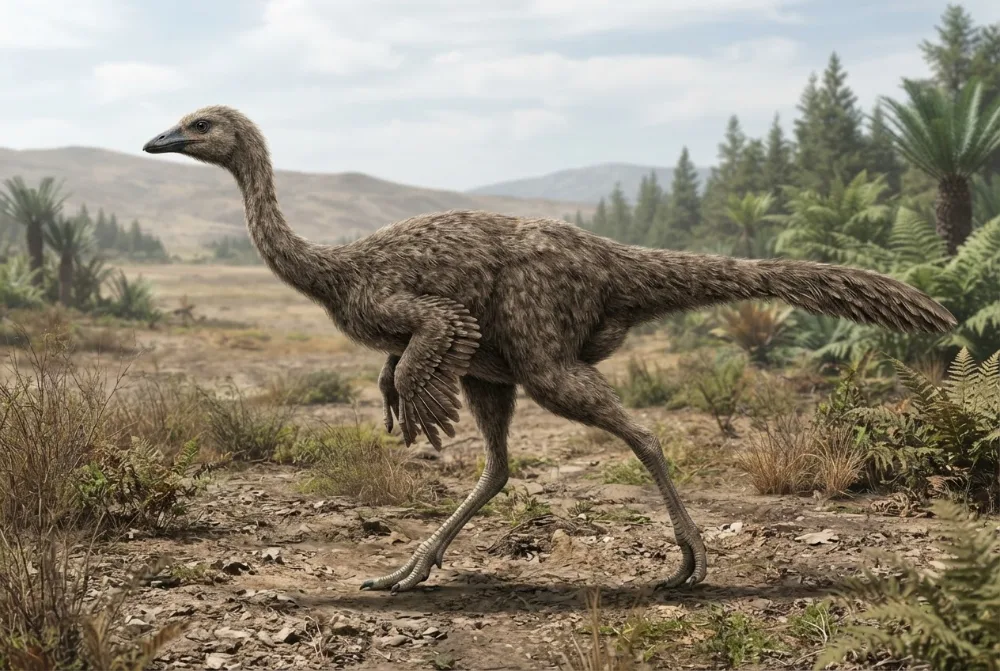
Archaeornithomimus was a fast, ostrich-like dinosaur that lived in Asia during the Late Cretaceous. It had a beak, long legs, and probably feathers. It could run quickly to escape predators or chase small prey.1
E phetse neng?
E ne e le kgolo hakae?
E ne e le telele hakae?
E ne e phahame hakae?
kakanyo
E ne e le boima hakae?
 telele jwaloka dintja tse 3 ho tloha nkong ho isa mohatleng🍌telele jwaloka dibanana tse 19 di behilwe ka mola🍉boima jwaloka mahapu a 14🧸boima jwaloka bana ba kereshe ba 4🎒boima jwaloka bana ba sekolo ba 2🏃e ne e ka matha dimitara tse 100 ka metsotswana e 5.5 (motho ya lebelo ka ho fetisisa o hloka 9,6)
Archaeornithomimus e ne e le kgolo hakae ha e bapiswa le WENA?
Ke dipalo feela ho browser ya hao. Ha ho letho le bolokwang kapa le romelwang kae kapa kae.
E ne e le lebelo hakae?


Dintlha tse monate
Its neck bones had air spaces inside, like modern birds, which made its neck lighter.1
Scientists think it had feathers that looked like those of an ostrich.1
It lived alongside the giant dinosaur Gigantoraptor and the predator Alectrosaurus.1
No stress fractures were found in its foot bones, meaning it probably didn't run too hard or too often.1
Its third toe bone was not pinched at the top, so its foot was not built for extreme speed like some other ornithomimids.1
The first fossils were found by an expedition led by Roy Chapman Andrews in 1923.1
Dipotso tse botswang haholo ka Archaeornithomimus
?How big was Archaeornithomimus?
About 3.4 metres (11 feet) long and weighed over 71.5 kilograms (158 pounds).1
?What did Archaeornithomimus eat?
It was an omnivore with a horny beak, eating small mammals, plants, fruit, eggs, and even hatchlings of other dinosaurs.1
?Did Archaeornithomimus have feathers?
Yes, scientists think it had feathers that looked like those of an ostrich.1
?When did Archaeornithomimus live?
It lived during the Late Cretaceous period, about 96 million years ago.1
?Where was Archaeornithomimus found?
Its fossils were found in the Iren Dabasu Formation of Inner Mongolia, China.1
?Was Archaeornithomimus a dinosaur?
Yes, it was a theropod dinosaur, specifically an ornithomimosaurian.1
Bakeng sa ditsebi tsa didinosaure
- Lebitso la saense
- Archaeornithomimus
- E rehilwe ke
- Russell 19724
- Sehlopha
- Didinosaure tsa mpshe
- Lelapa / leloko
- Ornithomimidae4
- Tlhophiso
- Theropoda > Ornithomimosauria4
- Dilemo tsa mafika
- dilemo tse dimilione tse 90 ho isa ho 72 (Coniacian / Campanian)4
- Dibopeho tsa mafika
- Iren Dabasu, Dabrazhin4
- Dinaha
- Tjhaena, Kazakhstan4
- Direkoto tsa difosili
- 3 ho The Paleobiology Database4
- Ho sibollwa
- The first fossils were found in 1923 in Inner Mongolia by an American Museum of Natural History expedition. In 1933, Charles Gilmore named them Ornithomimus asiaticus. In 1972, Dale Russell gave them their own genus, Archaeornithomimus.1
- E sa ntse e phehwa kgang
- Scientists are not sure whether Archaeornithomimus was a true ornithomimid or a more primitive ornithomimosaur. Some studies place it inside the family, others outside.1
Moo dintlha di tswang teng
- Archaeornithomimus (en.wikipedia.org)
- Archaeornithomimus | Natural History Museum (nhm.ac.uk)
- PBDB Taxon (paleobiodb.org)
- Archaeornithomimus in The Paleobiology Database (CC BY 4.0): dilemo, dibaka, dibopeho tsa mafika, tlhophiso.
Ntlha e nngwe le e nngwe leqepheng lena e na le nomoro e supang mohlodi wa yona. Haeba re fositse ho hong, re kopa tshwarelo, re balatedi ba didinosaure, ha re koranta ya saense. Re bolelle ho [email protected] mme re tla e lokisa.
 Rex o lapile! Dino Wiki ke projeke ya ntate bakeng sa mora wa hae ya ratang didinosaure, ke mahala, ha ho dipapatso, ha ho disebedi. Batho ba baholo ba ka fepa Rex seneke ho thusa hore e dule e le inthaneteng.Fepa Rex
 Gallimimus
 Ornithomimus
 Struthiomimus
 Deinocheirus
 Dromiceiomimus
 Anserimimus
 Tyrannosaurus
 Triceratops
 Velociraptor
 Spinosaurus
 Ankylosaurus
 Parasaurolophus