 Kwisi: O dinosaure efe?
 Ntwa ya didinosaure
 Peiso ya didinosaure
 Dipapadi tse nyane tsa didinosaure
 Albamo ya ditikara
 Manane a TOP a didinosaure
 Nkgethele!
Austriadactylus
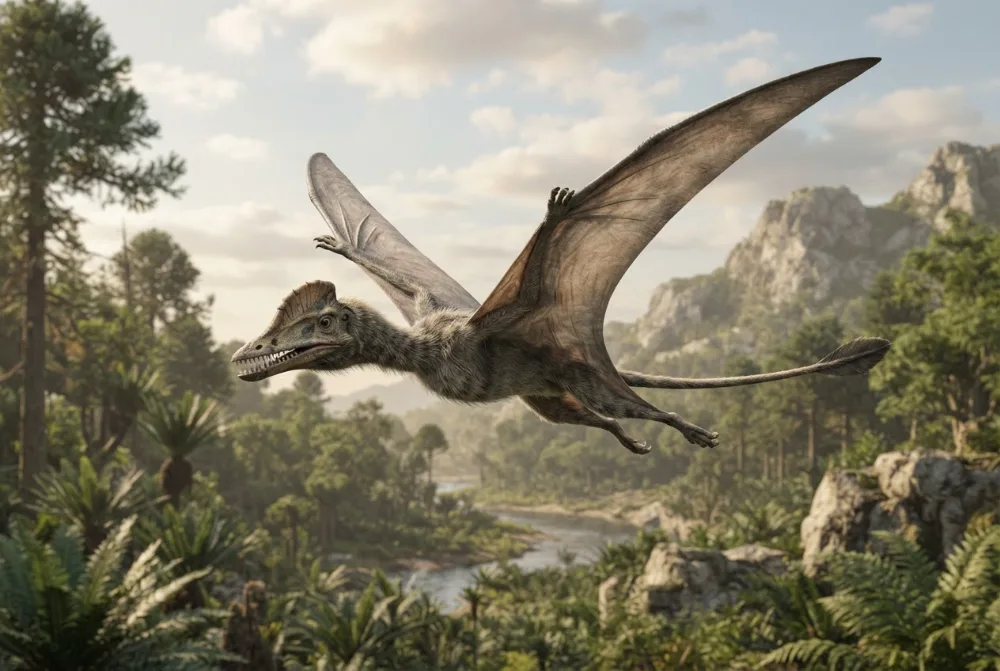
Austriadactylus was an early flying reptile with a long tail and a crest on its head. It lived about 215 million years ago in what is now Austria and Italy. This pterosaur had many different kinds of teeth, perfect for crunching hard-shelled bugs.12
E phetse neng?
E ne e le kgolo hakae?
Mapheo a yona a ne a pharaletse hakae?
 telele jwaloka dikatse tsa lapeng tse 2.5 ho tloha nkong ho isa mohatleng⚽e ne e ka fofa ho tshela lebala lohle la bolo ya maoto ka metsotswana e 9.7
Austriadactylus e ne e le kgolo hakae ha e bapiswa le WENA?
Ke dipalo feela ho browser ya hao. Ha ho letho le bolokwang kapa le romelwang kae kapa kae.
E ne e le lebelo hakae?


Dintlha tse monate
Austriadactylus had a bony crest on its head that started at the tip of its snout and went back to above its eye. The crest was about 2 cm tall.21
Its teeth were very different from each other. It had tall, pointed teeth at the front, blade-like teeth with tiny serrations in the middle, and triangular teeth with up to 12 small points at the back.2
Unlike many other long-tailed pterosaurs, Austriadactylus had a flexible tail without stiff rods made of bone.21
The only known fossil of Austriadactylus was found in an abandoned mine near Ankerschlag in Tyrol, Austria.21
Austriadactylus lived during the Late Triassic period, about 215 million years ago, in a shallow sea environment with islands.12
The name Austriadactylus cristatus means 'crested Austrian finger', referring to the wing finger and the crest on its head.1
Dipotso tse botswang haholo ka Austriadactylus
?What did Austriadactylus eat?
It mostly ate hard-shelled bugs. Scientists can tell from the tiny scratches on its teeth that it crunched hard invertebrates.1
?How big was Austriadactylus?
Its wingspan was about 120 cm (47 inches), and its skull was 11 cm long. It was about the size of a crow.1
?Did Austriadactylus have a crest?
Yes, it had a bony crest on its head that started at the tip of its snout and went back to above its eye. The crest was about 2 cm tall.1
?Is Austriadactylus a dinosaur?
No, it is a pterosaur, which is a flying reptile that lived at the same time as dinosaurs but is not a dinosaur.1
Bakeng sa ditsebi tsa didinosaure
- Lebitso la saense
- Austriadactylus
- E rehilwe ke
- Dalla Vecchia et al. 20023
- Sehlopha
- Dihahabi tse fofang
- Lelapa / leloko
- Pterosauria3
- Tlhophiso
- Pterosauria3
- Dilemo tsa mafika
- dilemo tse dimilione tse 215 ho isa ho 206 (Norian)3
- Dibopeho tsa mafika
- Seefelder Schichten, Dolomia di Forni3
- Dinaha
- Austria, Itali3
- Direkoto tsa difosili
- 2 ho The Paleobiology Database3
- Ho sibollwa
- Austriadactylus was named in 2002 by Fabio Marco Dalla Vecchia and colleagues. The fossil was found in an abandoned mine in Tyrol, Austria, and is stored at the State Museum of Natural History in Stuttgart, Germany.31
- E sa ntse e phehwa kgang
- Scientists are not sure if Austriadactylus is a close relative of Eudimorphodon or if it belongs to a different group. Some think it might even be the same animal as Eudimorphodon.1
Moo dintlha di tswang teng
- Austriadactylus (en.wikipedia.org)
- vrpa_22_124.196_199.tp (doc.rero.ch)
- Austriadactylus in The Paleobiology Database (CC BY 4.0): dilemo, dibaka, dibopeho tsa mafika, tlhophiso.
Ntlha e nngwe le e nngwe leqepheng lena e na le nomoro e supang mohlodi wa yona. Haeba re fositse ho hong, re kopa tshwarelo, re balatedi ba didinosaure, ha re koranta ya saense. Re bolelle ho [email protected] mme re tla e lokisa.
 Rex o lapile! Dino Wiki ke projeke ya ntate bakeng sa mora wa hae ya ratang didinosaure, ke mahala, ha ho dipapatso, ha ho disebedi. Batho ba baholo ba ka fepa Rex seneke ho thusa hore e dule e le inthaneteng.Fepa Rex
 Pteranodon
 Quetzalcoatlus
 Dorygnathus
 Rhamphorhynchus
 Anhanguera
 Pterodactylus
 Nothosaurus
 Massospondylus
 Plateosaurus
 Coelophysis
 Podokesaurus
 Simosaurus