 Kwisi: O dinosaure efe?
 Ntwa ya didinosaure
 Peiso ya didinosaure
 Dipapadi tse nyane tsa didinosaure
 Albamo ya ditikara
 Manane a TOP a didinosaure
 Nkgethele!
Bergamodactylus
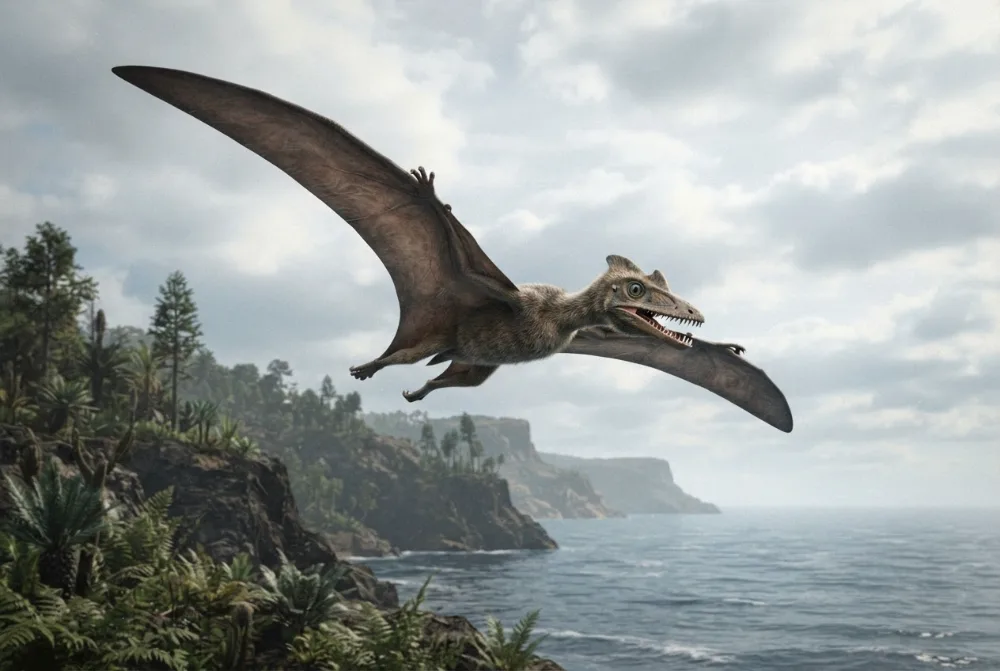
Bergamodactylus was a small flying reptile that lived in the Late Triassic, about 215 to 211 million years ago. It had a long wing finger and sharp teeth, and it soared over ancient seas in what is now Italy. It was not a dinosaur, but a pterosaur, a cousin of dinosaurs.13
E phetse neng?
E ne e le kgolo hakae?
Mapheo a yona a ne a pharaletse hakae?
Bergamodactylus e ne e le kgolo hakae ha e bapiswa le WENA?
Ke dipalo feela ho browser ya hao. Ha ho letho le bolokwang kapa le romelwang kae kapa kae.
E ne e le lebelo hakae?


Dintlha tse monate
Bergamodactylus was named in 2015 by Alexander Kellner, but the same fossil was earlier thought to be a young Eudimorphodon or Carniadactylus.1
The only known specimen is a skeleton with parts of the skull and most of the body, but it lacks the tail.1
Its teeth were complex with multiple cusps, similar to its relative Eudimorphodon, but they show little wear, so it probably ate soft food.1
The fossil was found in the Zorzino Limestone Formation, which was a marine environment, so it likely flew over the sea.3
Some scientists think Bergamodactylus is actually the same animal as Carniadactylus, because the differences might just be due to age or individual variation.1
Dipotso tse botswang haholo ka Bergamodactylus
?How big was Bergamodactylus?
It was small, with a wingspan of about 70 centimetres (roughly 2.3 feet). That is about as wide as a large pizza.12
?What did Bergamodactylus eat?
It probably ate soft-bodied prey like worms and insect larvae. Its teeth show little wear, unlike the fish-eating Eudimorphodon.2
?Is Bergamodactylus a dinosaur?
No, it is a pterosaur, a flying reptile that is a cousin of dinosaurs.1
?When did Bergamodactylus live?
It lived in the Late Triassic, about 215 to 211 million years ago.1
Mosenyi wa ditshomo
Tshomo: Bergamodactylus was a dinosaur.
Nnete: It was a pterosaur, a flying reptile that is a close cousin of dinosaurs, but not a dinosaur itself.1
Bakeng sa ditsebi tsa didinosaure
- Lebitso la saense
- Bergamodactylus
- E rehilwe ke
- Kellner 20153
- Sehlopha
- Dihahabi tse fofang
- Lelapa / leloko
- Campylognathoididae3
- Tlhophiso
- Pterosauria3
- Dilemo tsa mafika
- dilemo tse dimilione tse 215 ho isa ho 211 (Norian)3
- Dibopeho tsa mafika
- Zorzino Limestone3
- Dinaha
- Itali3
- Direkoto tsa difosili
- 1 ho The Paleobiology Database3
- Ho sibollwa
- The fossil was first described in 1978 by Rupert Wild, who thought it was a young Eudimorphodon. In 2015, Alexander Kellner named it Bergamodactylus wildi, honoring Wild.1
- E sa ntse e phehwa kgang
- Scientists still debate whether Bergamodactylus is a separate species or just a young Carniadactylus, because the differences might be due to growth stage.1
Moo dintlha di tswang teng
- Carniadactylus (en.wikipedia.org)
- Carniadactylus (Wikipedia) (Wikipedia)
- Bergamodactylus in The Paleobiology Database (CC BY 4.0): dilemo, dibaka, dibopeho tsa mafika, tlhophiso.
Ntlha e nngwe le e nngwe leqepheng lena e na le nomoro e supang mohlodi wa yona. Haeba re fositse ho hong, re kopa tshwarelo, re balatedi ba didinosaure, ha re koranta ya saense. Re bolelle ho [email protected] mme re tla e lokisa.
 Rex o lapile! Dino Wiki ke projeke ya ntate bakeng sa mora wa hae ya ratang didinosaure, ke mahala, ha ho dipapatso, ha ho disebedi. Batho ba baholo ba ka fepa Rex seneke ho thusa hore e dule e le inthaneteng.Fepa Rex
 Pteranodon
 Quetzalcoatlus
 Dorygnathus
 Rhamphorhynchus
 Anhanguera
 Pterodactylus
 Nothosaurus
 Massospondylus
 Plateosaurus
 Coelophysis
 Podokesaurus
 Simosaurus