 Kwisi: O dinosaure efe?
 Ntwa ya didinosaure
 Peiso ya didinosaure
 Dipapadi tse nyane tsa didinosaure
 Albamo ya ditikara
 Manane a TOP a didinosaure
 Nkgethele!
E phetse neng?

E ne e le kgolo hakae?
E ne e le telele hakae?
E ne e phahame hakae?
E ne e le boima hakae?
 telele jwaloka dikatse tsa lapeng tse 4 ho tloha nkong ho isa mohatleng🍌telele jwaloka dibanana tse 11 di behilwe ka mola🍉boima jwaloka mahapu a 4🏃e ne e ka matha dimitara tse 100 ka metsotswana e 10 (motho ya lebelo ka ho fetisisa o hloka 9,6)
Byronosaurus e ne e le kgolo hakae ha e bapiswa le WENA?
Ke dipalo feela ho browser ya hao. Ha ho letho le bolokwang kapa le romelwang kae kapa kae.
E ne e le lebelo hakae?


Dintlha tse monate
Byronosaurus had a large brain for its size, making it one of the smartest non-bird dinosaurs.1
Its eyes faced forward, so it could judge distances well, which helped it hunt.2
Two baby Byronosaurus skulls were found inside a nest of oviraptorid eggs, probably as leftovers from a predator.1
Unlike other troodontids, Byronosaurus had smooth teeth without serrations, like its close relative Xixiasaurus.1
The first Byronosaurus fossils were discovered in 1993 by an American Museum of Natural History expedition to the Gobi Desert.1
Byronosaurus lived during the Late Cretaceous, about 80 to 71 million years ago.1
Its bones were mixed with bones of other animals when found, and scientists had to carefully sort them out.2
Dipotso tse botswang haholo ka Byronosaurus
?How big was Byronosaurus?
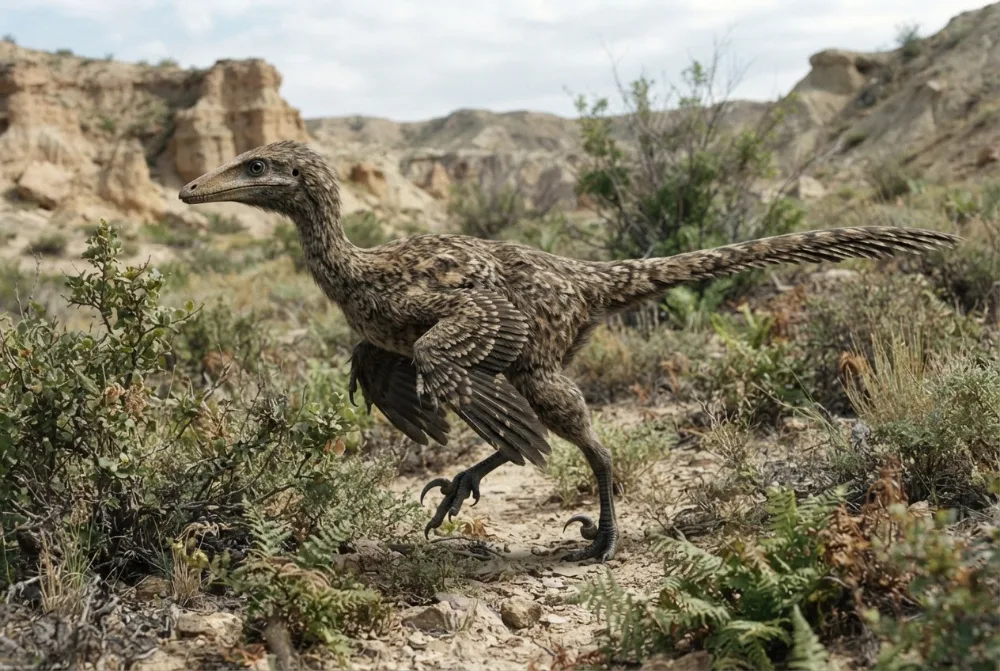
Byronosaurus was a small dinosaur, about 1.5 to 2 metres (5 to 6.6 feet) long and 50 cm (20 inches) tall. It weighed only about 4 to 20 kg (9 to 44 pounds), about the size of a large bird.12
?What did Byronosaurus eat?
Scientists are not sure. Some think it ate meat, others think it may have eaten plants or both. Its smooth teeth without serrations suggest it may have had a different diet from other troodontids.1
?When did Byronosaurus live?
Byronosaurus lived during the Late Cretaceous Period, about 80 to 71 million years ago. Its fossils were found in Mongolia.12
?Was Byronosaurus a dinosaur?
Yes, Byronosaurus was a small theropod dinosaur, specifically a troodontid. It was not a bird, but it was closely related to birds.1
Mosenyi wa ditshomo
Tshomo: Some people think all troodontids were meat-eaters with serrated teeth.
Nnete: Byronosaurus had smooth teeth without serrations, so it may have been an omnivore or herbivore, not a pure carnivore.1
Bakeng sa ditsebi tsa didinosaure
- Lebitso la saense
- Byronosaurus
- E rehilwe ke
- Norell et al. 20003
- Sehlopha
- Diraptor
- Lelapa / leloko
- Troodontidae3
- Tlhophiso
- Theropoda > Troodontidae3
- Dilemo tsa mafika
- dilemo tse dimilione tse 84 ho isa ho 72 (Campanian)3
- Dibopeho tsa mafika
- Djadokhta3
- Dinaha
- Mongolia3
- Direkoto tsa difosili
- 3 ho The Paleobiology Database3
- Ho sibollwa
- Byronosaurus was named in 2000 by Mark Norell, Peter Makovicky, and James Clark. The first skeleton was found in 1993 at Ukhaa Tolgod, Mongolia, and a second skull was found in 1996 at Bolor's Hill.1
- E sa ntse e phehwa kgang
- Scientists are not sure what Byronosaurus ate. Its smooth teeth suggest it might have been an omnivore or herbivore, but some experts think it was still a carnivore.1
Moo dintlha di tswang teng
- Byronosaurus (en.wikipedia.org)
- Byronosaurus jaffei | AMNH (amnh.org)
- Byronosaurus in The Paleobiology Database (CC BY 4.0): dilemo, dibaka, dibopeho tsa mafika, tlhophiso.
Ntlha e nngwe le e nngwe leqepheng lena e na le nomoro e supang mohlodi wa yona. Haeba re fositse ho hong, re kopa tshwarelo, re balatedi ba didinosaure, ha re koranta ya saense. Re bolelle ho [email protected] mme re tla e lokisa.
 Rex o lapile! Dino Wiki ke projeke ya ntate bakeng sa mora wa hae ya ratang didinosaure, ke mahala, ha ho dipapatso, ha ho disebedi. Batho ba baholo ba ka fepa Rex seneke ho thusa hore e dule e le inthaneteng.Fepa Rex
 Velociraptor
 Microraptor
 Deinonychus
 Asiamericana
 Richardoestesia
 Saurornitholestes
 Tyrannosaurus
 Triceratops
 Spinosaurus
 Ankylosaurus
 Parasaurolophus
 Pteranodon