 Kwisi: O dinosaure efe?
 Ntwa ya didinosaure
 Peiso ya didinosaure
 Dipapadi tse nyane tsa didinosaure
 Albamo ya ditikara
 Manane a TOP a didinosaure
 Nkgethele!
Caelestiventus
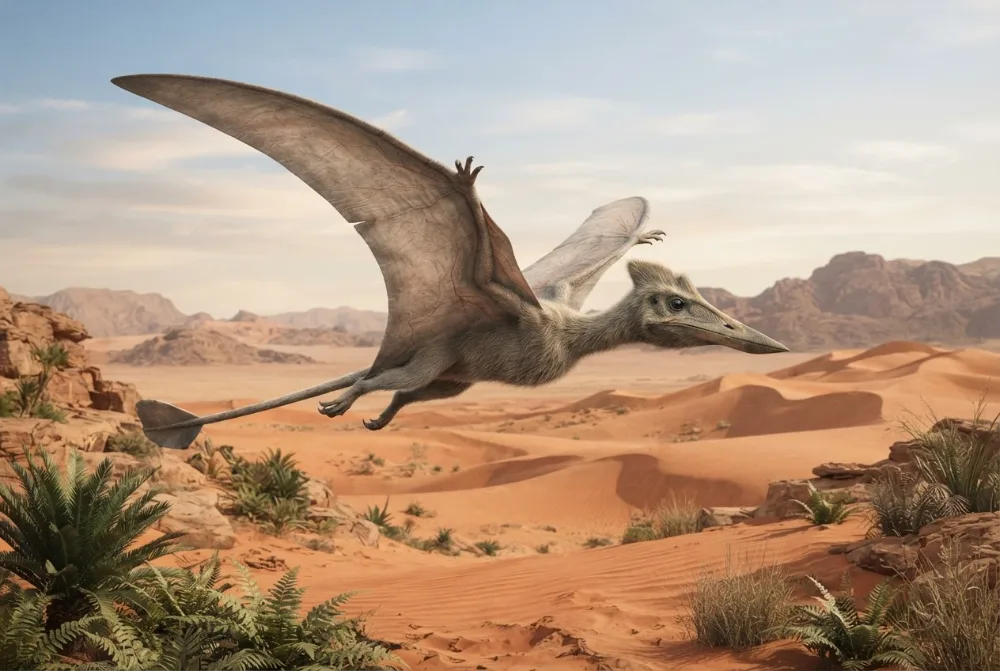
Caelestiventus was a flying reptile that lived in a hot desert during the Late Triassic, about 205 million years ago. It was one of the biggest pterosaurs of its time, with a wingspan over 1.5 meters (5 feet). Unlike most early pterosaurs, which are found in marine rocks, this one lived among sand dunes.21
E phetse neng?
E ne e le kgolo hakae?
Mapheo a yona a ne a pharaletse hakae?
 telele jwaloka dikatse tsa lapeng tse 3 ho tloha nkong ho isa mohatleng⚽e ne e ka fofa ho tshela lebala lohle la bolo ya maoto ka metsotswana e 7.3
Caelestiventus e ne e le kgolo hakae ha e bapiswa le WENA?
Ke dipalo feela ho browser ya hao. Ha ho letho le bolokwang kapa le romelwang kae kapa kae.
E ne e le lebelo hakae?


Dintlha tse monate
Caelestiventus is the only known desert-dwelling non-pterodactyloid pterosaur, and it is 65 million years older than any other desert pterosaur.21
Its skull was 17.8 centimeters (7 inches) long, and most of the skull bones were preserved in three dimensions, not squashed flat like most Triassic pterosaur fossils.1
The lower jaw of Caelestiventus was hollow and air-filled, with large openings that may have helped reduce weight for flight.1
It had three different kinds of teeth: long fang-like spikes at the front, large leaf-shaped blades, and tiny blades further back.1
The only known fossil includes most of the skull and the last finger bone of the wing, which supported the wingtip.1
Caelestiventus is closely related to Dimorphodon, a pterosaur from the Early Jurassic of Britain.21
The quarry where it was found also contained bones of crocodile-like reptiles, lizards, and small meat-eating dinosaurs.1
Dipotso tse botswang haholo ka Caelestiventus
?Was Caelestiventus a dinosaur?
No, Caelestiventus was a pterosaur, a flying reptile, not a dinosaur.13
?How big was Caelestiventus?
It had a wingspan of at least 1.5 meters (4.9 feet) and a skull 17.8 centimeters (7 inches) long. It was one of the largest Triassic pterosaurs, and the only known specimen was not fully grown.1
?What did Caelestiventus eat?
Scientists are not sure, but its three kinds of teeth (fang-like spikes, leaf-shaped blades, and tiny blades) suggest it ate different foods, possibly insects or small animals.1
?Did Caelestiventus have feathers?
No, it did not have feathers. Like most pterosaurs, it was covered in small hair-like structures called pycnofibers.3
?When did Caelestiventus live?
It lived during the Late Triassic Period, about 205 million years ago.1
?Where was Caelestiventus found?
It was discovered in the Saints & Sinners Quarry in northeastern Utah, USA, in fossilized sand dunes.1
Bakeng sa ditsebi tsa didinosaure
- Lebitso la saense
- Caelestiventus
- E rehilwe ke
- Britt et al. 20184
- Sehlopha
- Dihahabi tse fofang
- Lelapa / leloko
- Dimorphodontidae4
- Tlhophiso
- Pterosauria4
- Dilemo tsa mafika
- dilemo tse dimilione tse 237 ho isa ho 175 (Carnian / Toarcian)4
- Dibopeho tsa mafika
- Nugget Sandstone4
- Dinaha
- Amerika4
- Direkoto tsa difosili
- 1 ho The Paleobiology Database4
- Ho sibollwa
- The fossil was discovered in 2007 by Dan Chure and George Engelmann in the Nugget Sandstone of Utah. It was named in 2018 by Britt and colleagues, honoring Robin Hansen, a geologist who helped with the excavation.14
- E sa ntse e phehwa kgang
- Scientists are not sure if the hollow spaces in its skull and jaw were used for storing food, for making sounds, or for display.1
Moo dintlha di tswang teng
- Caelestiventus (en.wikipedia.org)
- Caelestiventus hanseni gen. et sp. nov. extends the desert-dwelling pterosaur record back 65 million years | Nature Ecology & Evolution (nature.com)
- Caelestiventus hanseni - BYU Geology (geology.byu.edu)
- Caelestiventus in The Paleobiology Database (CC BY 4.0): dilemo, dibaka, dibopeho tsa mafika, tlhophiso.
Ntlha e nngwe le e nngwe leqepheng lena e na le nomoro e supang mohlodi wa yona. Haeba re fositse ho hong, re kopa tshwarelo, re balatedi ba didinosaure, ha re koranta ya saense. Re bolelle ho [email protected] mme re tla e lokisa.
 Rex o lapile! Dino Wiki ke projeke ya ntate bakeng sa mora wa hae ya ratang didinosaure, ke mahala, ha ho dipapatso, ha ho disebedi. Batho ba baholo ba ka fepa Rex seneke ho thusa hore e dule e le inthaneteng.Fepa Rex
 Pteranodon
 Quetzalcoatlus
 Dorygnathus
 Rhamphorhynchus
 Anhanguera
 Pterodactylus
 Nothosaurus
 Massospondylus
 Plateosaurus
 Coelophysis
 Podokesaurus
 Simosaurus