 Kwisi: O dinosaure efe?
 Ntwa ya didinosaure
 Peiso ya didinosaure
 Dipapadi tse nyane tsa didinosaure
 Albamo ya ditikara
 Manane a TOP a didinosaure
 Nkgethele!
Caiuajara
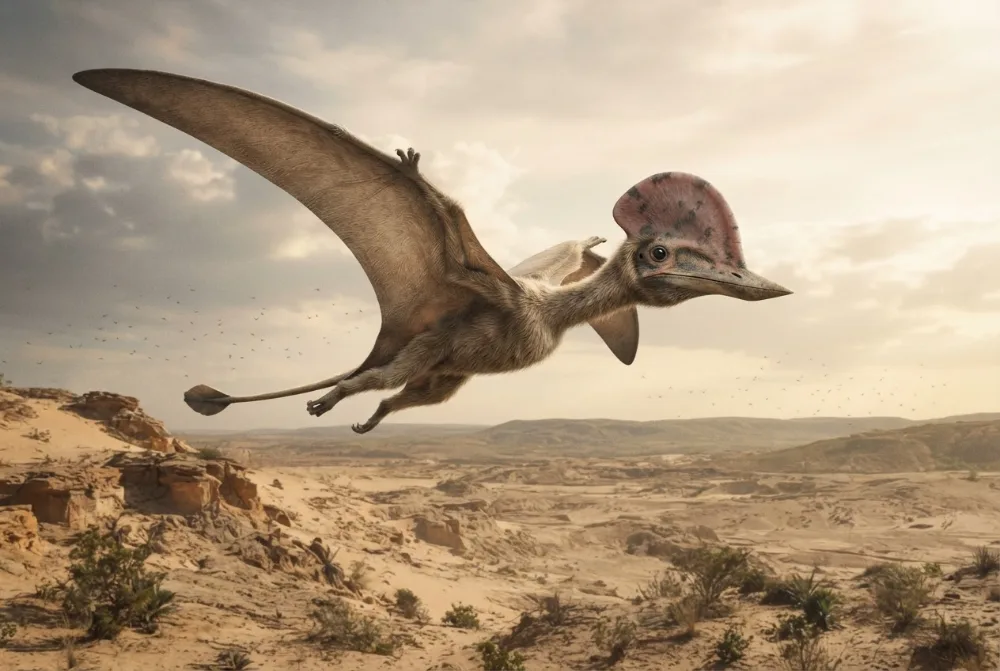
Caiuajara was a flying reptile that lived in a hot desert. It had a big crest on its head that grew steeper as it got older. Dozens of Caiuajara fossils were found together, showing they lived in colonies.1
E phetse neng?
E ne e le kgolo hakae?
Mapheo a yona a ne a pharaletse hakae?
 telele jwaloka dikatse tsa lapeng tse 5 ho tloha nkong ho isa mohatleng⚽e ne e ka fofa ho tshela lebala lohle la bolo ya maoto ka metsotswana e 7.3
Caiuajara e ne e le kgolo hakae ha e bapiswa le WENA?
Ke dipalo feela ho browser ya hao. Ha ho letho le bolokwang kapa le romelwang kae kapa kae.
E ne e le lebelo hakae?


Dintlha tse monate
Caiuajara is the first pterosaur found in southern Brazil. All other Brazilian pterosaurs come from the northeast.1
At least 47 individuals were found in one bone bed, which is very rare for pterosaurs.1
Young Caiuajara had a small, slanted head crest (about 115°). Adults had a larger, steeper crest (about 90°).1
Caiuajara could probably fly at a very young age. This is called being precocial.1
It lived around an oasis lake in a Cretaceous desert. Storms may have carried dead pterosaurs into the lake.1
Caiuajara belongs to a group called Tapejaridae, which had no teeth and are thought to have eaten fruit.1
Dipotso tse botswang haholo ka Caiuajara
?How big was Caiuajara?
The largest Caiuajara had a wingspan of about 2.35 meters (7.7 feet). The smallest juveniles had a wingspan of about 0.65 meters (2.1 feet).13
?Did Caiuajara have teeth?
No, Caiuajara had no teeth. It belonged to a group of toothless pterosaurs called Tapejaridae.13
?What did Caiuajara eat?
Scientists think Caiuajara ate fruit, because other tapejarid pterosaurs are thought to have been frugivorous. However, no direct food remains have been found with the fossils.13
?Could Caiuajara fly?
Yes, Caiuajara could fly. Even very young individuals had well-developed flight muscles and could probably fly soon after hatching.13
Bakeng sa ditsebi tsa didinosaure
- Lebitso la saense
- Caiuajara
- E rehilwe ke
- Manzig et al. 20144
- Sehlopha
- Dihahabi tse fofang
- Lelapa / leloko
- Tapejaridae4
- Tlhophiso
- Pterosauria > Pterodactyloidea4
- Dilemo tsa mafika
- dilemo tse dimilione tse 121 ho isa ho 72 (Aptian / Campanian)4
- Dibopeho tsa mafika
- Goio-Erê4
- Dinaha
- Brazil4
- Direkoto tsa difosili
- 1 ho The Paleobiology Database4
- Ho sibollwa
- Caiuajara was named in 2014 by Manzig and colleagues. The fossils were found near Cruzeiro do Oeste in southern Brazil.21
- E sa ntse e phehwa kgang
- Scientists are not sure exactly how old the rocks are. Caiuajara could be the youngest known tapejarid pterosaur, or the rocks might be older than thought.1
Moo dintlha di tswang teng
- Discovery of a Rare Pterosaur Bone Bed in a Cretaceous Desert with Insights on Ontogeny and Behavior of Flying Reptiles | PLOS One (journals.plos.org)
- PBDB Taxon (paleobiodb.org)
- Caiuajara (en.wikipedia.org)
- Caiuajara in The Paleobiology Database (CC BY 4.0): dilemo, dibaka, dibopeho tsa mafika, tlhophiso.
Ntlha e nngwe le e nngwe leqepheng lena e na le nomoro e supang mohlodi wa yona. Haeba re fositse ho hong, re kopa tshwarelo, re balatedi ba didinosaure, ha re koranta ya saense. Re bolelle ho [email protected] mme re tla e lokisa.
 Rex o lapile! Dino Wiki ke projeke ya ntate bakeng sa mora wa hae ya ratang didinosaure, ke mahala, ha ho dipapatso, ha ho disebedi. Batho ba baholo ba ka fepa Rex seneke ho thusa hore e dule e le inthaneteng.Fepa Rex
 Pteranodon
 Quetzalcoatlus
 Dorygnathus
 Rhamphorhynchus
 Anhanguera
 Pterodactylus
 Tyrannosaurus
 Triceratops
 Velociraptor
 Spinosaurus
 Ankylosaurus
 Parasaurolophus